+91 932 32 32 932

Call For Legal Consultation (India)

Facebook

Twitter

Linkedin

Youtube

Criminal Lawyer in Panvel – Advocate Bindu Dubey for Criminal Law Guidance
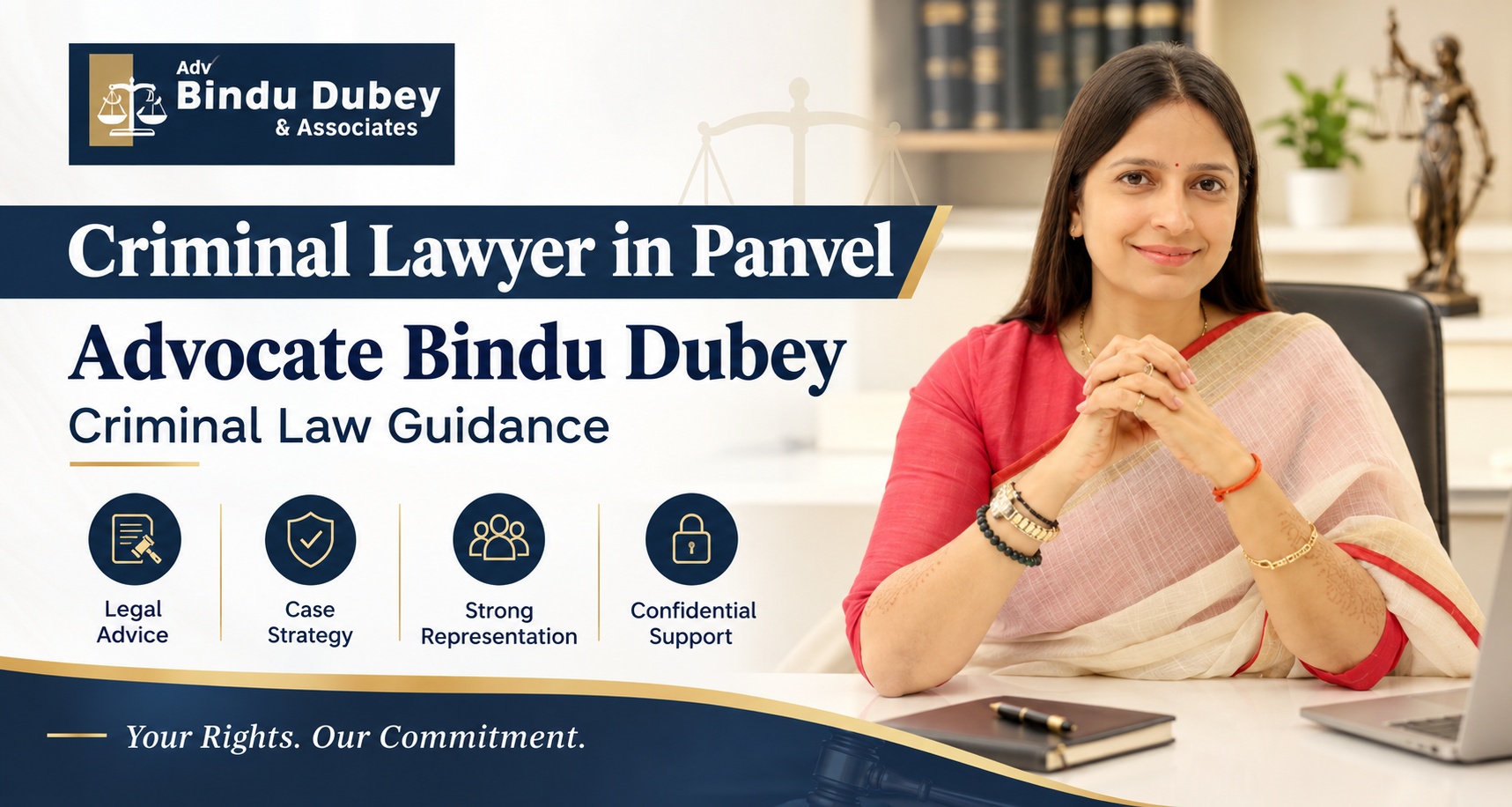
Criminal Lawyer in Panvel – Advocate Bindu Dubey for Criminal Law Guidance

[vc_row triangle_shape="no"][vc_column][vc_column_text css=""] Facing a criminal allegation, police inquiry, FIR, or court proceeding can be stressful for individuals and their families. Understanding the legal process, protecting your rights, and responding within the required time are important steps in any criminal matter. Seeking guidance from a Criminal Lawyer in Panvel can help individuals understand their legal options and make informed decisions at every stage of a case. Advocate Bindu Dubey provides a point of contact for individuals seeking legal guidance on criminal law matters in the Navi Mumbai region. Whether a person needs advice regarding a criminal complaint, bail application, police investigation, or...

Continue reading
Domestic Violence Cases in India: Numbers and Key Rulings

Domestic Violence Cases in India: Numbers and Key Rulings

Domestic violence cases in India are legal proceedings in which a person, most often a woman, accuses a husband, partner or in-laws of physical, sexual, verbal, emotional or economic abuse inside the home. The scale is large. In 2022, police registered 1,40,019 cruelty cases against husbands and their relatives, about 384 every day. That count captures only the fraction of abuse that ever reaches a police station. This guide puts the numbers, the law and the court record in one place. You will see yearly figures from the National Crime Records Bureau (NCRB), how a domestic violence in india cases moves...

Continue reading

Format of Anticipatory Bail: How to Draft It Under BNSS

Format of Anticipatory Bail: How to Draft It Under BNSS

The format of anticipatory bail application is simple. It has a court heading and cause title, the applicant's details, numbered facts, grounds, undertakings, a prayer, the advocate's signature, and a verification or affidavit. You file it in the Sessions Court (the district court) under Section 482 of the Bharatiya Nagarik Suraksha Sanhita, 2023 (BNSS). Below you get a copy-ready skeleton for each part. The problem is that most templates online still cite Section 438 CrPC, or they are generic text that never says why you fear arrest. A weak anticipatory bail petition gets a thin hearing. Many applicants also copy claims...

Continue reading

Anticipatory Bail in BNSS: Section 482 and How to Apply

Anticipatory Bail in BNSS: Section 482 and How to Apply

Anticipatory bail in BNSS is a court direction under Section 482 of the Bharatiya Nagarik Suraksha Sanhita, 2023, that you will be released on bail if the police arrest you in a specific non-bailable case. You apply before the arrest, to a Sessions Court or the High Court, when you have reason to believe you may be arrested. The order does not stop the investigation. It only means that an arrest in that case is followed by release on bail, subject to conditions. The BNSS replaced the Code of Criminal Procedure (CrPC) on 1 July 2024. Section 482 carries forward the...

Continue reading

Domestic Violence Case in India: Law, Procedure, Punishment

Domestic Violence Case in India: Law, Procedure, Punishment

A domestic violence case is a legal proceeding in which a woman asks a court or the police to stop abuse by a husband, partner or relative she shares, or has shared, a domestic relationship with. In India it runs on two tracks. The civil track is an application under the Protection of Women from Domestic Violence Act, 2005 (DV Act), which gives protection, a right to stay in the home and monetary relief. The criminal track is an FIR for cruelty under Section 85 of the Bharatiya Nyaya Sanhita (BNS), which replaced Section 498A of the Indian Penal Code...

Continue reading

Bombay High Court Convicts Tarun Tejpal: Can a High Court Reverse an Acquittal? A Legal Analysis

Bombay High Court Convicts Tarun Tejpal: Can a High Court Reverse an Acquittal? A Legal Analysis

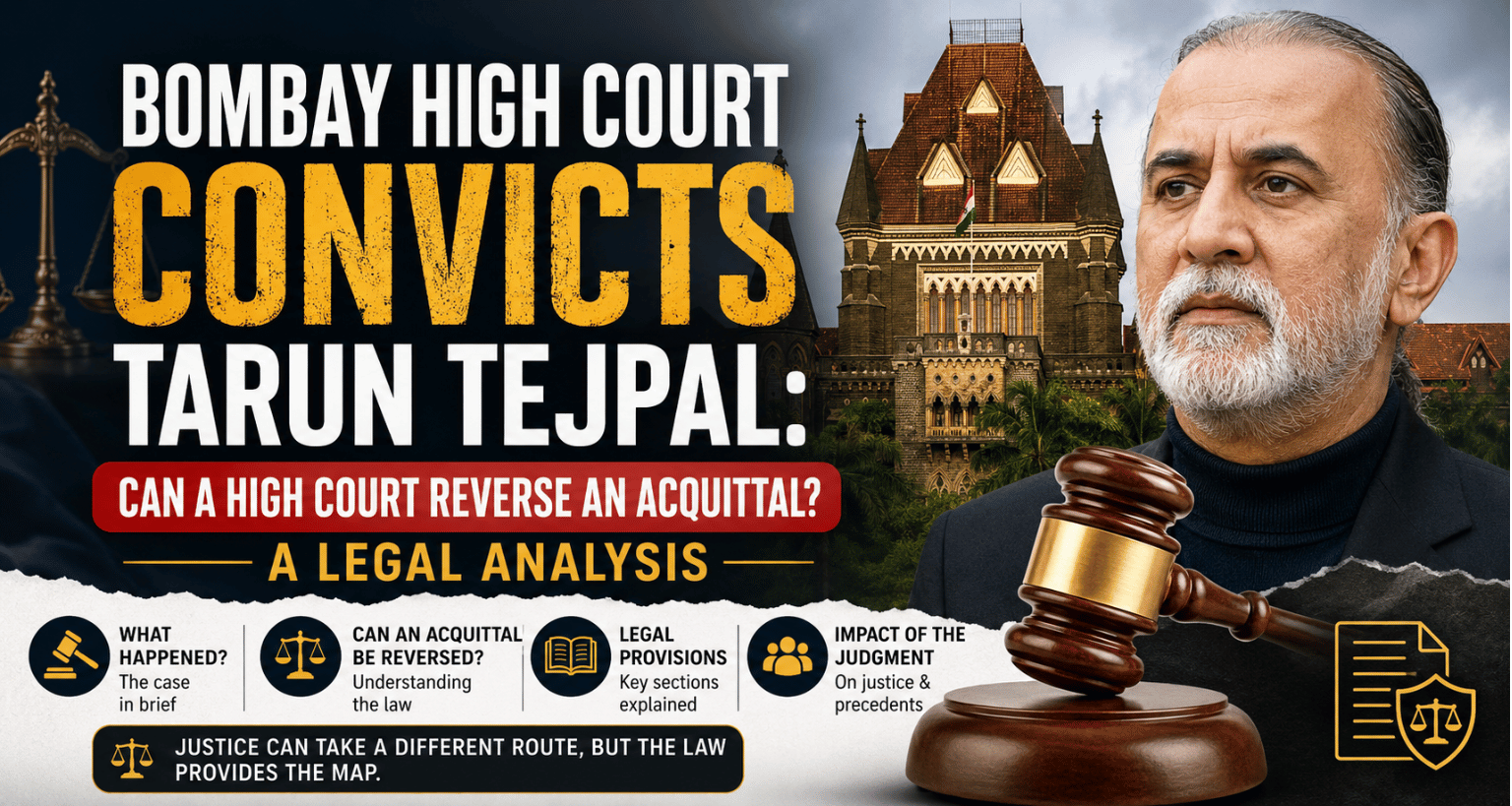
By Adv. Bindu DubeyAdvocate, High Court & Supreme Court of India On 6 August 2026, the Goa Bench of the Bombay High Court delivered one of the most discussed criminal judgments of recent times by setting aside the 2021 acquittal of former Tehelka editor Tarun Tejpal in the 2013 sexual assault case, recording his conviction and sentencing him to ten years' rigorous imprisonment. https://youtu.be/AkRYQZwrUXU The judgment has once again brought into public focus several important questions of criminal jurisprudence. Can a High Court reverse an acquittal? Does a conviction by the High Court become final immediately? Can the convicted person approach the Supreme...

Continue reading

Can Criminal Cases Be Quashed by the High Court? A Complete Legal Guide by Advocate Bindu Dubey

Can Criminal Cases Be Quashed by the High Court? A Complete Legal Guide by Advocate Bindu Dubey

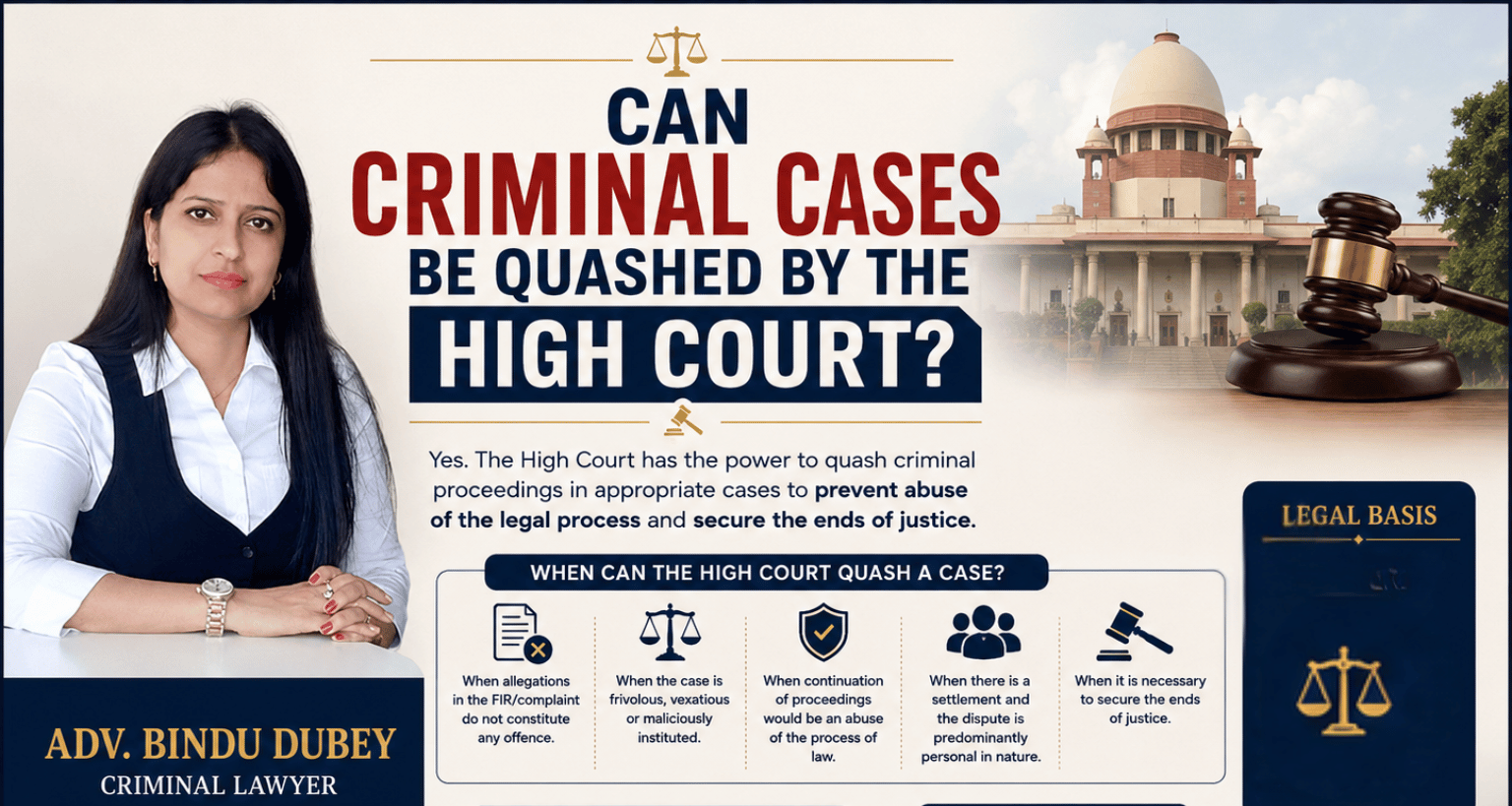
One of the most frequently asked questions by individuals facing criminal proceedings is, "Can criminal cases be quashed by the High Court?" The answer is yes, but only under specific legal circumstances. The High Court has the inherent power to quash criminal proceedings to prevent abuse of the judicial process and to ensure that justice is served. However, this extraordinary power is exercised cautiously and only in deserving cases. Whether the case arises from a family dispute, business disagreement, matrimonial conflict, or false criminal allegations, approaching the High Court for quashing can provide relief if the facts and law support such...

Continue reading

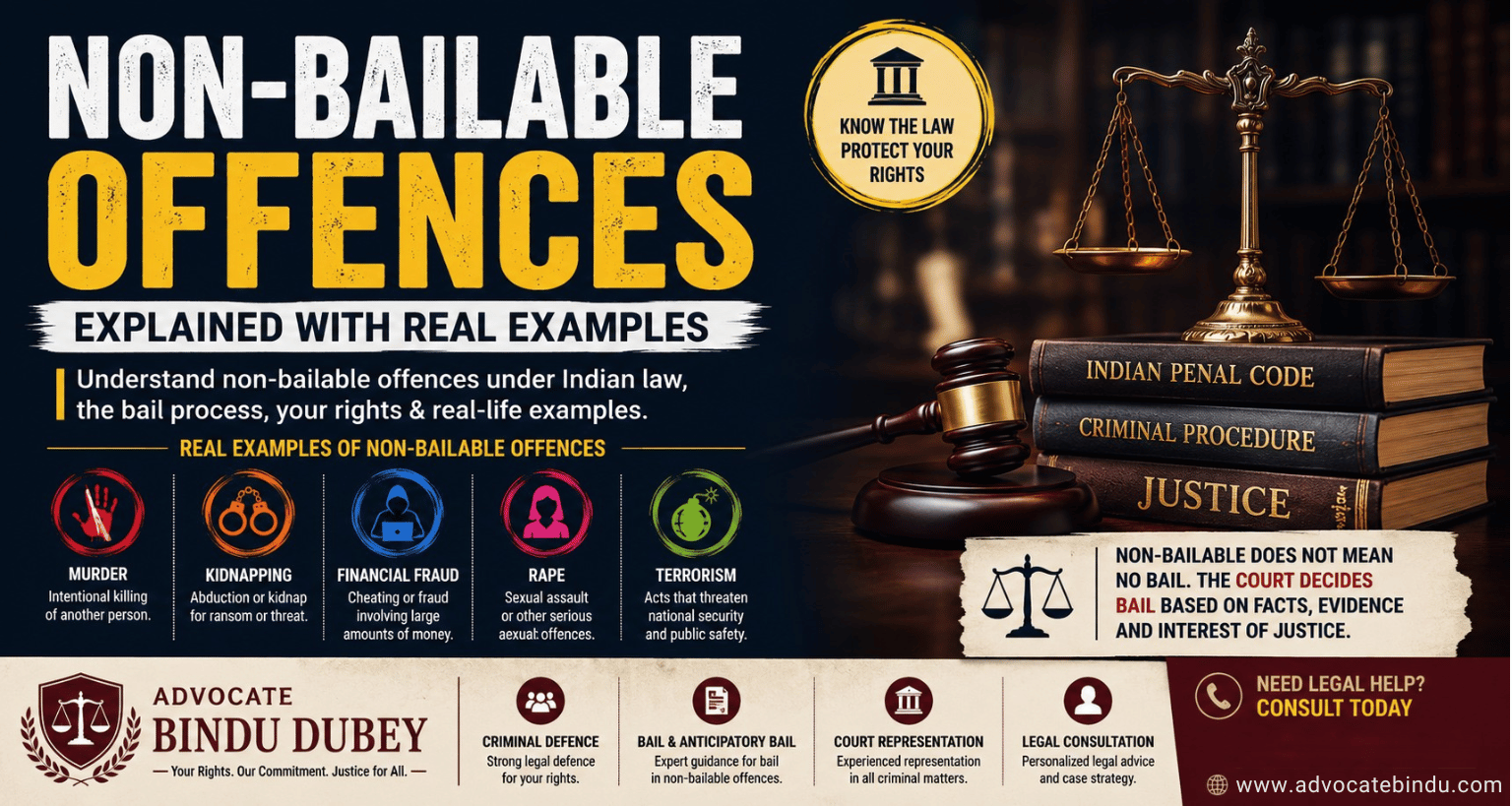
Non-Bailable Offences Explained with Real Examples

Non-Bailable Offences Explained with Real Examples

Being arrested or having a loved one arrested for a criminal offence can be overwhelming, especially when the offence is classified as non-bailable. Many people mistakenly believe that a non-bailable offence means the accused can never be released on bail. However, this is not true. Under Indian criminal law, a non-bailable offence simply means that bail is not granted as a matter of right. Instead, the court decides whether bail should be granted based on the facts and circumstances of each case. At the office of Advocate Bindu Dubey, clients often seek legal guidance after receiving notice of a serious criminal...

Continue reading

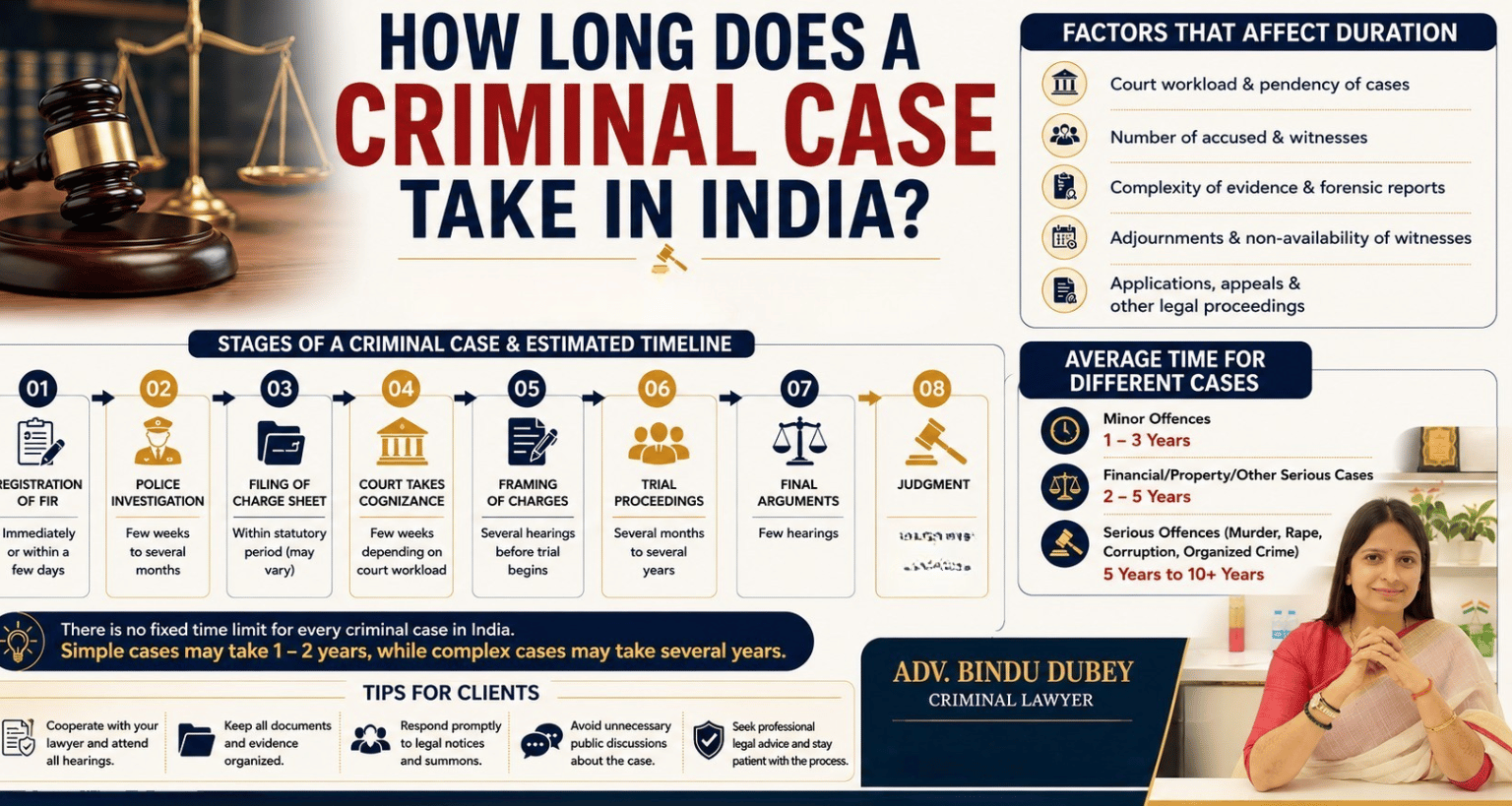
How Long Does a Criminal Case Take in India? A Complete Guide by Adv. Bindu Dubey

How Long Does a Criminal Case Take in India? A Complete Guide by Adv. Bindu Dubey

One of the most common questions people ask after a criminal complaint is filed is, "How long does a criminal case take in India?" The answer depends on several factors, including the nature of the offence, the complexity of the evidence, the number of witnesses, court workload, and the legal procedures involved. While some criminal cases are resolved within a few months, others may continue for several years before reaching a final judgment. Understanding the timeline of a criminal case helps victims, accused persons, and their families prepare for the legal process. Every stage of a criminal case follows procedures laid...

Continue reading

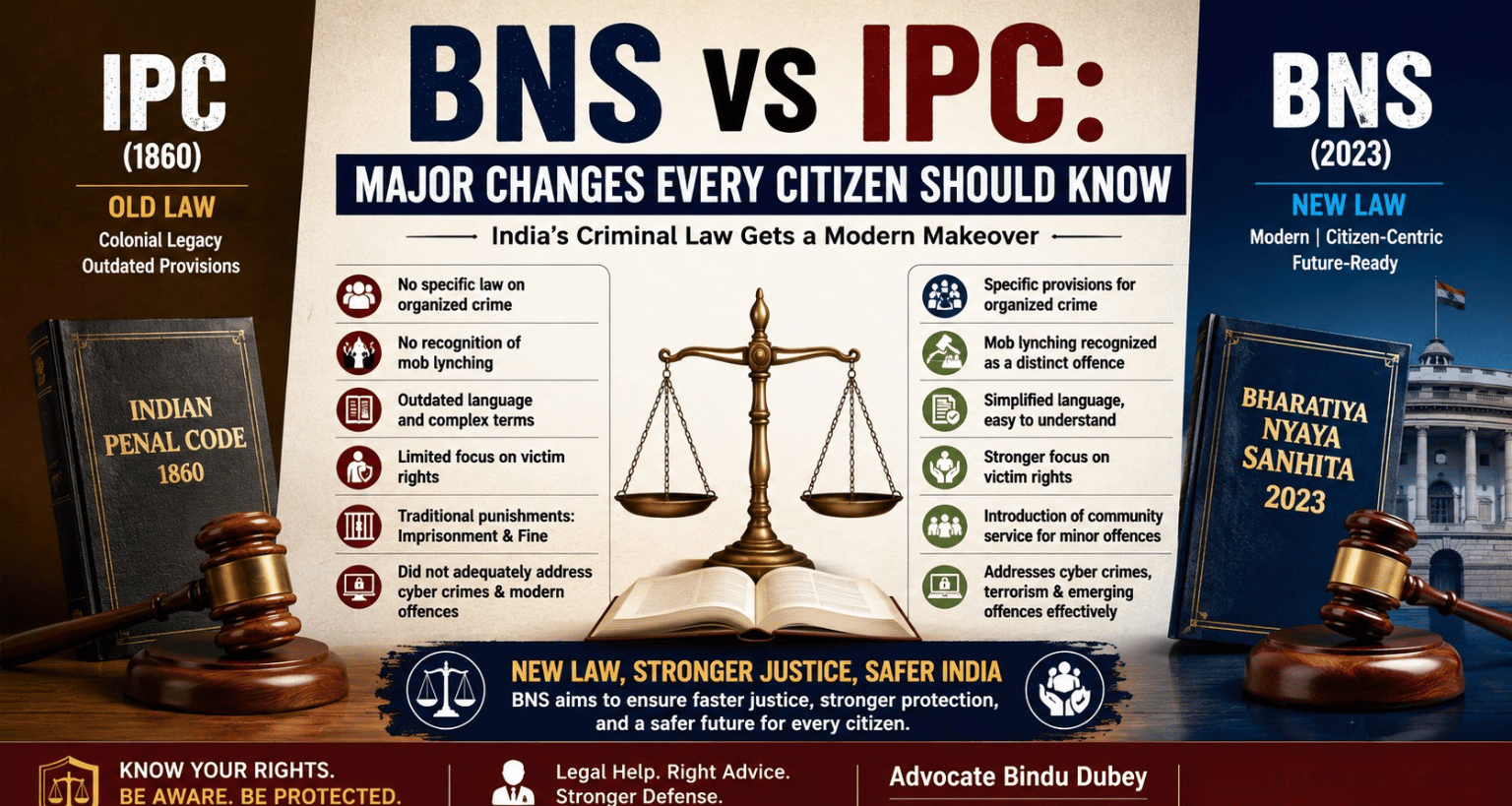
BNS vs IPC: Major Changes Every Citizen Should Know

BNS vs IPC: Major Changes Every Citizen Should Know

India's criminal justice system has entered a new era with the replacement of the Indian Penal Code (IPC), 1860 by the Bharatiya Nyaya Sanhita (BNS), 2023. This is one of the most significant legal reforms in independent India, designed to modernize criminal laws and make them more relevant to present-day challenges. The new legislation aims to improve public safety, strengthen victim protection, and ensure quicker justice while addressing modern crimes such as organized crime, terrorism, and cyber-related offences. Understanding BNS vs IPC: Major Changes Every Citizen Should Know is important for every citizen because these laws directly affect the rights,...

Continue reading