

How Long Does a Criminal Case Take in India? A Complete Guide by Adv. Bindu Dubey
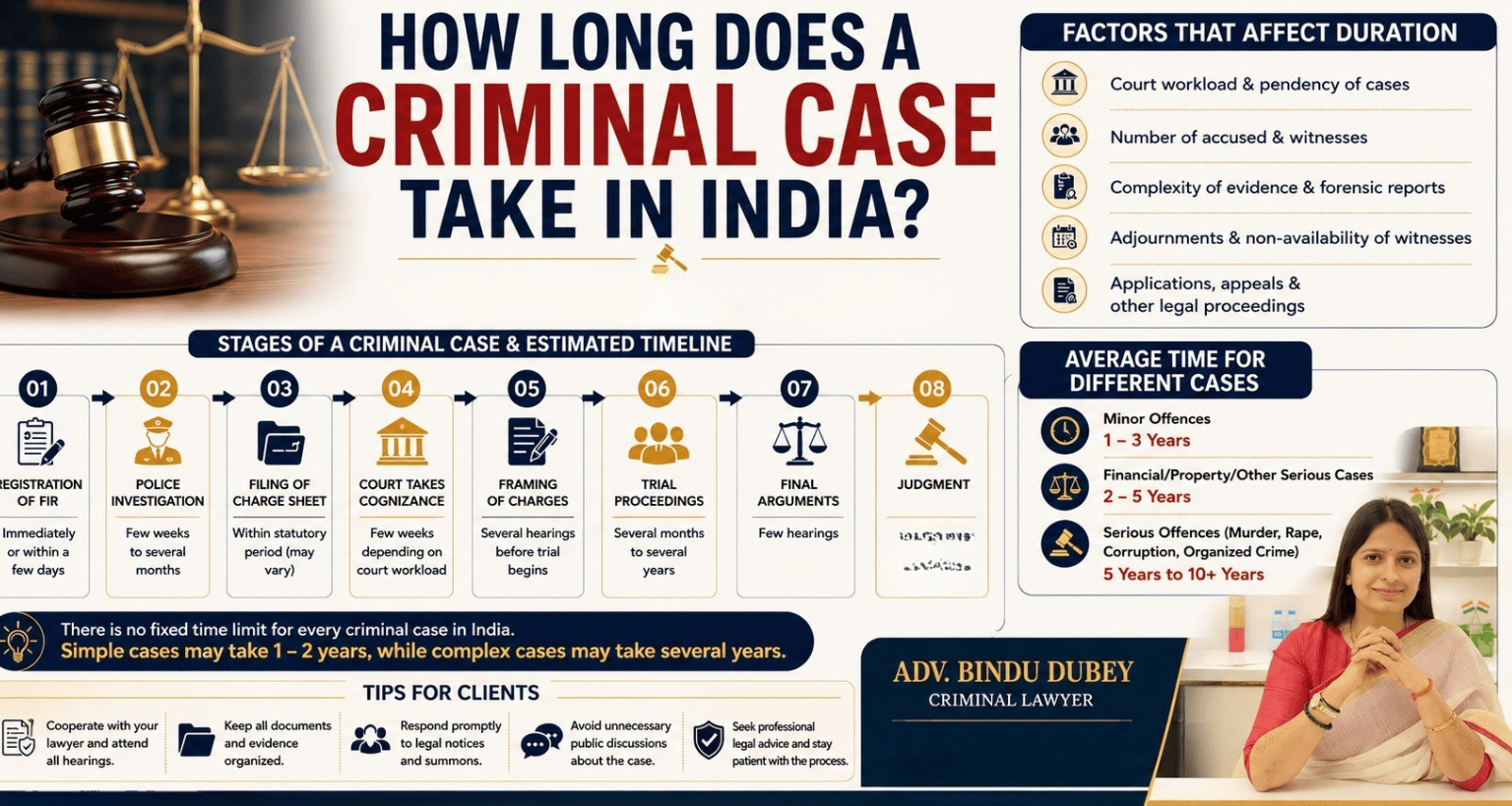
One of the most common questions people ask after a criminal complaint is filed is, “How long does a criminal case take in India?” The answer depends on several factors, including the nature of the offence, the complexity of the evidence, the number of witnesses, court workload, and the legal procedures involved. While some criminal cases are resolved within a few months, others may continue for several years before reaching a final judgment.
Understanding the timeline of a criminal case helps victims, accused persons, and their families prepare for the legal process. Every stage of a criminal case follows procedures laid down under the Bharatiya Nagarik Suraksha Sanhita (BNSS), Bharatiya Nyaya Sanhita (BNS), and other applicable laws. With proper legal guidance, unnecessary delays can often be minimized.
Adv. Bindu Dubey, an experienced criminal lawyer, assists clients at every stage of criminal proceedings, ensuring that their legal rights are protected and that their cases are handled efficiently.
Is There a Fixed Time Limit for Criminal Cases in India?
There is no fixed duration for every criminal case in India. The time required varies according to the seriousness of the offence and the facts of the case. Simple criminal matters may conclude within one or two years, whereas complicated cases involving multiple accused, extensive evidence, or serious offences may take several years before the final verdict.
Indian courts strive to ensure speedy justice, but practical challenges such as heavy case backlogs, frequent adjournments, and procedural requirements can extend the duration of proceedings.
Stages of a Criminal Case and Their Estimated Timeline
A criminal case progresses through several stages. The overall duration depends on how quickly each stage is completed.
1. Registration of FIR
The process begins with the registration of a First Information Report (FIR) in cognizable offences. Police record the complaint and initiate the investigation. FIR registration usually takes place immediately or within a few days after receiving the complaint.
2. Police Investigation
The investigating officer collects evidence, records witness statements, examines the crime scene, and gathers forensic reports where necessary.
Depending on the complexity of the offence, investigations may take anywhere from a few weeks to several months. In serious offences, investigations may continue longer with court approval where permitted by law.
3. Filing of Charge Sheet
After completing the investigation, the police submit a charge sheet before the appropriate court if sufficient evidence exists.
The filing of the charge sheet generally occurs within the statutory period prescribed for the offence, although extensions may apply depending on the circumstances.
4. Court Takes Cognizance
After receiving the charge sheet, the Magistrate examines the documents and decides whether sufficient grounds exist to proceed against the accused.
This stage generally takes a few weeks depending on the court’s workload.
5. Framing of Charges
The court frames formal charges after considering the prosecution material. The accused is informed of the allegations and asked whether they plead guilty or claim trial.
This stage may take several hearings before the actual trial begins.
6. Trial Proceedings
The trial is often the longest stage in a criminal case. During trial:
- Prosecution witnesses are examined.
- Defence cross-examines witnesses.
- Documentary evidence is produced.
- Expert witnesses may testify.
- The accused records their statement.
- Defence evidence, if any, is presented.
The trial alone may last from several months to several years depending on the number of witnesses and complexity of evidence.
7. Final Arguments
After evidence concludes, both sides present detailed legal arguments before the court.
This stage usually takes a few hearings.
8. Judgment
The court delivers its judgment after considering all evidence and legal submissions.
The judgment may result in conviction or acquittal.
Average Time Required for Different Types of Criminal Cases
Minor criminal offences involving limited evidence may conclude within one to three years.
Cases involving cheating, financial fraud, breach of trust, or property disputes often require two to five years due to documentary evidence and witness examination.
Serious offences such as murder, rape, organized crime, or corruption cases frequently continue for several years because of extensive investigations and numerous witnesses.
Appeals before higher courts may further increase the total duration of litigation.
Factors That Affect the Duration of Criminal Cases
Every criminal case is unique. Several practical and legal factors influence how quickly the proceedings move forward.
One major factor is the workload of the court. Courts with large numbers of pending cases naturally require more time to schedule hearings.
The number of accused persons also affects the timeline. Cases involving multiple accused often require additional procedural steps.
Availability of witnesses plays a significant role. If witnesses fail to appear repeatedly, hearings may be adjourned.
Forensic reports, digital evidence, and expert opinions may also take considerable time before becoming available.
Applications for bail, discharge, quashing, revision, or transfer of proceedings may temporarily delay the trial.
Frequent adjournments requested by either party can substantially increase the duration of a criminal case.
Can Criminal Cases Be Fast-Tracked?
Yes. Certain criminal matters are heard in Fast Track Courts or Special Courts established for specific categories of offences.
Cases involving sexual offences, crimes against women, children, senior citizens, or special statutes may receive priority depending on applicable laws and judicial directions.
However, even fast-track proceedings require compliance with due legal process.
How Can an Experienced Criminal Lawyer Reduce Delays?
A knowledgeable criminal lawyer helps avoid unnecessary procedural delays by ensuring that all legal documents are properly prepared and filed on time.
Timely appearances before the court, effective cross-examination, prompt responses to applications, and proper legal strategy contribute significantly toward efficient case management.
An experienced advocate also keeps clients informed about every stage of the proceedings, reducing confusion and uncertainty throughout the case.
Adv. Bindu Dubey represents clients in criminal matters with a strategic approach focused on protecting legal rights while ensuring procedural compliance at every stage.
What Happens After the Judgment?
The conclusion of the trial does not always mark the end of the criminal case.
If the accused is convicted, they may file an appeal before the Sessions Court, High Court, or Supreme Court, depending on the circumstances.
Similarly, if the complainant believes the acquittal was incorrect, legal remedies may also be available.
Appeal proceedings may continue for additional months or years depending on the complexity of the matter.
Can Criminal Cases Be Settled?
Some criminal offences are compoundable, meaning they may legally be settled between the parties with court permission where required.
However, serious offences such as murder, rape, terrorism, and offences affecting society generally cannot be compromised.
An experienced criminal lawyer can advise whether settlement is legally permissible in a particular case.
Tips for Clients During a Criminal Case
Individuals involved in criminal proceedings should remain patient and cooperate fully with their legal counsel throughout the process.
Maintaining complete records of documents, attending court hearings regularly, responding promptly to legal notices, and avoiding unnecessary public discussions about the case can positively impact the proceedings.
Clients should always rely on professional legal advice instead of unofficial opinions or misinformation.
Why Choose Adv. Bindu Dubey for Criminal Cases?
Criminal litigation demands experience, legal knowledge, strategic planning, and strong courtroom advocacy. Adv. Bindu Dubey provides dedicated legal representation in a wide range of criminal matters, including bail applications, FIR-related disputes, anticipatory bail, trial representation, appeals, and other criminal proceedings.
Clients receive practical legal guidance, transparent communication, and personalized strategies tailored to the facts of each case. Whether representing the accused or assisting victims, Adv. Bindu Dubey focuses on protecting clients’ rights while working toward a fair and lawful resolution.
Conclusion
If you are wondering how long does a criminal case take in India, the answer depends on multiple legal and practical factors. While straightforward matters may conclude relatively quickly, complex criminal trials can extend over several years. Understanding each stage of the criminal justice process helps individuals prepare for what lies ahead and make informed legal decisions.
Seeking timely advice from an experienced criminal lawyer can significantly improve case management, reduce avoidable delays, and ensure that your legal rights are protected throughout the proceedings. If you are facing a criminal matter or need guidance regarding an ongoing case, consulting Adv. Bindu Dubey can help you navigate the legal process with confidence and clarity.
Frequently Asked Questions (FAQs)
1. How long does a criminal case usually take in India?
The duration varies depending on the offence, evidence, court workload, and legal procedures. Some cases conclude within one to three years, while complex matters may take significantly longer.
2. Why are criminal cases delayed in India?
Common reasons include heavy court backlogs, repeated adjournments, witness availability, lengthy investigations, forensic reports, and multiple legal applications.
3. Can a criminal case be completed within six months?
Some simple cases may conclude quickly, but most criminal trials require more time due to mandatory legal procedures.
4. Can the accused speed up the trial?
The accused cannot control the court’s schedule but can avoid unnecessary delays by cooperating with the investigation, attending hearings, and working with an experienced criminal lawyer.
5. Should I hire a criminal lawyer immediately after an FIR?
Yes. Early legal advice helps protect your rights, ensures proper legal representation from the beginning, and can prevent procedural mistakes that may affect the outcome of the case.