

Domestic Violence Cases in India: Numbers and Key Rulings
Domestic violence cases in India are legal proceedings in which a person, most often a woman, accuses a husband, partner or in-laws of physical, sexual, verbal, emotional or economic abuse inside the home. The scale is large. In 2022, police registered 1,40,019 cruelty cases against husbands and their relatives, about 384 every day. That count captures only the fraction of abuse that ever reaches a police station.
This guide puts the numbers, the law and the court record in one place. You will see yearly figures from the National Crime Records Bureau (NCRB), how a domestic violence in india cases moves through the police and Magistrate courts, the landmark rulings that decide who is protected, the misuse debate, and real-life cases that show how proof works in practice.
Adv. Bindu Dubey & Associates is a criminal and family law firm in CBD Belapur, Navi Mumbai. It represents women seeking protection and families facing allegations of domestic violence in india cases, so this article treats both sides fairly. It is general information and not legal advice for your own case.
Why domestic violence cases in India matter
Domestic violence cases matter because cruelty by a husband or his relatives is the largest single category of recorded crime against women in India, and the registered cases are only a thin slice of what women face. To understand the scale, you need both the police numbers and the survey numbers.
How many cases are registered each year
Police data answers the question of how many domestic violence cases are registered each year. The NCRB records them as cruelty by husband or his relatives (Section 498A of the Indian Penal Code), and the table below sets out the figures from its Crime in India reports.

| Year | All crimes against women | Cruelty by husband or relatives | Share of all | Cases per day |
|---|---|---|---|---|
| 2019 | 4,05,861 | 1,25,298 | 30.9% | 343 |
| 2020 | 3,71,503 | 1,11,549 | 30.0% | 305 |
| 2021 | 4,28,278 | 1,36,234 | 31.8% | 373 |
| 2022 | 4,45,256 | 1,40,019 | 31.4% | 384 |
Two things stand out. The share has stayed between 30 and 32 percent of all crimes against women every year, and the 2022 count works out to roughly 16 cases an hour. The 2020 dip most likely reflects lockdowns that made it harder to reach a police station, not a fall in violence. In 2018 the NCRB counted 1,04,165 cases under Section 498A, so the 2022 figure is about a third higher.
What counts as domestic violence under the law
Section 3 of the Protection of Women from Domestic Violence Act, 2005 (the DV Act) defines domestic violence as any act, omission or conduct that harms or threatens a woman in a domestic relationship. It covers four forms:
- Physical abuse: beating, hitting, criminal force, or throwing her out of the home.
- Sexual abuse: forced or degrading sexual acts.
- Verbal and emotional abuse: insults, name-calling, isolation, taunts about dowry or about not having a child.
- Economic abuse: denying money for food, clothes or medicine, stopping her from working, or selling her jewellery and assets.
The Act protects more than wives. Mothers, sisters, widows and women in live-in relationships can also use it.
What the numbers do not show
Registered cases understate reality by a wide margin. The National Family Health Survey found that about 31 percent of ever-married women reported spousal violence in NFHS-4 (2015-16), and about 29 percent in NFHS-5 (2019-21). Applied to India’s married women, that is tens of millions, set against roughly 1.4 lakh registered cruelty cases a year.
Silence explains much of the gap. In the earlier NFHS-3, only about a quarter of women who faced violence sought help, and a third never told anyone. A forensic medicine journal notes that many cases surface only when the victim is hospitalised or dies, while milder abuse stays hidden because of stigma and financial dependence.
Registered cases show how many women reached a police station, not how many are living with violence.
Courts add a second bottleneck. Data placed before the Supreme Court by the National Legal Services Authority showed more than 4 lakh domestic violence cases pending. A woman who does file may wait a long time for a final order.
How a domestic violence case works in India
A domestic violence case in India usually runs on up to three tracks: a civil application under the DV Act, a criminal FIR, and a family court claim for maintenance or divorce. You can use one, two or all three, and the choice shapes how fast you get relief.
The laws behind the cases
Four laws appear in almost every case. The table shows what each covers and how it works. Since 1 July 2024, new criminal complaints are registered under the Bharatiya Nyaya Sanhita (BNS), which replaced the IPC.
| Law | What it covers | How it works |
|---|---|---|
| DV Act, 2005 | Physical, sexual, verbal, emotional and economic abuse in a domestic relationship | Civil. A Magistrate grants protection, residence, money or custody orders |
| Section 85 BNS (earlier Section 498A IPC) | Cruelty by a husband or his relatives, including harassment for dowry | Criminal. Up to 3 years and fine. Cognizable and non-bailable |
| Section 80 BNS (earlier Section 304B IPC) | Death of a woman within 7 years of marriage after dowry harassment | Criminal. Minimum 7 years, up to life |
| Dowry Prohibition Act, 1961 | Giving, taking or demanding dowry | Criminal penalties |
The DV Act gives relief, not punishment. Under Sections 18 to 22, a Magistrate can pass a protection order, a residence order, monetary relief, a custody order and compensation. The first hearing is normally listed within three days of the application, and the Act aims for disposal within 60 days, though real timelines run longer.
A domestic violence complaint is rarely one case. It is up to three, and the route you pick decides how fast you get relief.
How to start a case as a victim
You do not need to decide everything on day one. These steps work in most situations:
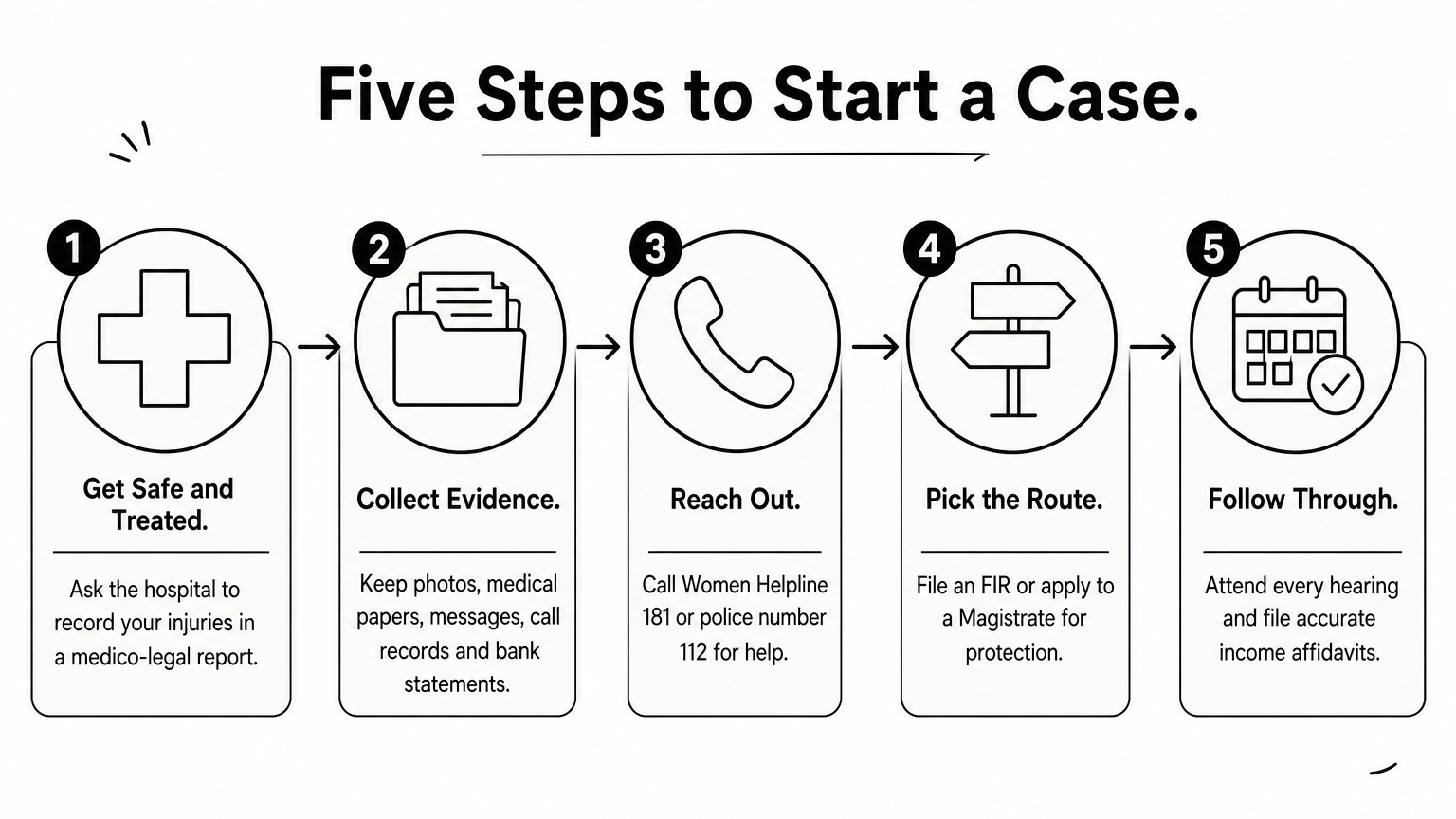
- Get to safety and get treated. Ask the hospital to record your injuries in a medico-legal report.
- Collect evidence. Keep photographs, medical papers, messages, call records, bank statements that show money control, and a list of gifts and stridhan you gave or received.
- Reach out. Call the Women Helpline 181 or the police emergency number 112. You can also go to the nearest police station, a Protection Officer, or the District Legal Services Authority, which offers free legal aid to women.
- Pick the route. File a police complaint for an FIR, or apply to the Magistrate under Section 12 of the DV Act. You can also file a maintenance claim. Many women do more than one.
- Follow through. Attend every hearing and file accurate income and property affidavits.
Interim orders are what most women need first. In our experience at Adv. Bindu Dubey & Associates, which has handled 300+ DV and dowry-related cases, interim orders under the DV Act typically come within 3 to 6 months of filing.
If you are the one accused
Start with one rule: never ignore a notice. A DV Act notice needs a reply and an appearance, and a missed date can lead to orders against you in your absence. An FIR under Section 85 BNS is non-bailable, so if you fear arrest, apply for anticipatory bail under Section 482 of the BNSS (earlier Section 438 CrPC) before the police act.
Keep your own records too: messages, bank transfers, proof of who lived where, and dates. Courts expect allegations that name each relative and each act, and vague blanket accusations against distant relatives are often where defences succeed. The same discipline helps a victim, because a well-documented complaint is harder to dismiss.
Landmark court cases that shaped the law
The best-known domestic violence cases in India are not sensational crimes but rulings that decided who the law protects, who can be sued, and where a woman may live. Each one below changed how a Magistrate reads the 2005 Act or how police use Section 498A.
Cases at a glance
| Case | Year | Court | What it settled |
|---|---|---|---|
| Inder Raj Malik v. Sunita Malik | 1986 | Delhi High Court | A person can face charges under both Section 498A and the Dowry Prohibition Act without double jeopardy |
| S.R. Batra v. Taruna Batra | 2007 | Supreme Court | Narrow view of "shared household" (later overruled) |
| Sandhya Wankhede v. Manoj Bhimrao Wankhede | 2011 | Supreme Court | Complaints only against adult males (later overruled) |
| V.D. Bhanot v. Savita Bhanot | 2012 | Supreme Court | Act protects women whose household was shared before it came into force |
| Indra Sarma v. V.K.V. Sarma | 2013 | Supreme Court | Test for live-in relationships "in the nature of marriage" |
| Arnesh Kumar v. State of Bihar | 2014 | Supreme Court | No automatic arrests under Section 498A |
| Hiralal P. Harsora v. Kusum Narottamdas Harsora | 2016 | Supreme Court | "Adult male" struck out of the respondent definition |
| Lalita Toppo v. State of Jharkhand | 2018 | Supreme Court | Live-in partner can claim maintenance under the Act |
| Satish Chander Ahuja v. Sneha Ahuja | 2020 | Supreme Court | Wide meaning of "shared household" |
The 1986 Delhi High Court ruling is the oldest. It held that demanding dowry and cruelty to a wife are separate offences, so one set of facts can support charges under both laws.
Who the law protects and who it can be used against
The DV Act is not limited to legally wedded wives. In Indra Sarma (2013), the Supreme Court set out when a live-in relationship counts as a domestic relationship. In Lalita Toppo (2018), it held that a live-in partner can seek maintenance under the Act even where Section 125 CrPC would not help her. There is a limit, though. In Kamlesh Devi (2019), the Court refused relief where the parties were neighbours, not members of a shared household.
The question of who can be named as respondent changed completely. Section 2(q) originally said "adult male person", and Sandhya Wankhede (2011) read it literally, so a mother-in-law or sister-in-law could not be named. Harsora (2016) overturned that by striking down the words "adult male". Today a complaint can be filed against female relatives and non-adults too.
The right to stay in the marital home
Residence is where most DV Act fights happen. S.R. Batra (2007) held that a wife could not claim a house owned only by her in-laws. Satish Chander Ahuja (2020) widened the idea of a shared household, so a woman who lived with her husband in a house owned by his parents may still seek a residence order.

V.D. Bhanot (2012) dealt with timing. The wife had been driven out in 2005, before the Act came into force in 2006. The Supreme Court held that a woman who once shared a household is still covered, and ordered the husband to give her part of the house and Rs 10,000 a month for maintenance.
Courts have read the 2005 Act generously: live-in partners, female relatives and women who already left the home all fall within its reach.
Misuse claims and the safeguards courts added
Courts accept that Section 498A is sometimes misused, and they responded with procedure rather than repeal. In Sushil Kumar Sharma (2005), the Supreme Court upheld the section’s validity but warned against its abuse, and later rulings built safeguards around arrest.
What Arnesh Kumar changed
Arnesh Kumar v. State of Bihar (2014) is the ruling that most affects how police behave. The Court noted that 1,97,762 people were arrested under Section 498A in 2012, and that the charge-sheet rate was 93.6% while the conviction rate was about 15%. It directed police not to arrest automatically in offences punishable up to seven years, which includes cruelty to a wife. The key directions were:
- The officer must check the grounds for arrest listed in the CrPC and record reasons in writing.
- Where arrest is not needed, the police issue a notice of appearance instead (now Section 35 BNSS).
- The Magistrate must examine those reasons before authorising any remand.
Why the family welfare committee idea ended
Rajesh Sharma v. State of U.P. (2017) went further and created Family Welfare Committees to screen 498A complaints before arrests. In 2018, in Social Action Forum for Manav Adhikar v. Union of India, the Supreme Court removed that scheme, holding that such a mechanism had no basis in the statute. The Arnesh Kumar safeguards stayed.
A 15% conviction rate does not prove that most complaints are false. It also reflects long trials, withdrawn complaints, settlements, and the difficulty of proving abuse that happened behind closed doors. High Courts have also quashed 498A proceedings where the parties settled, as in B.S. Joshi v. State of Haryana (2003). A fair reading is that both genuine victims and wrongly accused families need procedural protection.
The Supreme Court did not weaken Section 498A. It limited automatic arrest and left the offence intact.
Real-life domestic violence cases in India
Real cases show a pattern that statistics hide: dowry pressure, escalation over time, and proof problems. These examples come from a published medical case report, a widely reported dowry death and a Supreme Court judgment.
Cases that reached court after serious harm
A case report in the Indian Journal of Forensic and Community Medicine (2021) describes a 29-year-old woman in an arranged marriage. Her husband and father-in-law demanded more dowry and beat her regularly. When she became pregnant with a girl, her in-laws pressured her to abort, and she was allegedly given an unknown substance. She spent two months on a ventilator and left hospital after six months with quadriparesis and ventilator dependence. She lodged an FIR, and a medical board was still examining the cause when the report was written.
Vismaya, a 24-year-old medical student in Kerala, died in June 2021, and her family said her husband had harassed her over dowry. He was convicted in 2022 under the dowry death provision. Both cases reached the law only after severe injury or death, which matches what researchers say about delayed reporting.
A case where relatives were acquitted
Bibi Parwana Khatoon v. State of Bihar (2017) shows the other side of proof. A woman was burnt to death and her husband’s family was convicted of dowry death. The Supreme Court set aside the conviction of her sister-in-law and brother-in-law, because there was no proof beyond reasonable doubt that they had harassed her for dowry or shared the husband’s intent, and they lived in a separate village.
The lesson holds for both sides. A conviction needs evidence against each person named, so a victim should record who did what and when. The accused should expect a court to look at each individual’s role.
Indian courts convict on evidence against each accused person, not on the fact that a marriage ended in tragedy.
Recent data and the shift from IPC to BNS
Recent cases now run under new law numbers, and the latest figures sit in two public sources. Knowing both saves you from quoting outdated sections or old statistics.
Where to find the latest numbers
The NCRB publishes Crime in India annually, usually with a lag of a year or more, so check its newest edition for 2023 and later years. The cruelty-by-husband category is reported every year, and it has remained near three in ten crimes against women in the years shown above. For survey data, the NFHS-5 (2019-21) is the most recent full national survey, so treat any "latest" figure from another source with care. No single official count combines criminal cases and DV Act applications, so a true "total" is not available.
Old IPC sections and their BNS replacements
The DV Act and the Dowry Prohibition Act continue unchanged. Criminal sections moved when the BNS and BNSS took over from the IPC and CrPC on 1 July 2024:
| Earlier provision | Current provision | Subject |
|---|---|---|
| Section 498A IPC | Section 85 BNS | Cruelty by husband or relatives |
| Section 304B IPC | Section 80 BNS | Dowry death |
| Section 438 CrPC | Section 482 BNSS | Anticipatory bail |
| Section 125 CrPC | Section 144 BNSS | Maintenance |
| Section 41A CrPC | Section 35 BNSS | Notice of appearance |
Older rulings such as Arnesh Kumar are still cited, but lawyers now read them alongside the new numbering.
What the cases tell you
Domestic violence cases in India are numerous, under-reported and shaped by a few key rulings. Police registered about 1.4 lakh cruelty cases in 2022, surveys point to far more women affected, and courts have widened the DV Act while adding safeguards against arbitrary arrest. Whether you are seeking protection or defending an allegation, evidence and the right route decide the outcome.
If you are dealing with a case in Navi Mumbai, Thane, Panvel or Mumbai, you can speak to a domestic violence and dowry cases lawyer in Navi Mumbai. Meetings run from 10 am to 9 pm by prior appointment, in person or by phone.