

Domestic Violence Case in India: Law, Procedure, Punishment
A domestic violence case is a legal proceeding in which a woman asks a court or the police to stop abuse by a husband, partner or relative she shares, or has shared, a domestic relationship with. In India it runs on two tracks. The civil track is an application under the Protection of Women from Domestic Violence Act, 2005 (DV Act), which gives protection, a right to stay in the home and monetary relief. The criminal track is an FIR for cruelty under Section 85 of the Bharatiya Nyaya Sanhita (BNS), which replaced Section 498A of the Indian Penal Code on 1 July 2024. You can use one track or both.
Most people searching this term want practical answers. What does the law count as violence? Who can file, and where? Which documents help? What happens at each hearing, what is the punishment, and what has the Supreme Court said? This article answers those questions in that order. It also covers the other side, which is what to do if a case is filed against you.
Adv. Bindu Dubey & Associates is a criminal and family law firm in CBD Belapur, Navi Mumbai. It handles domestic violence, dowry and maintenance matters before Magistrate courts, Sessions courts, the Bombay High Court and the Supreme Court. The explanations below reflect how these cases move in practice for people in Navi Mumbai, Thane, Raigad and Mumbai. They are general information and not advice on your particular facts.
Why the type of domestic violence case you file matters
The track you choose decides which court you approach, how quickly you get relief and what the other side risks in your domestic violence case. A woman who needs a safe place to live this week needs a different case from a woman who wants the abuser prosecuted. Many people file only one, or the wrong one, and lose months.
Domestic violence case meaning under Indian law
Section 3 of the DV Act defines domestic violence as any act, omission or conduct that harms or endangers the health, safety, life, limb or well-being of the woman, mental or physical. The Act names physical abuse, sexual abuse, verbal and emotional abuse, and economic abuse. It also covers harassment meant to force the woman or her relatives to meet a dowry or property demand, and threats of any of these.
Economic abuse in domestic violence case is the form people miss most often. It includes withholding money for food, clothes or medicine, selling your stridhan or jewellery without consent, blocking you from the shared household and stopping you from earning. You do not need an injury or a medical report to have a case. Insults, threats, being locked out and having your salary controlled all count, if you can describe and prove them.

Who can file and against whom
The Act protects an "aggrieved person", meaning a woman who is or has been in a domestic relationship with the respondent. A domestic relationship (Section 2(f)) exists between people related by blood, marriage or adoption, in a relationship in the nature of marriage, or living together as a joint family. Wives, mothers, sisters, daughters, widows and live-in partners can all use the Act.
The respondent is usually the husband or male partner and his relatives. Since the Supreme Court’s 2016 ruling in Hiral P. Harsora v. Kusum Narottamdas Harsora, female relatives such as a mother-in-law or sister-in-law can be named too. The Act does not let a man file as the aggrieved person. A man facing violence at home has to rely on the general criminal law.
Civil case, criminal case, or both
The two tracks do different jobs, and the table below sets them side by side.
| Point | DV Act case | BNS Section 85 case (old 498A IPC) |
|---|---|---|
| Nature | Civil remedy, with a criminal penalty only for breach of an order | Criminal offence |
| Where it starts | Application before a Magistrate, directly or through a Protection Officer | FIR at a police station, or a complaint to a Magistrate |
| Main aim | Protection, residence, money, custody, compensation | Punishing cruelty |
| Who is covered | Any woman in a domestic relationship, including live-in partners | A married woman, against her husband or his relatives |
| Possible result | Protection, residence and monetary orders | Up to three years in prison and a fine |
| Arrest | Not on the application itself, only on breach of an order | Cognizable and non-bailable offence |
A domestic violence case is a set of remedies, not one complaint, and the right mix depends on what you need first.
How common these cases are
The National Family Health Survey (NFHS-5, 2019-21) found that about 29 percent of ever-married women aged 18 to 49 reported spousal violence. The National Crime Records Bureau recorded 104,165 cases of cruelty by husband or relatives under Section 498A in 2018. That was 31.9 percent of all IPC crimes against women that year.
These figures cover only what was reported. Fear of stigma, financial dependence and not knowing the law keep many women from approaching any court. If you are weighing whether your situation "counts", the answer is usually that the law covers more than people assume.
Laws and sections that govern a domestic violence case
Four laws do most of the work: the DV Act, Sections 85 and 86 of the BNS, the Dowry Prohibition Act, 1961, and the BNS provision on dowry death. Which sections in domestic violence case apply depends on your facts and on the date of the incident.
Key sections of the DV Act
If you are searching for the domestic violence case section that matters most, start with this table.
| Section | What it does |
|---|---|
| 2(a) | Defines the "aggrieved person" |
| 2(f) | Defines "domestic relationship" |
| 2(s) | Defines "shared household" |
| 3 | Defines domestic violence |
| 12 | Allows an application to the Magistrate |
| 17 | Gives the right to reside in the shared household |
| 18 | Protection orders |
| 19 | Residence orders |
| 20 | Monetary relief |
| 21 | Custody orders for children |
| 22 | Compensation and damages |
| 23 | Interim and ex parte orders |
| 31 | Penalty for breaching a protection order |
Section 36 says the Act adds to other laws and does not replace them. Section 26 lets you ask for DV Act reliefs inside other proceedings, such as a divorce petition. That is why a DV application, a criminal complaint and a maintenance claim can run together.
Section 498A IPC and its replacement, BNS 85 and 86
Section 498A was inserted into the IPC in 1983. It punishes a husband or his relative who subjects a woman to cruelty with imprisonment up to three years and a fine. The offence is cognizable, non-bailable and non-compoundable.
For acts committed on or after 1 July 2024, the same offence sits in Section 85 of the BNS, and Section 86 defines cruelty. Acts before that date are still prosecuted under 498A IPC, which is why judgments and news reports keep using the old number. Cruelty has two limbs. The first is wilful conduct likely to drive the woman to suicide or cause grave injury to her life, limb or health. The second is harassment to force her or her relatives to meet an unlawful demand for property or valuable security.
Related sections, old and new
Domestic violence FIRs often add other sections. The table maps the common ones.
| IPC section | BNS section | Offence |
|---|---|---|
| 498A | 85 and 86 | Cruelty by husband or relatives |
| 304B | 80 | Dowry death |
| 323 | 115(2) | Voluntarily causing hurt |
| 406 | 316 | Criminal breach of trust, often used for stridhan |
| 506 | 351 | Criminal intimidation |
The Dowry Prohibition Act separately punishes giving, taking or abetting dowry under Section 3, and demanding dowry under Section 4. Maintenance claims under Section 125 of the old Code of Criminal Procedure now fall under Section 144 of the Bharatiya Nagarik Suraksha Sanhita (BNSS).
The DV Act and Section 85 BNS are not rivals. One protects you now, the other punishes the conduct.
How to file a case for domestic violence in India
You can file through a Protection Officer, directly before a Magistrate, or by lodging an FIR, and you can use more than one route. Safety comes first. If you are in danger right now, call the police on 112 or the Women Helpline on 181.
The three ways to start a case
- Protection Officer. Protection Officers are appointed by the state government in a domestic violence case to help women under the Act. The officer records your complaint in a Domestic Incident Report, forwards it to the Magistrate and helps with shelter and medical care. You can reach one through the Magistrate court, the district women and child development office or helpline 181.
- Direct application to the Magistrate. Section 12 lets the woman, a Protection Officer or any person on her behalf file the application. A lawyer usually drafts it, and the court can act on it even if no Domestic Incident Report exists.
- Police FIR. For offences such as Section 85 BNS, you can go to any police station. A Zero FIR can be registered at any station regardless of where the incident happened, then transferred. Section 173 of the BNSS also allows an e-FIR, which you must sign within three days.
Choose by need. If you need a roof, money or custody quickly, the DV Act application is the faster tool. If there is physical violence, threats or dowry harassment, an FIR starts a criminal investigation. Many women do both.
Where you can file
Section 27 of the DV Act gives jurisdiction to the Magistrate where you live permanently or temporarily, where you work or carry on business, where the respondent lives, or where the cause of action arose. You are not forced to return to the town of the matrimonial home.
Take a woman who leaves her husband’s home in another state and moves to her parents’ house in Navi Mumbai. She can file before the Magistrate court that covers her current area. The Supreme Court took a similar view for the criminal side in Rupali Devi v. State of Uttar Pradesh (2019), holding that courts where a wife took shelter after leaving the matrimonial home can hear a cruelty case.
Evidence checklist and incident log
Courts decide these cases on specific facts, dates and proof. Gather what you have before you file, and do not delete anything from your phone.

- Marriage certificate, wedding photos or other proof of the relationship
- Medical records, prescriptions and any medico-legal case papers
- Photos of injuries or damaged property, with dates
- Messages, emails, call logs and voice notes
- Bank statements, income proofs and a list of stridhan and gifts
- Earlier police complaints, helpline records or counselling notes
- Names and numbers of people who saw or heard the incidents
Electronic records need a certificate under Section 63 of the Bharatiya Sakshya Adhiniyam, so keep the original device. Alongside the documents, keep a running log. Copy this format and fill one entry per incident.
Date and time:
Place:
What happened (in your own words):
Who did it:
Witnesses:
Injury or medical record:
Proof kept (photo, message, bill):
Police or helpline contacted:
A clear log lets your lawyer draft an application with dates instead of general statements. Judges notice the difference.
A dated, specific account of each incident does more for your case than a long general complaint.
Domestic violence case procedure, step by step
Under the DV Act, the Magistrate should list the first hearing within three days of the application and should try to finish the case within 60 days of that hearing. Real timelines are often longer, especially where the other side seeks adjournments.
The DV Act application
- Filing. The application under Section 12 goes to the Magistrate, with the Domestic Incident Report if one exists. Hearings are held in camera if the court or either side asks.
- Notice. The Magistrate fixes the first date. The Protection Officer serves notice on the respondent, ordinarily within two days.
- Interim relief. If violence has happened or is likely, the court can pass interim or ex parte orders under Section 23 on your affidavit.
- Counselling and disclosure. The Magistrate may direct counselling and may call for affidavits of income and assets, especially where maintenance is claimed. The Supreme Court’s 2020 guidelines in Rajnesh v. Neha make these affidavits routine.
- Evidence and arguments. Evidence is usually led by affidavit, with cross-examination where needed. The court follows the criminal procedure code but may adopt its own procedure under Section 28.
- Final order. The Magistrate passes protection, residence, monetary, custody or compensation orders. Under Section 25 they stay in force until you apply for discharge, and the court can modify them if circumstances change.
- Appeal. Either side can appeal to the Court of Session within 30 days of the order.
A worked example shows the clock. Suppose you file on 1 March and the first hearing is on 4 March. The 60-day target then runs to about 3 May. Treat that as the law’s aim, not a promise. Interim orders matter because they protect you while the final hearing waits.
The criminal case under Section 85 BNS
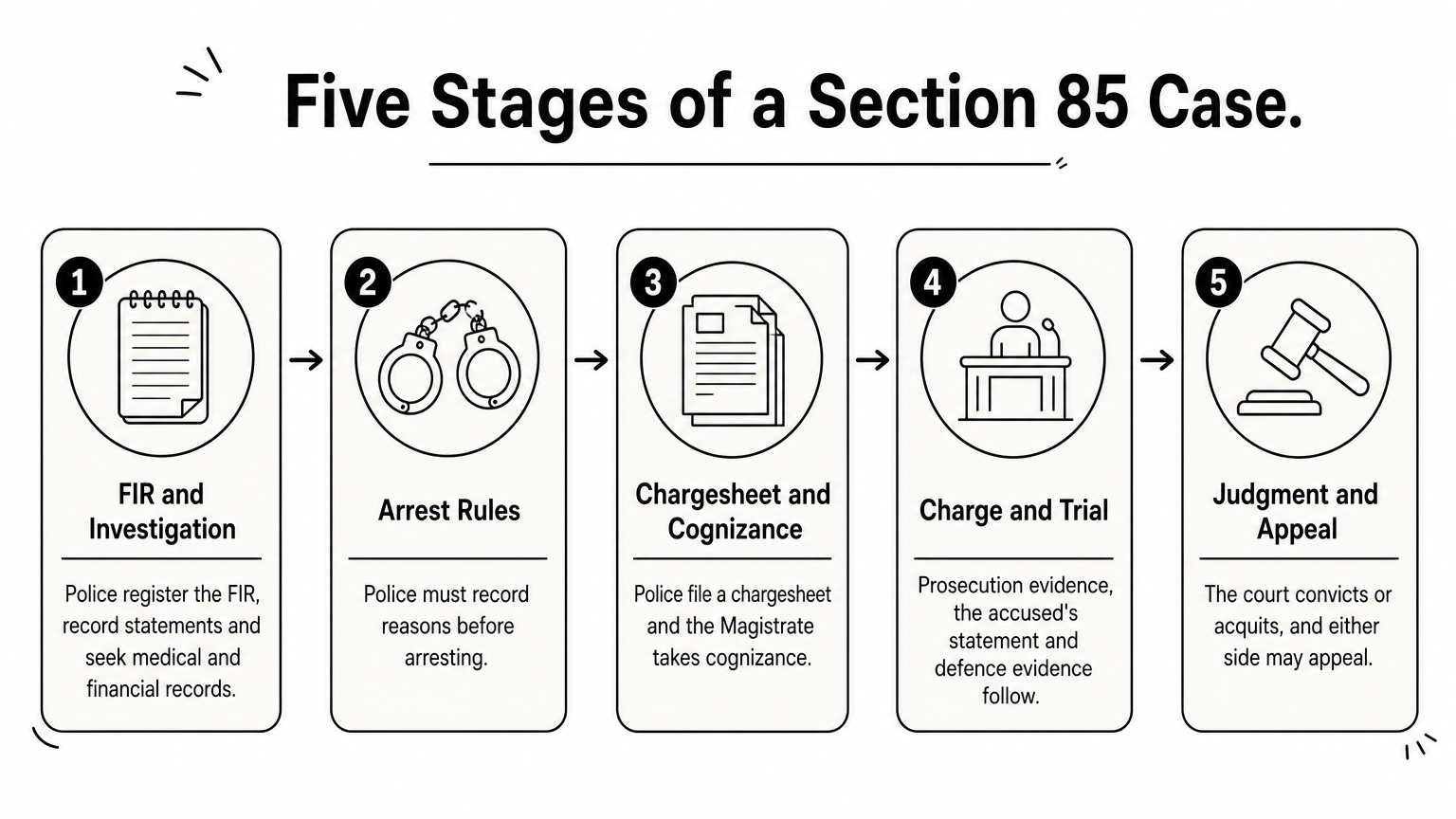
- FIR and investigation. The police register the FIR, record statements and may call for medical and financial records.
- Arrest rules. Police are not supposed to arrest automatically. Under Arnesh Kumar v. State of Bihar (2014), they must record reasons, and for such offences they usually issue a notice of appearance now found in Section 35 BNSS.
- Chargesheet and cognizance. If the police find a case, they file a chargesheet and the Magistrate takes cognizance.
- Charge and trial. The offence is triable by a Magistrate of the first class. Trial includes prosecution evidence, the accused’s statement and defence evidence.
- Judgment and appeal. The court convicts or acquits, and either side can appeal to the Sessions Court.
Because the offence is non-bailable, the accused usually applies for bail, or for anticipatory bail under Section 482 BNSS before arrest. The offence is non-compoundable, but where spouses settle, the High Court can quash the proceedings under Section 528 BNSS.
The civil case gives you protection in weeks. The criminal trial usually takes years, so plan for both timelines.
Domestic violence case punishment and court relief
The DV Act does not send a man to jail for the abuse itself. It gives the woman civil orders, and jail follows only if the respondent breaks them. Punishment for the underlying conduct comes from the criminal sections.
Orders a Magistrate can pass under the DV Act
| Order | Section | What it can do |
|---|---|---|
| Protection order | 18 | Bars violence, contact, entering your workplace or school, and operating shared bank accounts |
| Residence order | 19 | Stops dispossession from the shared household, or directs alternative accommodation |
| Monetary relief | 20 | Covers lost earnings, medical costs, loss from damaged property, and maintenance for you and your children |
| Custody order | 21 | Gives temporary custody of children and sets visiting rules |
| Compensation | 22 | Awards damages for mental torture and emotional distress |

Section 17 gives every woman in a domestic relationship the right to live in the shared household whether or not she owns it. She cannot be evicted except through a legal procedure. Monetary relief under Section 20 must be adequate, fair and consistent with the standard of living she is used to.
Punishments in a domestic violence case
| Offence | Punishment |
|---|---|
| Breach of a protection order (DV Act, Section 31) | Up to one year, or a fine up to ₹20,000, or both. Cognizable and non-bailable |
| Cruelty by husband or relatives (BNS 85, old 498A) | Up to three years and a fine |
| Dowry death (BNS 80, old 304B) | Minimum seven years, up to life imprisonment |
| Giving or taking dowry (Dowry Prohibition Act, Section 3) | Minimum five years and a fine of at least ₹15,000 or the value of the dowry, whichever is more |
| Demanding dowry (Dowry Prohibition Act, Section 4) | Six months to two years and a fine up to ₹10,000 |
Sentences depend on proof beyond reasonable doubt. That standard makes cases hard, because the violence often happens inside the home with no outside witness. This is why your own log, medical records and messages carry so much weight.
Maintenance runs alongside
Monetary relief under the DV Act is separate from maintenance under Section 144 BNSS, and from interim maintenance in divorce proceedings. Courts adjust for overlapping claims so that you are not paid twice for the same period. Tell your lawyer about every proceeding already filed, so claims can be coordinated rather than contradicted.
Under the DV Act, the real force lies in the orders, because breaking one turns a civil dispute into an arrestable offence.
Case law on domestic violence: rulings that shape cases
The Supreme Court has widened who the Act protects and tightened how police and courts treat cruelty complaints. The rulings below come up in almost every contested case.
| Case | Year | What it settled |
|---|---|---|
| D. Velusamy v. D. Patchaiammal | 2010 | Test for a "relationship in the nature of marriage" |
| Preeti Gupta v. State of Jharkhand | 2010 | Courts must scrutinise over-broad allegations against relatives |
| Indra Sarma v. V.K.V. Sarma | 2013 | Applied the live-in test to a woman who knew her partner was married |
| Arnesh Kumar v. State of Bihar | 2014 | No automatic arrest in 498A cases |
| Hiral P. Harsora v. Kusum Narottamdas Harsora | 2016 | Female relatives can be respondents |
| Lalita Toppo v. State of Jharkhand | 2018 | Live-in partner can claim maintenance under the Act |
| Rupali Devi v. State of U.P. | 2019 | Cruelty case can be filed where the wife took shelter |
| Satish Chander Ahuja v. Sneha Ahuja | 2020 | Wider meaning of "shared household" |
| Rajnesh v. Neha | 2020 | Disclosure affidavits and maintenance guidelines |
Who the Act protects
Velusamy said a live-in relationship counts if the couple present themselves as spouses, are of legal age, are qualified to marry and have lived together voluntarily for a significant period. Indra Sarma applied that test and found no marriage-like relationship where the woman knew her partner was already married. Lalita Toppo then confirmed that a woman in a qualifying live-in relationship can claim maintenance under the DV Act.
Harsora removed the words "adult male" from Section 2(q). A woman can now name a female relative of the husband as a respondent if that person is in a domestic relationship with her. Courts still expect specific allegations against each person named.
Shared household and the right to reside
An older ruling, S.R. Batra v. Taruna Batra (2007), held that a wife had no claim to a house that belonged only to her mother-in-law. Satish Chander Ahuja overruled it in 2020. A shared household is now the home where the woman lived in a domestic relationship, whoever owns it, and the court looks at the facts. Residence orders therefore reach beyond properties owned by the husband.
Safeguards in the criminal case
Arnesh Kumar told police to stop routine arrests under Section 498A and told Magistrates not to approve detention mechanically. The Court’s 2018 decision in Social Action Forum for Manav Adhikar v. Union of India removed the family welfare committee scheme created earlier in Rajesh Sharma, while leaving the arrest safeguards intact. Preeti Gupta and later rulings such as Kahkashan Kausar v. State of Bihar (2022) warn against general, omnibus accusations against every in-law. The Court also held in B.S. Joshi v. State of Haryana (2003) that the High Court can quash a cruelty case when spouses genuinely settle.
Courts protect real victims and also demand specific facts, so the strongest cases name who did what, and when.
When a domestic violence case is filed against a husband
If a domestic violence case is filed against you, do not ignore the notice, and do not contact the complainant directly. A missed date can lead to ex parte orders under the DV Act or a warrant in the criminal case. Get a lawyer before the first hearing.
The first steps for the accused
- Read the notice or FIR and note every date and section cited.
- If an FIR exists or is likely, consider anticipatory bail under Section 482 BNSS before arrest.
- Attend the police inquiry when called and ask for the notice of appearance in writing.
- Preserve your messages, bank records, salary slips and proof of money spent on the household. Courts look closely at income affidavits.
- Follow every interim order to the letter.
Breach is the single most expensive mistake. A breach of a protection order is a separate cognizable, non-bailable offence under Section 31, and it damages your standing on everything else. Do not evict the wife from the shared household either, because Section 17 permits removal only through the legal procedure.
How a defence is built
A defence begins with the complaint itself. Look for vague allegations, missing dates, delay without explanation, and relatives named with no specific role. Preeti Gupta and Kahkashan Kausar support asking the court to examine those gaps. Do not respond with a counter-complaint made in anger. Courts read retaliation as such.
The defence also tests the proof: medical records that do not match the story, messages that contradict a claim, or an income affidavit that overstates your earnings. Even a case with a weak criminal side can end in a monetary order if the relationship and the need are proven, so prepare honest income and expense disclosures.
Settlement and exit
Many matrimonial disputes end by agreement, through mutual consent divorce with a settlement on maintenance, stridhan and children. Where a criminal case is pending and both sides settle, the High Court can quash it under Section 528 BNSS, following B.S. Joshi. Settlement must be voluntary and recorded properly. A settlement signed under pressure tends to unravel.
Whether you are the complainant or the accused, the case turns on documents, dates and compliance with every order.
What to do next
A domestic violence case in India is one problem with two sets of tools. The DV Act gives you quick civil protection, a right to stay in the home and monetary relief. Section 85 BNS, the old 498A, and the dowry laws punish the conduct itself. Your evidence log, your choice of track and your compliance with every order decide how the case goes, whichever side you are on.
If you need help with a domestic violence matter in Navi Mumbai, Thane, Raigad or Mumbai, whether as a complainant or as an accused, you can speak to Adv. Bindu Dubey & Associates by phone or WhatsApp. Bring your documents and your incident log, and ask for a plain explanation of the options before you file anything.