

Bombay High Court Convicts Tarun Tejpal: Can a High Court Reverse an Acquittal? A Legal Analysis
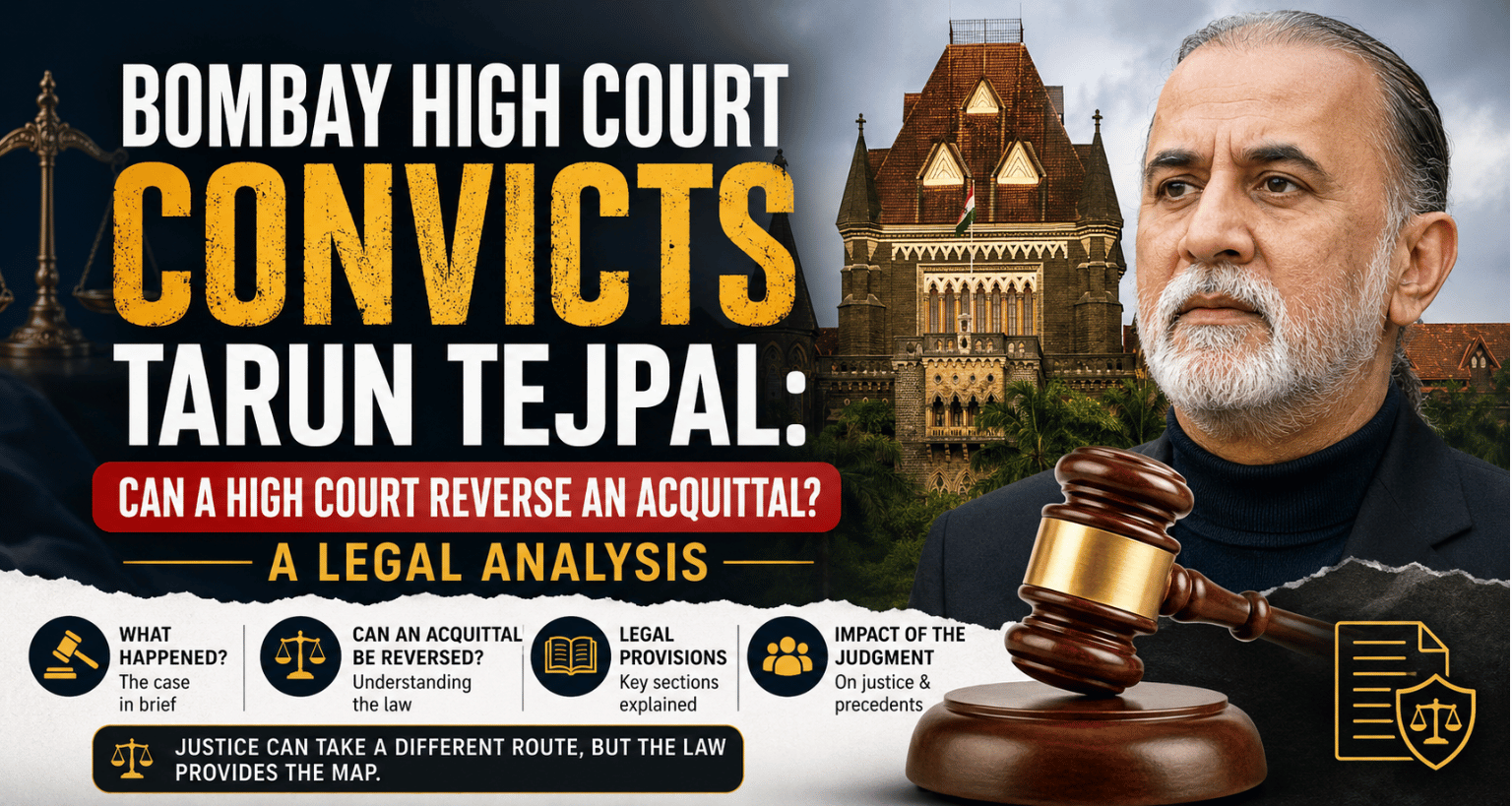
By Adv. Bindu Dubey
Advocate, High Court & Supreme Court of India
On 6 August 2026, the Goa Bench of the Bombay High Court delivered one of the most discussed criminal judgments of recent times by setting aside the 2021 acquittal of former Tehelka editor Tarun Tejpal in the 2013 sexual assault case, recording his conviction and sentencing him to ten years’ rigorous imprisonment.
The judgment has once again brought into public focus several important questions of criminal jurisprudence. Can a High Court reverse an acquittal? Does a conviction by the High Court become final immediately? Can the convicted person approach the Supreme Court? Does filing an appeal automatically suspend the conviction or sentence?
These are questions that deserve legal answers rather than emotional reactions.
This article is not intended to comment upon the guilt or innocence of any individual beyond the operative judicial findings available in the public domain. Instead, it seeks to explain the legal framework governing appeals against acquittal, the constitutional remedies available after conviction, and the broader significance of this judgment within India’s criminal justice system.
As lawyers, our responsibility is not to participate in media trials but to explain how the law operates. Judicial decisions must always be understood within the framework of constitutional principles, statutory provisions and appellate review.
Timeline of the Case
Understanding the procedural history is essential because the present judgment is the result of a statutory appellate process rather than a fresh criminal trial.
- November 2013 – Allegations of sexual assault arose during an event in Goa.
- Criminal proceedings were initiated following registration of an FIR.
- After investigation, a chargesheet was filed and the matter proceeded before the Sessions Court in Goa.
- In May 2021, the Sessions Court acquitted the accused.
- The State challenged the acquittal before the Bombay High Court.
- On 6 August 2026, the Bombay High Court reversed the acquittal, convicted the accused and imposed a sentence of ten years’ rigorous imprisonment.
- It has also been publicly reported that the conviction is likely to be challenged before the Supreme Court of India.
This procedural journey itself illustrates an important feature of the Indian judicial system – every judgment, whether of conviction or acquittal, may be subjected to appellate scrutiny where the law permits.
Why This Judgment Is Legally Significant
The significance of today’s judgment extends far beyond the facts of one criminal case.
It reaffirms that the criminal justice system is built upon multiple institutional safeguards. A trial court records evidence and delivers its verdict. The High Court possesses appellate jurisdiction to examine whether the trial court correctly appreciated the evidence and applied the law. In appropriate cases, the Supreme Court exercises constitutional jurisdiction to examine whether the High Court’s decision itself warrants interference.
This layered appellate structure ensures that judicial errors, if any, can be corrected through legal processes rather than public opinion.
The judgment has also revived discussion on important principles such as:
- appellate review of acquittals;
- appreciation of oral, documentary and electronic evidence;
- protection of the rights of survivors;
- safeguarding the constitutional rights of accused persons;
- maintaining public confidence in judicial institutions.
The importance of this decision therefore lies not merely in its outcome but in the legal principles that govern appellate criminal jurisdiction.
Can a High Court Reverse an Acquittal?
One of the most common misconceptions among the public is that once an accused has been acquitted by a trial court, the matter comes to an end forever.
Legally, this is incorrect.
Indian criminal law has always recognised the right of the State to challenge an acquittal before the High Court in appropriate cases. An appeal against acquittal is an integral part of criminal procedure and serves as an institutional safeguard against possible legal or evidentiary errors committed during trial.
However, this power is not unlimited.
The Supreme Court has repeatedly held that an acquittal reinforces the presumption of innocence and that appellate courts must exercise great caution before disturbing such findings. Mere possibility of another view is generally insufficient. Interference is ordinarily justified where the findings of the trial court are legally unsustainable, perverse, based upon misreading of evidence, or where material evidence has been ignored.
Thus, an appellate court does not simply substitute its opinion because it prefers a different interpretation. It must provide legally sustainable reasons for reversing an acquittal.
Whether those standards have been correctly applied in the present case will naturally remain open to further judicial examination should the matter proceed before the Supreme Court.
Does the High Court’s Conviction Mean the Case Has Finally Ended?
No. Today’s conviction represents a significant judicial milestone, but it does not necessarily conclude the litigation.
India’s constitutional framework provides remedies against judgments of the High Court. A convicted person may invoke the appellate jurisdiction available under law or seek relief before the Supreme Court in accordance with the Constitution and applicable statutes.
It has been publicly reported that Tarun Tejpal intends to challenge the judgment before the Supreme Court.
This is neither unusual nor improper.
Every convicted individual has the constitutional right to pursue legal remedies available under law.
Respect for the rule of law requires equal respect for judicial verdicts as well as for the appellate process established by the Constitution.
Does Filing an Appeal Automatically Suspend the Conviction?
NO. This is perhaps the most widespread misunderstanding following any conviction.
Merely filing an appeal before the Supreme Court does not automatically stay the operation of the High Court’s judgment.
Unless the Supreme Court specifically grants interim relief—such as suspension of sentence, stay of conviction where legally permissible, or bail after conviction—the judgment of the High Court continues to remain operative.
The grant of interim relief depends upon judicial satisfaction after considering numerous legal factors, including the nature of the offence, grounds of challenge, applicable legal principles and the overall facts of the case.
Each case is decided on its own merits.
What Issues May Come Before the Supreme Court?
If an appeal or Special Leave Petition is filed, the Supreme Court is not expected to conduct another trial.
Rather, it examines whether substantial questions of law or serious legal errors arise from the High Court’s judgment.
Among the issues that may require judicial examination are:
- whether the High Court correctly exercised appellate jurisdiction;
- whether the acquittal was rightly reversed;
- whether evidence was appreciated according to settled legal principles;
- whether procedural safeguards were followed;
- whether the conviction and sentence conform to established principles of criminal law.
The Supreme Court may affirm the conviction, modify the judgment, or interfere where the law so requires.
Predicting the outcome before the Court has had the opportunity to examine the complete record would be inappropriate.
Rights of the Survivor and Rights of the Accused: Both Matter
Modern criminal jurisprudence rejects the notion that justice can be achieved by protecting only one side.
The rights of survivors deserve dignity, fairness and effective access to justice.
At the same time, every accused person enjoys constitutional protections, including a fair trial, legal representation, appellate remedies and judicial review.
These principles are not contradictory.
They coexist because the Constitution seeks to ensure that justice is both fair and lawful.
The legitimacy of the criminal justice system depends upon maintaining this balance.
Common Questions the Public Is Asking
Can the High Court reverse an acquittal?
Yes, provided the law permits such interference and the appellate court records legally sustainable reasons.
Can the convicted person approach the Supreme Court?
Yes. Constitutional remedies remain available in accordance with law.
Does filing an appeal automatically result in bail?
No. Bail after conviction is governed by judicial discretion and is never automatic.
Does today’s judgment become ineffective merely because an appeal may be filed?
No. Unless a competent court grants interim relief, the High Court’s judgment continues to operate.
Can the Supreme Court restore the earlier acquittal?
If the Supreme Court finds legal grounds warranting interference, it possesses the authority to modify, set aside or affirm the High Court’s judgment in accordance with law.
Broader Lessons from This Judgment
This case offers several broader lessons for the legal community and the public.
First, criminal litigation is often a lengthy judicial process involving multiple stages of scrutiny.
Secondly, appellate review is an essential safeguard rather than a weakness of the judicial system.
Thirdly, judicial decisions must always be analysed through evidence and legal principles instead of social media narratives.
Finally, respect for the judiciary requires respecting the entire judicial hierarchy—from the trial court to the High Court and ultimately the Supreme Court where constitutional remedies are invoked.
No individual court should be viewed in isolation. The strength of the Indian judicial system lies in the availability of structured appellate review.
Conclusion
The Bombay High Court’s judgment represents an important chapter in one of India’s most closely followed criminal cases.
Whether the judgment ultimately withstands scrutiny before the Supreme Court, if challenged, will be determined through the constitutional appellate process.
Until any further judicial orders are passed, the High Court’s conviction and sentence remain operative.
For lawyers, law students and the general public, this case serves as a valuable reminder that criminal justice is not driven by headlines but by evidence, legal reasoning, constitutional safeguards and judicial discipline.
As officers of the court, lawyers must approach such judgments with objectivity rather than emotion, recognising that every judicial decision exists within a larger constitutional framework designed to balance accountability, fairness and the rule of law.
Disclaimer
This article is intended solely for legal awareness and educational purposes. It is based on the operative judgment and information available in the public domain as on the date of publication. The detailed written judgment is awaited and this article may be updated after the complete text of the judgment becomes available. Nothing contained herein should be construed as legal advice or as expressing any opinion beyond the applicable legal principles discussed.