

Anticipatory Bail in BNSS: Section 482 and How to Apply
Anticipatory bail in BNSS is a court direction under Section 482 of the Bharatiya Nagarik Suraksha Sanhita, 2023, that you will be released on bail if the police arrest you in a specific non-bailable case. You apply before the arrest, to a Sessions Court or the High Court, when you have reason to believe you may be arrested. The order does not stop the investigation. It only means that an arrest in that case is followed by release on bail, subject to conditions.
The BNSS replaced the Code of Criminal Procedure (CrPC) on 1 July 2024. Section 482 carries forward the old Section 438 with a few changes, so most of what you read about the old provision still holds, but some details have moved.
This article explains why the provision matters, what each part of Section 482 says, how it differs from CrPC Section 438 and from regular bail, and how an application is filed. Adv. Bindu Dubey & Associates handles anticipatory bail applications for clients in Navi Mumbai, Thane, Raigad and Mumbai, and the filing steps below reflect how such applications move through courts in this region.
Why anticipatory bail under BNSS matters
It matters because it lets you contest a threatened arrest before you lose your liberty. After an arrest in a non-bailable case, you may be remanded to custody, and regular bail then has to be argued from inside that position. Section 482 lets you be heard first.
What the order does and does not do
Strictly speaking, no court grants bail to a person who is free. In Balchand Jain v. State of M.P. (1976), the Supreme Court called "anticipatory bail" a misnomer. What you actually receive is a direction that you be released on bail if arrested in a named case. The order stays dormant until the arrest, and then it operates immediately.

The provision exists because the 41st Law Commission saw that influential people were filing false cases to humiliate rivals and keep them in jail. It entered the CrPC in 1973 as Section 438, and the BNSS has kept it as Section 482 since 1 July 2024.
Anticipatory bail does not make arrest impossible. It makes release on bail the automatic result of an arrest.
When you can apply
You can apply when you have reason to believe you may be arrested for a non-bailable offence. You do not need an FIR. The Supreme Court held in Gurbaksh Singh Sibbia (1980) and again in Sushila Aggarwal (2020) that an FIR is not a precondition, but you must show concrete facts and not vague fear.
Two limits follow. You cannot seek the order for an offence in which you are already arrested. But if you are in custody in one case and fear arrest in another, you can apply for the second, as the Supreme Court held in Dhanraj Aswani v. Amar S. Mulchandani (2024).
Section 482 BNSS explained: eligibility, conditions, limits
Section 482 has four sub-sections. The first says who may apply and where, the second lists conditions, the third governs what happens on arrest, and the fourth excludes certain offences.
Eligibility and the courts
Under Section 482(1), you must believe you may be arrested on an accusation of a non-bailable offence. You apply to the High Court or the Court of Session, and the court may grant the direction "if it thinks fit". A Magistrate cannot grant it. If the offence is bailable, you do not need it, because bail is a right.
Conditions the court can impose
Section 482(2) lets the court attach conditions based on the facts. The usual ones are:
- You make yourself available for police interrogation whenever required.
- You do not threaten, induce or promise anything to a person acquainted with the facts, to stop them from speaking to the court or police.
- You do not leave India without the court’s prior permission.
- Any other condition a court could impose when granting regular bail under Section 480(3).
Treat the conditions as part of the order: if you breach them, the protection can be taken away.
What happens on arrest, and who is excluded
Under Section 482(3), if you are arrested without a warrant in that case and are ready to furnish bail, you must be released. You can do this at the time of arrest or at any point in police custody. If a Magistrate later issues a warrant, it must be a bailable warrant in line with the court’s direction.
Section 482(4) bars the remedy for rape of a girl under 16 or 12 (BNS Section 65) and gang rape of a woman under 18 (BNS Section 70(2)).
BNSS Section 482 vs CrPC Section 438
Section 482 keeps the core of Section 438: the same courts, the same trigger and the same effect. The differences lie in what the text no longer lists and which offences are excluded.
What changed in the text
| Point | CrPC Section 438 | BNSS Section 482 |
|---|---|---|
| In force | 1974 onward | 1 July 2024 |
| Factors for the court | Listed in sub-section (1): gravity of accusation, antecedents, flight risk, intent to injure or humiliate | Not listed |
| Clauses (1A) and (1B) | Notice to the Public Prosecutor and applicant’s presence at final hearing | Not carried over |
| Conditions and effect of arrest | Sub-sections (2) and (3) | Retained in the same form |
| Excluded offences | Rape of a girl under 16 or 12, and gang rape of a girl under 16 or 12 | Rape of a girl under 16 or 12, and gang rape of a woman under 18 |
What this means in practice
Dropping the listed factors does not make courts ignore them. Sushila Aggarwal still directs courts to weigh the nature and gravity of the offence, the role attributed to you and the facts of the case, and it advises issuing notice to the Public Prosecutor. The Supreme Court’s reasoning on the old section therefore remains your best guide.
One caution. Which Code applies can depend on when the FIR was registered, since pending investigations may continue under the CrPC. The test is nearly identical, so the practical effect is small, but a lawyer should confirm the correct section for your case.
Section 482 is the old Section 438 with a shorter text and a wider exclusion, so the Supreme Court’s earlier rulings still guide courts.
Bail and anticipatory bail under BNSS compared
Regular bail is sought after arrest and anticipatory bail before it. Both turn on the facts, but they sit under different sections and operate differently.
Side-by-side comparison
| Feature | Anticipatory bail | Regular bail |
|---|---|---|
| Timing | Before arrest | After arrest |
| Sections | 482 | 478 (bailable offences), 480 and 483 (non-bailable) |
| Offences | Non-bailable only | Bailable and non-bailable |
| Courts | Sessions Court or High Court | Police or Magistrate, and higher courts, depending on the offence |
| Effect | Operates only when you are arrested | Releases you from custody |
| Duration | Usually not time-limited, and can last until trial ends | Until cancelled or the trial ends |
Which one to choose
Choose anticipatory bail when you expect arrest and the offence is non-bailable. Choose regular bail once you are in custody. If a Sessions Court refuses your application, you can approach the High Court. A refusal does not close the door on regular bail after an arrest, and the earlier order is considered along with the facts.

Anticipatory bail protects you before arrest. Regular bail frees you after it.
How to file an anticipatory bail application under BNSS
You file a written application, usually through a lawyer, in the Sessions Court or High Court with jurisdiction over the place of the alleged offence. It must set out the concrete facts and the reason you fear arrest.
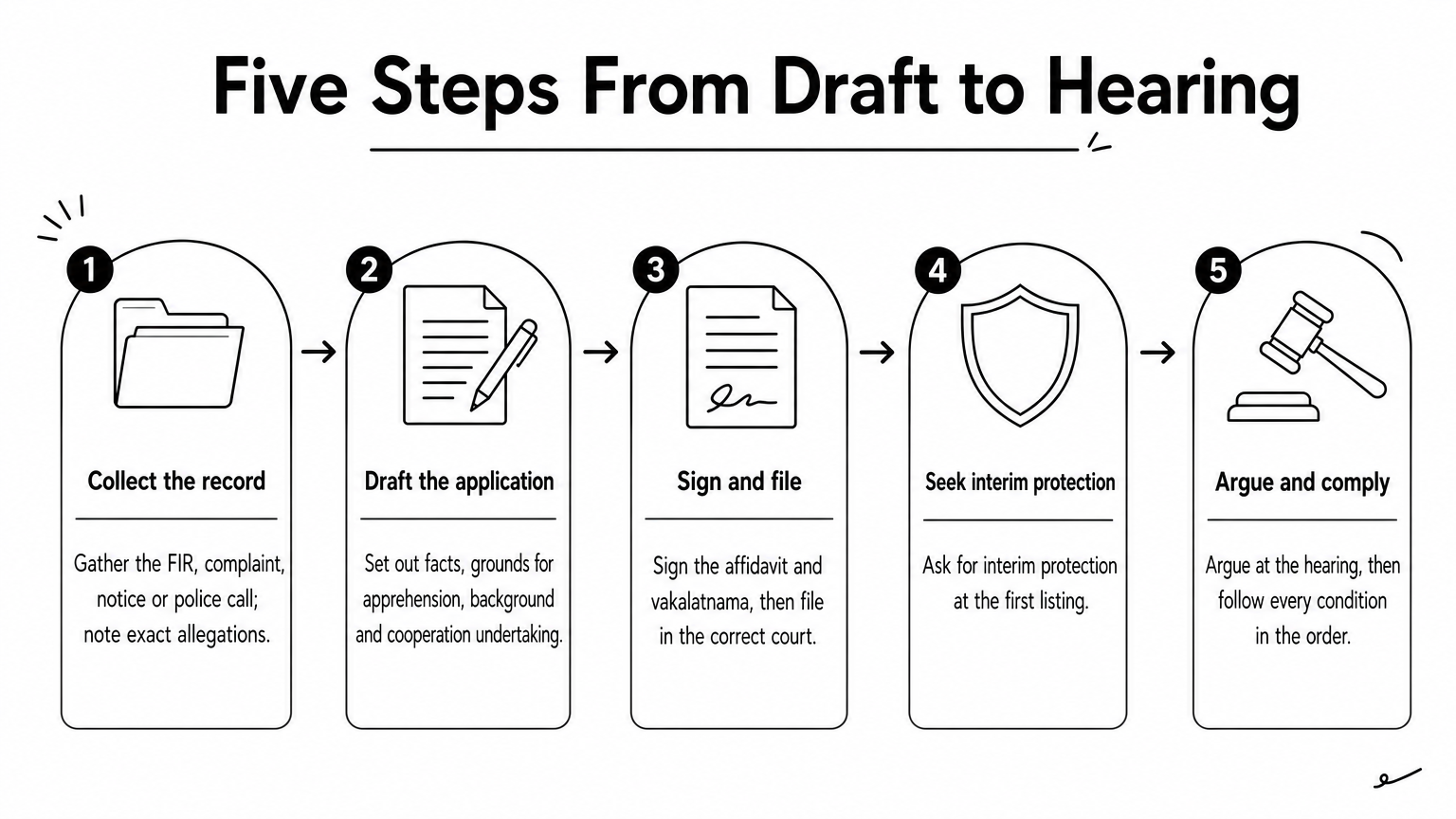
Steps from draft to hearing
- Collect the FIR or complaint, or any notice or call from the police, and note the exact allegations.
- Have the application drafted under Section 482 BNSS with the facts, the grounds for your apprehension, your background, and an undertaking to cooperate with the investigation.
- Sign the affidavit and vakalatnama, and file the application in the correct court.
- Ask for interim protection at the first listing, since the court may issue notice to the Public Prosecutor.
- Argue at the hearing. If you succeed, comply with every condition in the order.
A petition built on concrete facts, not general fear, is the one a court can act on.
Practical points before you file
Apply early, and do not wait for the arrest to be imminent. Be honest about any earlier cases, because a hidden record damages credibility. Because the order is limited to one specific case, a new FIR needs a new application.
At Adv. Bindu Dubey & Associates, you book a paid consultation of about an hour, in person at the CBD Belapur office or by phone. The advocate hears the full background and gives you a roadmap. Meetings are held by appointment from 10 am to 9 pm, Sunday to Saturday. The fee structure is shared with you, and drafting and filing begin once you pay in advance.
Getting protection before an arrest
Section 482 BNSS lets you ask a Sessions Court or the High Court for a direction that you be released on bail if arrested in a specific non-bailable case. You need a real reason to fear arrest and concrete facts, not an FIR. The court may attach conditions, and sexual offences against minors are excluded. The text is shorter than the old Section 438, but the Supreme Court’s guidance still shapes how it is applied.
This article is general information, not advice for your case. If you fear an arrest, speak to Adv. Bindu Dubey & Associates about your anticipatory bail application before the police act.