

Good Family Lawyer in India: 5 Options to Compare

When you search for a legal family lawyer, the best pick is an advocate who practises regularly in the court that will hear your case, shows a Bar Council enrollment number, and explains scope and fees before you pay. Five options cover most readers. A specialist firm such as Adv. Bindu Dubey & Associates suits disputes with a criminal edge and NRI cases. A solo family court advocate suits uncontested matters on a budget. An online directory suits anyone starting from zero. A personal referral suits readers who want a proven track record in one court. Free legal aid suits anyone who cannot afford fees.
Divorce, child custody, maintenance and domestic violence cases usually arrive at the worst moment, and every advocate’s website claims to be the best. You need a way to compare options on facts. This article walks through five realistic ways to hire a good family lawyer, with how each works, who it suits and what to watch for. It is written for readers in Navi Mumbai, Thane, Panvel and Mumbai, but the checks apply anywhere in India.
We practise family and criminal law from CBD Belapur, so we list ourselves first and say plainly where another option fits you better. Apply the same questions to us that you apply to everyone else.
1. Adv. Bindu Dubey & Associates, CBD Belapur
How it works
Adv. Bindu Dubey & Associates is a criminal and family law firm led by Adv. Bindu Dubey (LLM Gold Medalist). It handles divorce, mutual consent divorce, domestic violence, dowry cases, maintenance, alimony, child custody and property settlement. The firm appears in Family Courts, Sessions Courts, the Bombay High Court and the Supreme Court.
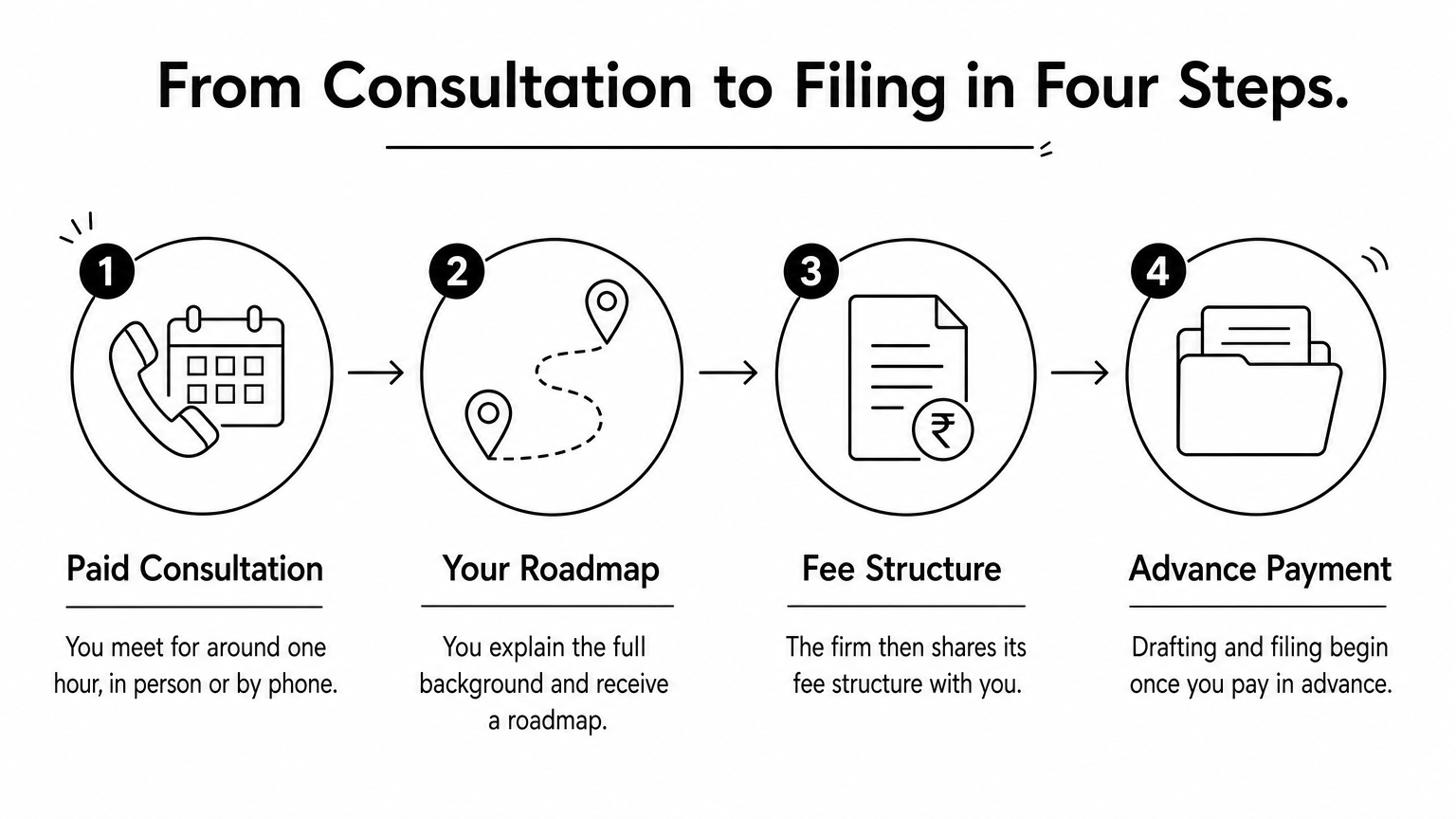
You start with a paid consultation of around one hour, in person or by phone. You explain the full background and receive a roadmap. The fee structure is then shared, and drafting and filing begin once you pay in advance.
Who it suits
This option suits readers whose family dispute may turn criminal, such as 498A dowry allegations, DV Act complaints or bail. One team can then handle both the family court file and the criminal file. It also suits NRIs, because the firm offers remote video consultations.
Take a mutual consent case as an example. A couple married four years agrees on maintenance and custody. The firm’s page puts a mutual consent divorce at 6 to 8 months, with a six-month cooling-off period that courts may waive in some cases. The couple must have completed one year of marriage.
If your family dispute could turn criminal, hire one team that can argue both files.
Cost and watch-outs
The firm publishes no flat fee, because it varies with complexity. Ask for a quote and the scope of each stage in writing. Meetings run Sunday to Saturday, 10 am to 9 pm, by prior appointment, and you can call +91 93232 32932. Clients speak directly with the advocate, so confirm who will appear on your hearing dates before you pay.
2. A solo family court advocate
How it works
A solo advocate works alone or with one junior. They draft your petition, appear at every hearing and usually charge per case or per stage. Family courts first push parties toward settlement or counselling, so pick someone who is comfortable negotiating as well as arguing.

Who it suits
This is the right choice for an uncontested mutual consent divorce, a simple maintenance application or a single custody petition where both parents broadly agree. You get one point of contact, and fees are often lower than at a larger firm. Choose it when your case is predictable and you want personal attention.
Cost and watch-outs
Fees vary widely, so ask whether the quoted amount covers all hearings or only some. Then ask the question that matters most: who appears if you are in another court on my date? Also check which court has jurisdiction. A petition is generally filed where the marriage took place, where you last lived together, or where the other spouse lives. Finally, ask for the enrollment number and verify it with the State Bar Council.
Ask who appears on hearing day, because availability matters more than reputation.
3. An online lawyer directory
How it works
Directories list advocates by city and practice area, with ratings, years of experience and sometimes a call-back option. Filter for family law, your locality and your language. Then read the reviews for detail. A review that describes communication, timelines and the outcome tells you more than "very good lawyer." A rating from 90 reviews also carries more weight than one from five.

Who it suits
Directories suit you if you have no contacts, live far from the court or are comparing firms from abroad. They work as a research step, not a hiring step. Use one to build a shortlist of three, then speak to each advocate yourself.
Cost and watch-outs
Browsing is usually free, though some platforms charge for call-backs or pass your enquiry to several advocates. Check whether the ranking reflects reviews or paid placement. Confirm that the person who phones you is the advocate and not a sales executive. Verify enrollment numbers independently, because a directory profile is not a credential.
A directory gives you a shortlist, never a verdict.
4. A referral from someone you trust
How it works
Ask anyone who has been through a divorce or custody case in the same court you will attend. Advocates you already know from property or criminal matters can also refer you to a family colleague. A district bar association can point you to practising members. The referral should name the advocate and say what the case involved.
Who it suits
Referrals suit sensitive cases and readers who want a track record in a specific court. Custody is a good example. Ask whether the advocate has handled custody petitions for a child of a similar age and whether the matter was settled or fully contested. A family lawyer who has won contested divorces is not automatically the best fit for a quiet mutual consent filing.
Cost and watch-outs
A referral does not change the fee, and you should still ask for the same written scope. Remember that the referrer’s case was not yours. Their facts, spouse and judge differed. Meet two or three advocates before deciding, even when the first referral feels certain.
A referral tells you about one client’s case, and only a consultation tells you about yours.
5. Free legal aid through the DLSA
How it works
Under the Legal Services Authorities Act, 1987, each district has a District Legal Services Authority (DLSA) that provides free legal services through panel advocates. Eligible groups include women, children and people below an income limit set by the state. The NALSA helpline, 15100, can direct you to the right office.
Who it suits
This option suits women seeking maintenance or custody, and anyone who genuinely cannot afford a private advocate. It is also a sound fallback if your finances change mid-case. Carry identity proof, income proof and every document connected to your dispute.
Cost and watch-outs
The service is free for eligible applicants, but you are assigned an advocate rather than choosing one. Panel advocates often carry heavy caseloads, so expect less time per hearing. For a complex contested matter, some people use legal aid first and then add private counsel for the hardest stage.
Legal aid removes the cost barrier, but it cannot give you a choice of lawyer.
Picking the right advocate and moving forward
The right family lawyer is the one whose practice matches your case, whose enrollment you have verified and whose fee and scope are in writing. A specialist firm, a solo advocate, a directory shortlist, a referral and free legal aid each have a place depending on your budget and how contested your dispute is. Meet at least two advocates, ask who will appear at each hearing, and decide only after you understand the roadmap.
If you want a first opinion on divorce, custody, maintenance or a domestic violence matter, you can book a consultation with Adv. Bindu Dubey & Associates in person, by phone or by video.