

Contested Divorce Procedure in India: How to File and Fight
The contested divorce procedure in India has six stages. You plead a legal ground in a petition, file it in the right family court, get summons served on your spouse, answer the reply and interim claims, prove your case through evidence and cross-examination, and receive a decree after final arguments. Expect roughly two to five years. Your case will rest on documents and a provable ground, not on how bad the marriage felt.
Most people reach a lawyer after months of fighting at home. They do not know which ground fits their facts, which court has jurisdiction, or which papers matter. Small errors, such as filing in the wrong court, pleading vague cruelty, or ignoring a summons, can cost a year or more. A spouse who opposes the case can also use every adjournment available.
At Adv. Bindu Dubey & Associates, we are a family law firm in CBD Belapur and we appear in family courts across Navi Mumbai, Thane and Mumbai. This guide covers who can file, the grounds, the documents, each step from petition to decree, and a realistic timeline. It is general information, so have a lawyer check it against your own facts.
What a contested divorce is and who can file
A contested divorce is one where a spouse asks the family court for a decree on a legal ground and the other spouse opposes it, so the judge decides after hearing evidence. In a mutual consent case under Section 13B, both spouses agree and the court mostly checks the settlement. In a contested case, you must prove a ground with evidence.
Grounds you can plead
For Hindus, Buddhists, Jains and Sikhs, Section 13 of the Hindu Marriage Act, 1955 lists the grounds. Choose the one your evidence can carry:
- Adultery
- Cruelty, physical or mental
- Desertion for at least two continuous years immediately before filing
- Conversion to another religion
- Incurable unsound mind, or a mental disorder that makes living together unreasonable
- Communicable venereal disease
- Renunciation of the world
- Not heard of as alive for seven years
A wife has a few extra grounds under Section 13(2), such as the husband being guilty of rape, sodomy or bestiality. Other communities follow their own laws: the Special Marriage Act, the Indian Divorce Act, the Parsi Marriage and Divorce Act, or the Dissolution of Muslim Marriages Act. Irretrievable breakdown is not a statutory ground under the Hindu Marriage Act. The Supreme Court has used Article 142 to grant divorces on that basis, but you cannot plan a case around it.
Where and when you can file
Section 14 bars a petition in the first year of marriage unless you show exceptional hardship or depravity. Under Section 19, you can file where the marriage took place, where your spouse lives, or where you last lived together. A wife can also file where she lives now.
Say the marriage took place in Mumbai, the husband lives in Vashi and the wife lives in Panvel. She can file in the family court that covers Panvel. He can file where his wife lives or where they last stayed together. Depending on the facts, that means the family court at Bandra, Thane or Navi Mumbai.
A contested divorce is won on a ground you can prove, not on how difficult the marriage was.
Step 1. Collect documents and draft the petition
Start by gathering papers that prove the marriage, the ground and the finances. Then have your lawyer draft a petition that states facts with dates, not general complaints.
Documents to collect
Organize the papers by purpose, because each category answers a different question the court will ask:
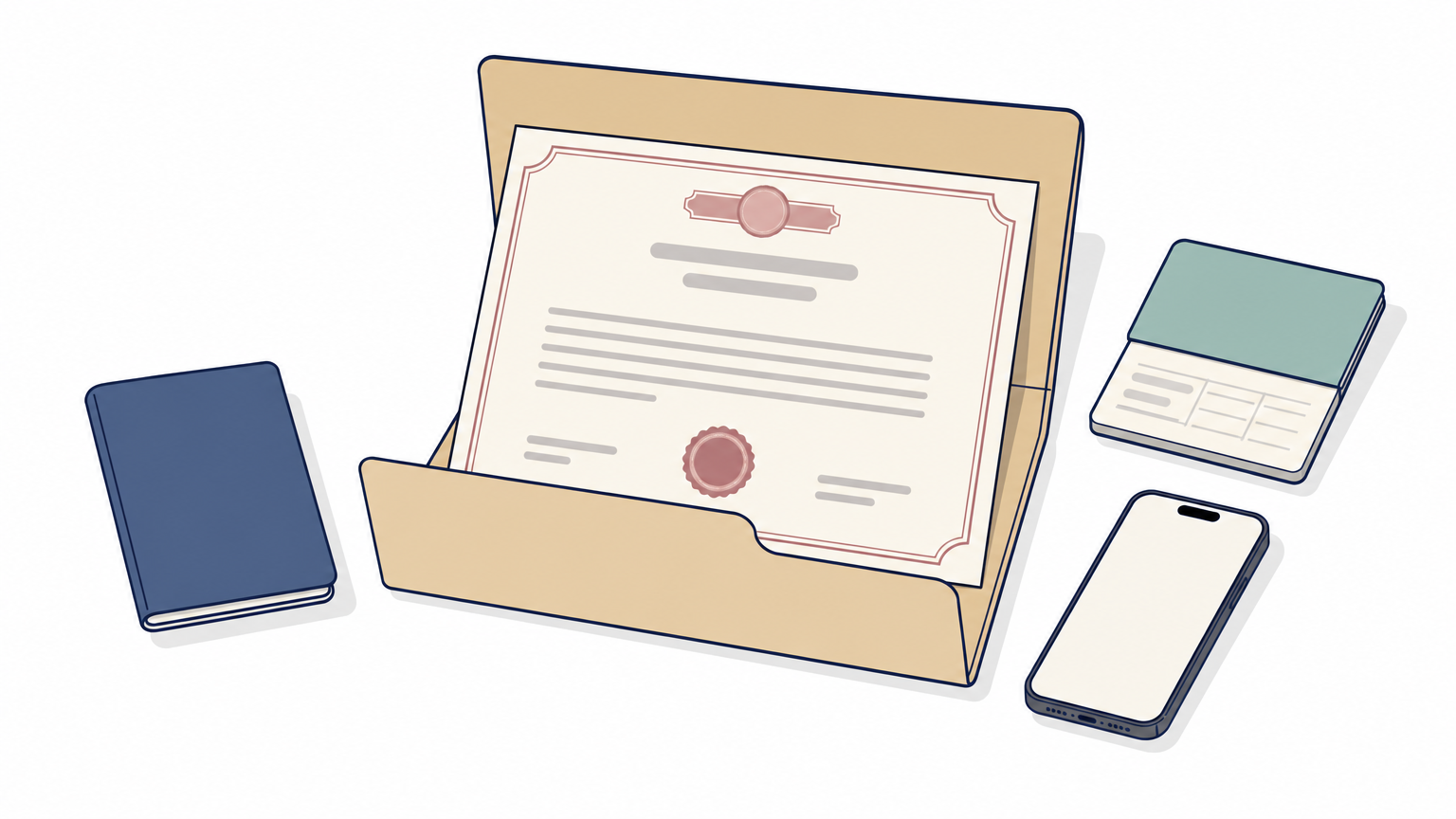
- Marriage: registration certificate, wedding photographs, invitation card
- Identity and address: Aadhaar, PAN and passport of both spouses, plus current address proof
- The ground: medical records, police complaints, messages, emails, call logs, photographs
- Money: three years of income tax returns, salary slips, bank statements, property papers, loan statements
- Children: birth certificates and school records
- Separation: proof of the date you began living apart
Electronic evidence such as WhatsApp chats needs a certificate under Section 63 of the Bharatiya Sakshya Adhiniyam. Keep original devices safe. Do not delete anything, even messages that look unhelpful.
Drafting the petition
A good petition has numbered paragraphs covering the marriage details, the history of living together, the children, each incident supporting the ground with dates, the court’s jurisdiction, and the reliefs you want. Reliefs usually include the decree, custody and maintenance or alimony. You sign a verification affidavit, so write only what you can defend under cross-examination.
At our firm, the first step is a paid consultation of about an hour. We hear the full background and give you a roadmap. We then share the fee structure, and drafting and filing begin once the advance is paid.
Every line in your petition is a line the other side’s lawyer will cross-examine you on.
Step 2. File the petition and get it served
File the signed petition, affidavit, vakalatnama and documents with the registry of the family court that has jurisdiction, and pay the court fee. The court then registers the case and issues summons to your spouse.
Filing at the registry
The registry scrutinizes the papers and lists objections, such as a missing annexure or an unsigned page. Cure these quickly, because the case gets a number and a first date only after scrutiny is cleared. Keep a complete set of copies for yourself. Missing documents are the most common reason a first date slips.
Summons, service and first hearing
Summons go through the court, registered post or email. If your spouse dodges service, you can ask for substituted service, such as a newspaper publication. If they do not appear after valid service, the court can proceed ex parte and hear your evidence alone.
Under Section 9 of the Family Courts Act, the court must first try to settle the matter, so it often refers you both to a counsellor. Attend every session. Counselling rarely saves the marriage, but your conduct is on record, and it can open a path to settlement on custody and money.
A spouse who avoids summons only delays the case, because valid service lets the court move ahead without them.
Step 3. Reply, interim relief and evidence
After service, your spouse files a written statement, usually within 30 days, extendable up to 90 under the Code of Civil Procedure. The court then frames issues, decides interim applications, and both sides lead evidence.
Written statement and interim relief
The written statement answers your allegations paragraph by paragraph, and it may include a counterclaim for divorce. In parallel, either spouse can apply under Section 24 of the Hindu Marriage Act for interim maintenance and litigation expenses if their income is not enough. Section 26 covers interim custody and visitation. Courts also expect both sides to file an affidavit of assets and liabilities.
If you are the husband, expect your wife to claim maintenance and sometimes to file a Domestic Violence Act complaint or a Section 85 BNS (earlier Section 498A) case. These run in separate courts, so plan one strategy across all of them.
Evidence and cross-examination
Each side files an affidavit of evidence in place of oral examination-in-chief, marks its documents as exhibits, and brings any witnesses. Then the opposing lawyer cross-examines. This stage takes the longest, because hearings are spaced weeks apart.

Prepare for cross-examination by rereading your petition and affidavit until they match. Answer only what is asked, keep answers short, and never exaggerate. A contradiction between your petition and your testimony hurts more than a weak fact.
Cross-examination decides most contested divorces, so prepare for it from the day you file.
Step 4. Final hearing, decree and appeal
Once evidence closes, both lawyers argue, and the judge decides whether you proved the ground. If you did, the court passes a decree dissolving the marriage along with orders on alimony and custody.
Judgment, alimony and appeal
Section 25 allows permanent alimony as a lump sum or monthly payment, based on income, assets, conduct and the standard of living during the marriage. Either side can appeal to the High Court within 30 days under Section 28. Under Section 15, neither spouse should remarry until the appeal period has passed or the appeal is decided.
How long a contested divorce takes
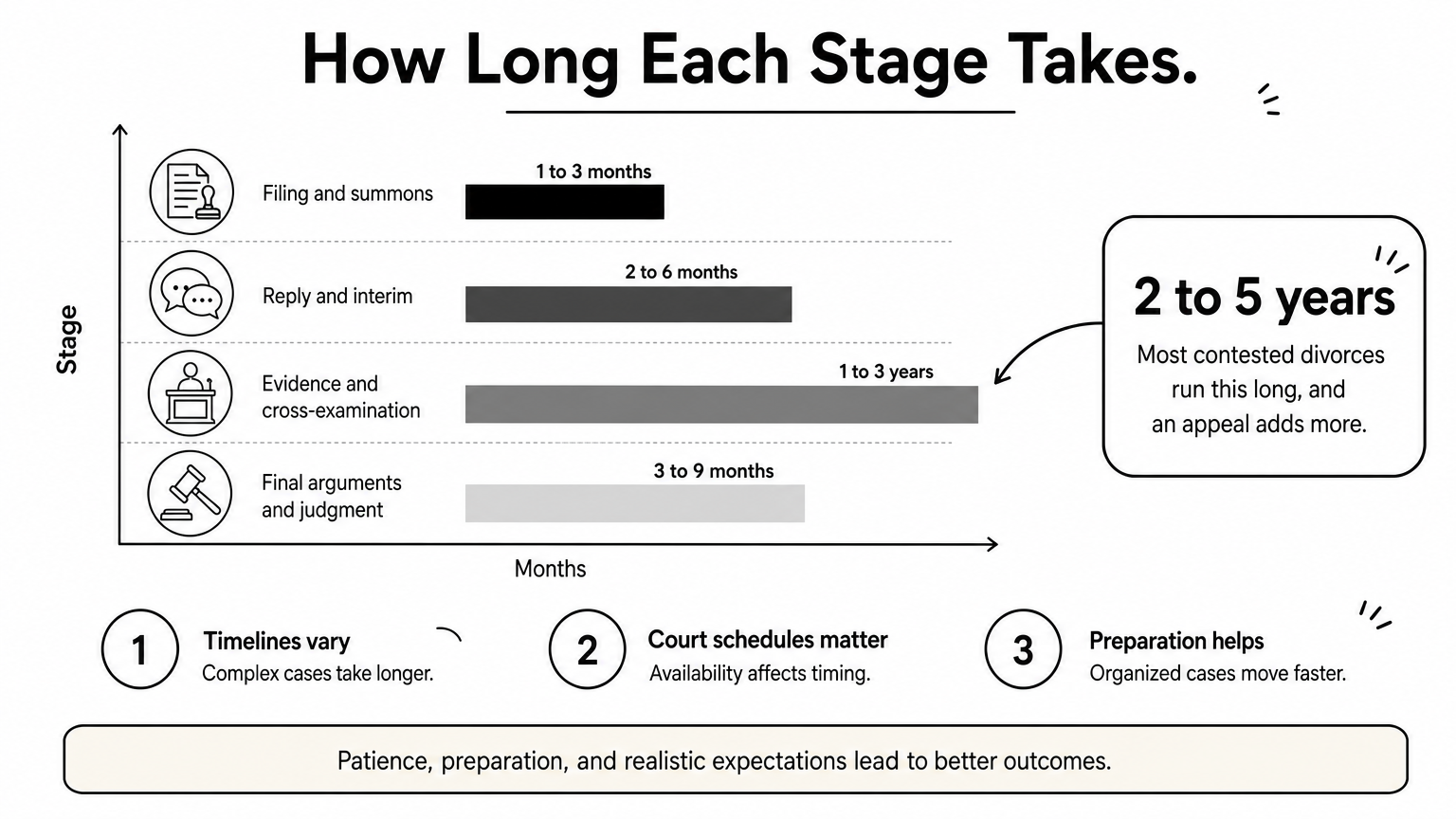
Most contested divorces run two to five years, and an appeal adds more. These stage estimates are indicative, because stages overlap and adjournments change them:
| Stage | Typical time |
|---|---|
| Filing, summons and counselling | 1 to 3 months |
| Written statement and interim applications | 2 to 6 months |
| Evidence and cross-examination | 1 to 3 years |
| Final arguments and judgment | 3 to 9 months |
If you file in January 2027, a decree between 2029 and 2032 is a reasonable expectation. A mutual consent divorce, by comparison, can finish within about 6 to 8 months, so consider whether a negotiated exit is possible before you commit to a trial.
Plan for years, not months, and spend the early weeks building evidence that will still hold up in year three.
Starting your case with a plan
A contested divorce follows a fixed path. Check your ground, collect your documents, file in the right family court, handle summons and counselling, fight the interim claims, prove your case in evidence, and argue for the decree. Each step goes better when the petition was careful in the first place.
If you are in Navi Mumbai, Panvel, Thane or Mumbai and want a roadmap for your own facts, you can book a consultation with Adv. Bindu Dubey by phone, WhatsApp or at our CBD Belapur office.