

What Is a Review Petition in High Court? Grounds and Format
A review petition in High Court is an application asking the same High Court to re-examine its own judgment or order because of a specific flaw. The flaw can be an error apparent on the face of the record, new and important evidence that you could not produce earlier, or another sufficient reason. In civil and writ matters you generally have 30 days from the date of the order to file. It is not a second appeal, and it is usually decided by the same bench that passed the order.
Courts guard the finality of their judgments, so a review petition is a narrow remedy. Most fail because the petitioner tries to re-argue the case instead of pointing to a clear mistake. Knowing the exact grounds, the limit and the format decides whether your petition is even considered.
This article explains why the remedy matters, which grounds the court accepts, how to file step by step, what the format looks like (with a template), and how likely success is. It is written from the practice of Adv. Bindu Dubey & Associates, which appears before the Bombay High Court.
Why a review petition matters before you file
A review petition matters because it is the only way to ask the same court to correct its own mistake without going up to the Supreme Court. Used correctly, it can save you months. Used as a second chance to argue, it wastes court time and your fees.
A narrow remedy, not a second appeal
The High Court is a court of record, and the civil power to review sits in Section 114 and Order XLVII of the Code of Civil Procedure (CPC). The Supreme Court has repeatedly held that a review is not an appeal in disguise. The error must be self-evident on the record, one that you can point to without a long chain of reasoning. If you need to argue that the court took a wrong view of the law or the facts, that is the job of an appeal or a Special Leave Petition.

A review petition fixes a visible mistake in the order. It does not give you a second hearing on the merits.
Where the power exists: civil, writ and criminal orders
Whether you can seek review at all depends on the kind of order you want reviewed.
| Type of order | Source of the power | What the court can do |
|---|---|---|
| Civil judgment or order | Section 114 and Order XLVII Rule 1, CPC | Review on the three grounds |
| Writ judgment under Article 226 | High Court as a court of record (Article 215), applying Order XLVII principles | Review on the same grounds |
| Criminal judgment or order | Section 403 of the BNSS (earlier Section 362 CrPC) | Correct clerical or arithmetical errors only |
The criminal bar is strict. If a High Court has decided a criminal appeal, revision or bail matter, you generally cannot ask it to rethink the outcome. Your remedies lie elsewhere, usually before the Supreme Court.
Grounds and time limit for a review petition
The court accepts a review only on the grounds in Order XLVII Rule 1 CPC, and only if you file within 30 days of the order. Miss either test and the petition fails before the court looks at the merits.
The three grounds under Order XLVII Rule 1
| Ground | What it means | Example |
|---|---|---|
| New and important matter or evidence | Something that existed but was not known to you, or could not be produced despite due diligence | A registered document that surfaced after the hearing |
| Mistake or error apparent on the face of the record | A plain error visible from the record itself | The order records a wrong date, ignores a document already on file, or overlooks a binding Supreme Court ruling |
| Any other sufficient reason | A catch-all that courts read as similar to the first two grounds | A party was never served, yet the order treats it as heard |
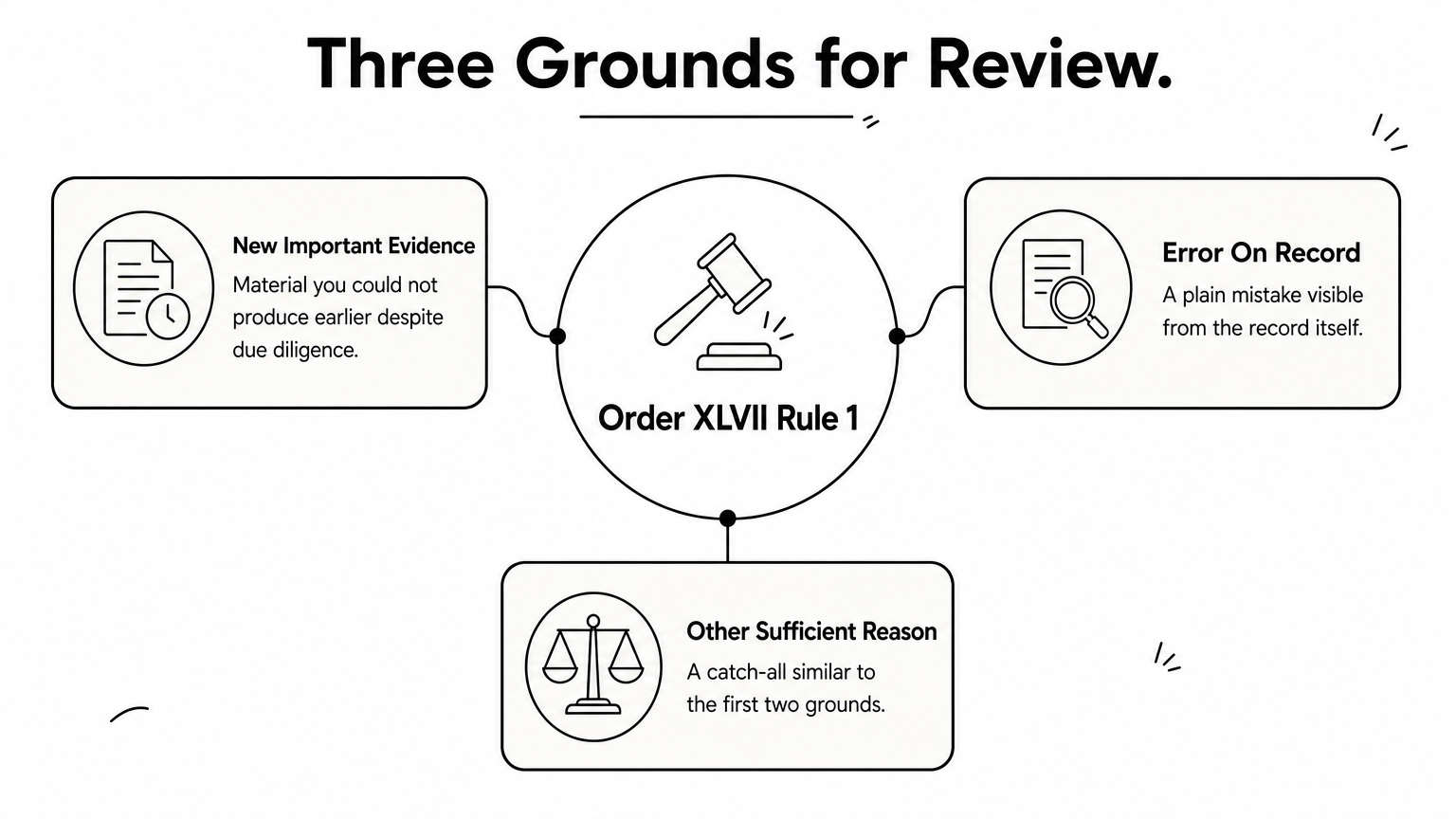
On the first ground, you must prove due diligence, which means explaining why the material was not before the court earlier. For the second, your petition should quote the paragraph of the judgment and the page of the record that shows the error.
The 30-day limit and who can apply
Article 124 of the Limitation Act, 1963 sets 30 days from the date of the decree or order. The time spent obtaining the certified copy is excluded, so apply for the copy on the day the order is pronounced. If you are late, you must file an application showing sufficient cause for the delay. Courts do not grant condonation as a matter of routine.
Two more points trip people up. You can file only if you have not appealed against the same order, so choose your route deliberately. And under Order XLVII Rule 9, you cannot seek review of an order passed on review.
Count your 30 days from the date of the order and file well before the last day.
How to file a review petition in High Court, step by step
You file by drafting a petition with a supporting affidavit, lodging it in the High Court registry with the certified copy of the order, and waiting for the same bench to decide whether to issue notice. The steps below follow that order.
The filing steps
- Apply for the certified copy of the judgment immediately and read it line by line for the error.
- Choose your remedy. Decide whether review, appeal or a Special Leave Petition fits your complaint. Do not file them casually in parallel.
- Draft the petition and affidavit. State the ground, the paragraph that shows the error, and the relief you want.
- File in the registry as your High Court’s rules require, with court fee, certified copy, vakalatnama and, if you are late, a delay condonation application.
- Cure registry objections. The registry scrutinises the papers, and defects must be fixed before the matter is listed.
- Attend the listing. The petition goes before the same judges who passed the order.
What happens after you file
Many review petitions are first considered by circulation in chambers without oral arguments. Under Order XLVII Rule 4, if the court finds no sufficient ground, it rejects the petition. If it finds a ground, it issues notice to the opposite party, hears both sides and then decides whether to review. If review is granted, the court rehears the matter or corrects the order as needed. Rejection of a review is not appealable under the CPC.
Format of a review petition in High Court
A review petition follows the usual High Court petition structure: cause title, heading, facts, grounds, prayer, verification and affidavit. Each High Court’s own rules decide the numbering, paper size, margins and number of copies, so check those rules before you finalise the draft.

The parts of the petition
Include these parts in this order:
- Cause title and heading, naming the court, the side (original or appellate), the review petition number and the number of the case under review.
- Parties, in the same order and description as in the original case.
- Synopsis and list of dates, if your High Court requires them.
- Delay condonation application, where the 30 days have passed.
- Facts relevant to the error, kept short.
- Grounds for review, each tied to Order XLVII Rule 1.
- Prayer, asking for review and recall or modification of the order.
- Verification and supporting affidavit, with annexures including the certified copy of the order.
A template you can adapt
IN THE HIGH COURT OF JUDICATURE AT [PLACE]
[ORIGINAL / APPELLATE] SIDE

REVIEW PETITION NO. ____ OF 20__
IN [WRIT PETITION / APPEAL / SUIT] NO. ____ OF 20__

[Name], [description] ........ Petitioner
        VERSUS
[Name], [description] ........ Respondent

REVIEW PETITION UNDER ORDER XLVII RULE 1 READ WITH SECTION 114 OF THE CPC
[OR: UNDER ARTICLE 226 / ARTICLE 215 OF THE CONSTITUTION OF INDIA]
SEEKING REVIEW OF THE JUDGMENT AND ORDER DATED __/__/20__

1. The petitioner seeks review of the order dated __/__/20__ passed by this Hon'ble Court.
2. Facts: [short, dated, numbered paragraphs]
3. Grounds:
   (a) There is an error apparent on the face of the record at paragraph __ of the order, because [state the error in one or two lines].
   (b) [New and important evidence, with reasons it could not be produced earlier despite due diligence.]
4. The petition is filed within limitation. [Or: There is a delay of __ days, explained in the accompanying application.]

PRAYER
(a) Review and recall/modify the order dated __/__/20__;
(b) Pass any other order the Court deems fit.

Place: ____        Advocate for the Petitioner
Date: ____

[Verification and supporting affidavit follow]
Keep each ground to the error itself, with the paragraph and page numbers. A petition that runs to many pages of argument signals that you are arguing the case again.
Name the error, cite the paragraph, ask for the correction, and stop.
Success rate of a review petition and what comes next
The success rate of a review petition in High Court is low. The reason is structural: the court is asked to find fault with its own decision on narrow grounds. I am not aware of any reliable official figure for High Courts, so treat any precise percentage you read online with caution.
Why most petitions are dismissed
Courts dismiss most review petitions at the first stage. The usual reasons are re-arguing the merits, relying on a view of the law that merely differs from the court’s, or filing outside the 30 days without a good explanation. Petitions that pass the first stage typically show a clear record error, such as a binding precedent that was cited but overlooked, a document already on file that was not considered, or an order passed without hearing a party who was entitled to be heard.
What to do if the review fails
A dismissed review does not end your case. The usual next step is a Special Leave Petition under Article 136 before the Supreme Court against the original order. Do not assume that the review petition paused the clock for that filing. Have your lawyer calendar both timelines from the start. If the Supreme Court has already decided the matter with reasons, the High Court’s own order may have merged into that decision, and a High Court review is no longer available.
Before you file your review petition
A review petition in High Court works only when you can point to a plain error or genuinely new evidence, file within 30 days, and present it in the correct format without arguing the case again. For criminal orders the door is almost closed, and for everything else it is narrow.
Before you decide, get the certified copy and have a lawyer read the order against these grounds. If you have a High Court order in Maharashtra and want an honest view on whether review, appeal or a Special Leave Petition fits, you can speak to Adv. Bindu Dubey about your review petition. The consultation is paid and runs for around an hour, and it ends with a clear roadmap and fee structure.