

Mandamus Writ Petition: Meaning, When Issued, and Format
A mandamus writ petition asks a High Court or the Supreme Court to order a public authority to do something the law already requires it to do. "Mandamus" is Latin for "we command". The court does not tell the authority how to decide. It orders the authority to act, for instance to decide a pending application, follow a statutory rule, or obey a binding order.
In India you file this kind of writ petition under Article 226 of the Constitution in a High Court, or under Article 32 in the Supreme Court when a fundamental right is violated. The petition must show your legal right, the authority’s duty, and its failure to perform that duty. This article explains why the remedy matters, when courts grant it, the format a petition for a writ of mandamus follows, how to file it, and the mistakes that get it dismissed.
Adv. Bindu Dubey & Associates handles writ petitions before the Bombay High Court as part of its criminal law practice from Navi Mumbai. The guidance below reflects how these petitions are drafted in practice, so you can judge whether your problem fits the remedy before you spend money on one.
Why a mandamus petition matters and when courts grant it
A writ of mandamus petition matters because it is often the fastest way to make a government body do what the law already demands. Courts grant it when you have a legal right, the authority has a matching public duty, and it has failed to perform that duty.
What the writ does for you
A civil suit against a government department can take years. A writ petition goes straight to the High Court, which can list urgent matters quickly and pass interim directions while the case is pending. That speed is the main reason people choose it.

The writ enforces a duty that already exists. It fits situations such as an authority sitting on your application beyond the time the statute allows, refusing a benefit the rules clearly give you, or ignoring a government order or court judgment.
Mandamus enforces a duty that already exists; it never creates a right.
The tests a court applies
Before issuing the writ, the court checks five things. Your petition must address each one.
| Test | What you must show |
|---|---|
| Legal right | You personally have a right under a statute, rule or the Constitution |
| Public duty | The respondent is a public authority with a mandatory, not optional, duty |
| Demand and refusal | You asked in writing and the authority refused or ignored you |
| No better remedy | No equally effective alternative exists, such as a statutory appeal |
| Fair timing | You came to court without unexplained delay |
A demand can be skipped when it would plainly be futile. The alternative remedy rule is one of discretion, so a court may still hear you if the authority acted without jurisdiction or violated a fundamental right. Courts generally refuse mandamus against a private party in a private dispute, to force a discretionary decision one way, to enforce a purely contractual promise, or to direct a legislature to make a law.
Prove the right, the duty and the refusal, and the rest of the petition follows.
Mandamus writ petition format and how to draft it
A writ petition for mandamus follows a fixed sequence: cause title, synopsis and dates, facts, grounds, prayer, then verification and annexures. Formatting rules differ between High Courts, so check the rules of your court before you print.
Parts of the petition in order
- Cause title. The court’s name, "Writ Petition No. ___ of 2026", the line "Petition under Article 226 of the Constitution of India", and the names and addresses of petitioner and respondents.
- Synopsis and list of dates. A one-page summary and a dated chronology of events.
- Memo of parties. Each respondent’s designation and address.
- Facts. Numbered paragraphs in chronological order, each pointing to an annexure.
- Grounds. Separate lettered paragraphs (A, B, C) giving the legal reasons: your right, the duty, the demand, the refusal and the lack of an alternative remedy.
- Statements on jurisdiction. Why this court can hear the matter, and that no similar petition is pending or was earlier filed.
- Prayer. The exact relief you want.
- Verification and affidavit. Signed by the petitioner, with the advocate’s signature on the petition.
- Annexures and index. Page-numbered documents, plus the vakalatnama.

Keep facts and grounds apart. Facts say what happened. Grounds argue why the law required the authority to act. Petitions that blend the two are harder for a judge to read quickly.
A template you can adapt
Use this skeleton and replace the bracketed text.
IN THE HIGH COURT OF JUDICATURE AT [CITY]
[Jurisdiction as required by the court's rules]

WRIT PETITION NO. ____ OF 2026

[Name, address], ...Petitioner
VERSUS
1. [Authority], through [officer], ...Respondent No. 1
2. [Authority], through [officer], ...Respondent No. 2

PETITION UNDER ARTICLE 226 OF THE CONSTITUTION OF INDIA
SEEKING A WRIT OF MANDAMUS

FACTS: 1. ... 2. ... 3. ...
GROUNDS: A. Because the Petitioner has a legal right under [law/rule]...
         B. Because Respondent No. 1 has a statutory duty to...
         C. Because the representation dated [date] was not decided...
         D. Because no equally efficacious alternative remedy exists...

PRAYER:
(a) Issue a writ of mandamus or any other appropriate writ, order or
    direction in the nature of mandamus, directing Respondent No. 1 to
    [specific act] within [four] weeks;
(b) Pending the petition, direct that [interim relief];
(c) Award costs of this petition;
(d) Pass any other order the Court deems fit.
The prayer decides what the court can order, so draft it with care. Name the specific act you want and a deadline for it. If you only need a decision on a pending application, ask for that decision, not for your preferred outcome.
A good prayer asks the court to order the authority to act, and names the act and the deadline.
How to file the petition and what happens next
You file the petition in the High Court that has territorial jurisdiction, or in the Supreme Court if a fundamental right is directly violated. For most people the High Court is the right first step.
High Court or Supreme Court
Article 226 lets a High Court issue writs to enforce fundamental rights and also for "any other purpose", such as a statutory duty. Article 32 lets the Supreme Court issue writs only to enforce fundamental rights, and it often expects you to approach the High Court first without a good reason not to.
The petition goes to the High Court within whose area the cause of action arose, wholly or partly, or where the authority sits. A dispute with an authority in Navi Mumbai, Thane or Mumbai will usually be filed in the Bombay High Court.
Filing steps and the hearing
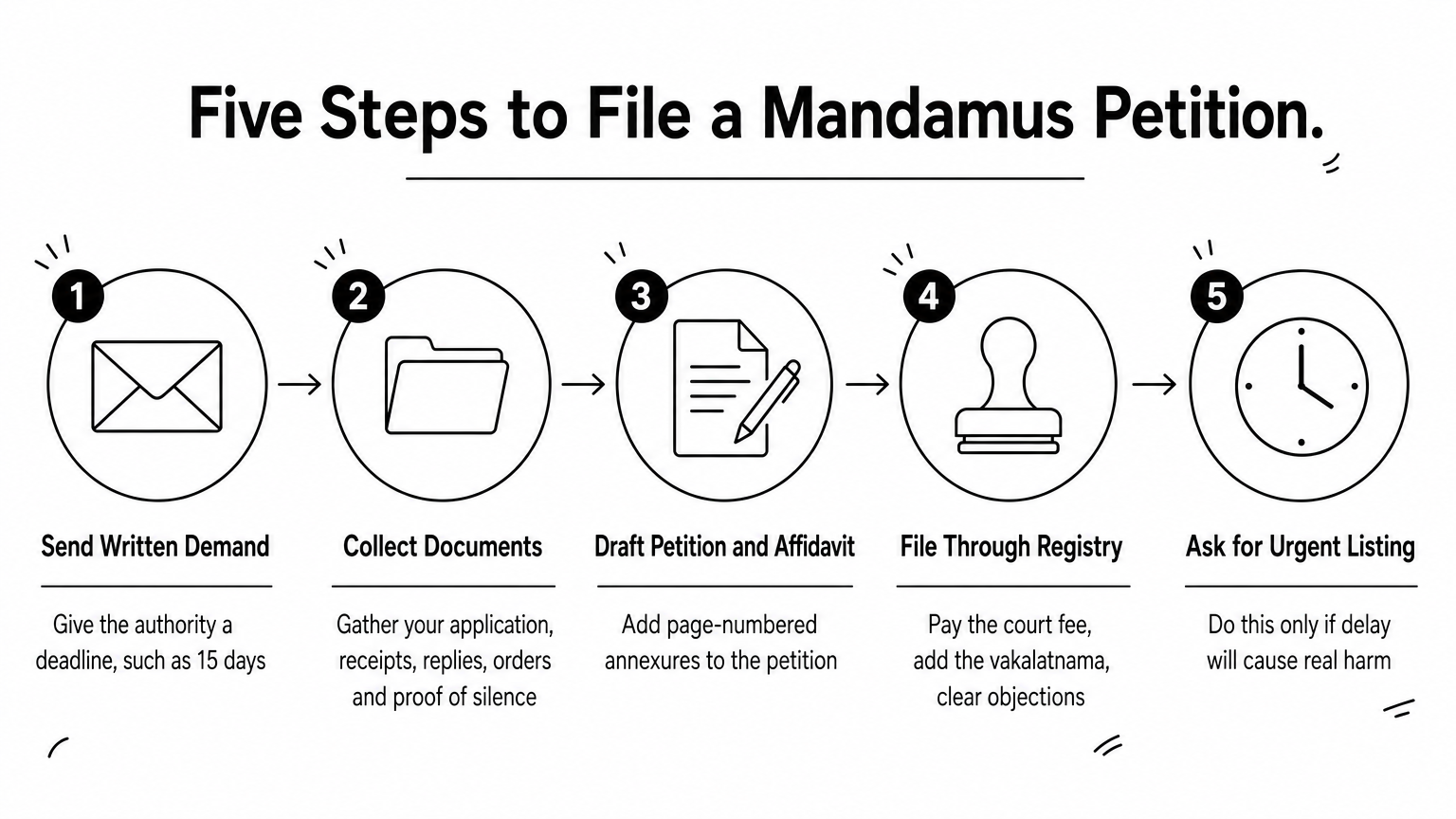
- Send a written representation or legal notice with a reasonable deadline, such as 15 days.
- Collect documents: your application, receipts, replies, orders and proof of the authority’s silence.
- Draft the petition and affidavit, with page-numbered annexures.
- File through the registry with the court fee and vakalatnama, and clear any objections the registry raises.
- Ask for urgent listing only if delay will cause real harm.
At the first hearing, the court either dismisses the petition at admission or admits it and issues notice to the respondents. They file a reply, and the court may grant interim relief. A final order often directs the authority to decide within a fixed period. A writ of mandamus does not guarantee that you win on the merits, because the authority can still reject your application by a reasoned order.
Send the written demand first; it is your proof that the authority had a chance to comply.
Mistakes that get a mandamus petition dismissed
Most dismissals trace back to a petition that sought the wrong relief, named the wrong respondent, or came too late. Each of these is avoidable at the drafting stage.
Wrong relief or wrong respondent
- Asking the court to dictate how a discretion is used, rather than to make the authority decide.
- Suing a private person or company in a private dispute with no public duty involved.
- Seeking to enforce a plain contract, which belongs in a civil suit.
- Raising heavily disputed facts that need witnesses and cross-examination.
Courts exercising writ jurisdiction do not hold trials. If your case depends on proving who is telling the truth, a civil or criminal forum fits better.
Delay and incomplete records
There is no fixed statutory limit for a writ petition, but unexplained delay can defeat it. Explain every gap in your chronology. Attach the demand letter and the authority’s reply, or proof that it never replied.
Disclose every material fact, including those that hurt you. A petitioner who hides important facts can be refused relief on that ground alone.
Disclose every material fact, including the ones that hurt; suppression alone can end the petition.
Your next step with a mandamus petition
A petition for writ of mandamus works when you can show a legal right, a public duty and a refusal, and when the prayer asks for one clear act. Follow the format above, send the demand first, and file without delay. This article is general information, not advice on your facts.
If an authority is ignoring a duty it owes you, discuss your writ petition with Adv. Bindu Dubey & Associates. The consultation lets you walk through your documents, test whether mandamus fits, and get a roadmap before anything is filed.