

Criminal Defense Lawyer Near Me: 6 Options and How to Pick
If you are searching for a criminal defense lawyer near me in Navi Mumbai, choose on four points. Look for regular practice in the court where your case sits, experience with your kind of offence, direct access to the advocate, and a fee explained before work starts. A firm with Belapur and High Court practice suits arrests and bail. A solo court advocate suits simple local matters, a specialist suits NDPS or cyber cases, and free legal aid suits anyone who cannot pay.
The real problem is speed. An arrest or an FIR leaves you hours, not weeks, to decide. Search results mix law firm pages, directory profiles with two or three ratings, and claims that everyone is the best. Nothing there tells you which type of lawyer matches your situation.
This article sets out six options, each explained the same way: how it works, who it suits, and what it costs or what to check. The first is our own firm, Adv. Bindu Dubey & Associates, a criminal and family law practice in CBD Belapur. We say plainly where the other five are the better fit.
1. Adv. Bindu Dubey & Associates in CBD Belapur
How it works

Adv. Bindu Dubey & Associates is a criminal and family law firm led by Adv. Bindu Dubey (LLM Gold Medalist), with a team of 15 lawyers. It works from offices in CBD Belapur, Navi Mumbai and Fort, Mumbai. The firm appears in the Belapur, Panvel, Thane and Alibaug courts, the Sessions Courts, the Bombay High Court and, in a few cases, the Supreme Court.
The work covers regular, anticipatory and interim bail, FIR filing and quashing, complaints, trials, appeals, writ petitions and NDPS cases. For bail, the firm’s own timelines are 1 to 3 days for minor offences and 1 to 2 weeks for major non-bailable offences in the Sessions or High Court. If a relative is arrested on a minor charge, plan for an answer within three days. For a serious non-bailable charge, plan for up to two weeks.
A defense lawyer earns their fee by reaching the right court quickly, not by listing the most courts.
Who it suits
This option suits people facing arrest, an FIR, or a need for anticipatory bail in fraud, cheating, rape, murder, NDPS, 498A and dowry cases. It also suits families whose dispute has both a family side and a criminal side. Clients speak directly with the advocate, with no middleman, and NRIs can use remote video consultations for matters in India.
Cost and what to check
The first consultation is paid and lasts about an hour. After hearing the full background, Adv. Bindu Dubey gives you a roadmap and shares the fee structure. Work starts after you pay in advance, and drafting and filing follow. Meetings run from 10 am to 9 pm, Sunday to Saturday, by prior appointment, and urgent consultation is available. Call +91 932 32 32 932 or send a WhatsApp message.
Before you commit to any firm, including this one, confirm three things:
- The scope of work for each stage, so you know what the fee covers.
- Who will appear on your hearing dates.
- The Google reviews the firm lists, which you can read yourself.
2. A solo advocate at your local court
How it works
A solo advocate practises daily at one court, such as Belapur, Panvel or Thane, and handles files personally. That daily presence means they know the registry staff, the hearing routine and how the bench treats bail applications. You usually meet at a chamber near the court, hand over the FIR copy and your papers, and the advocate appears on your dates.
The best local lawyer is the one who is physically at your court on the day your matter is called.
Who it suits
This option suits simple, contained matters: a bailable offence, a first bail application, a reply to a notice, or a first appearance after a complaint. It also suits you if you want one person who knows your file from start to finish. It is a weaker fit for a case likely to reach the High Court, or one with many accused and a long trial.
Cost and what to check
Fees depend on the offence, the court and the stage, so ask for the structure in writing. Put these questions before you hand over any papers:
- Who appears on your hearing date if the advocate is busy in another court?
- Is the fee for one appearance, one stage, or the whole case?
- Does the advocate also handle High Court work, or will you need to change lawyers later?
3. A specialist for your type of offence
How it works

Some advocates build their practice around one kind of offence, such as NDPS, cyber crime, cheating and fraud, or 498A. They know the technical points that decide those cases. In NDPS matters, the defense often turns on whether investigators followed the mandatory search, seizure and sampling procedure, and bail in commercial quantity cases faces the stricter conditions of Section 37 of the NDPS Act. In cyber cases, the electronic evidence is the case.
Match the lawyer to the offence in your FIR, because the technical rules differ for each kind of case.
Who it suits
This option suits you when the FIR names the NDPS Act or the IT Act, or when the allegation is technical, such as financial fraud or forgery. Ask which code applies. Since 1 July 2024, new FIRs are registered under the Bharatiya Nyaya Sanhita and the Bharatiya Nagarik Suraksha Sanhita, while older cases continue under the IPC and CrPC. Anticipatory bail, once Section 438 CrPC, is now Section 482 of the BNSS. A good specialist cites the correct code from the first call.
Cost and what to check
Ask how many cases of your type the lawyer has argued at your current stage, whether bail, discharge or trial, and in which court. Specialists often quote by stage, so ask for that breakdown. Be wary of any lawyer who guarantees an outcome. No honest criminal lawyer can promise a verdict or a bail order.
4. High Court counsel for appeals and quashing
How it works
When a matter outgrows the Sessions Court, it moves to the Bombay High Court. Counsel who practise there file criminal appeals against convictions, petitions to quash an FIR or complaint under the High Court’s inherent powers, bail applications after the Sessions Court refuses, and writ petitions. Hearings follow the High Court’s listing, so a lawyer who knows how to seek urgent listing matters.
A refusal in the Sessions Court is a stage in your case, not the end of it.
Who it suits
This option suits three kinds of reader. The first has been convicted and wants to appeal. The second believes an FIR is false or a civil dispute dressed up as a criminal one. The third has been refused bail in the Sessions Court. Appeal time limits are strict, so contact counsel soon after the judgment rather than after the family has finished deciding.
Cost and what to check
High Court work involves longer drafting, certified copies and listing effort, so expect a fee structure by stage. Ask whether the named counsel will argue the matter or a junior will. Ask whether they have handled your type of petition before. Gather these papers first so the first meeting is productive:
- The FIR and the charge sheet, if filed.
- Every bail order and the lower court judgment.
- Notices, summons and remand papers.
5. Online lawyer directories
How it works
Online directories list advocates by locality, such as Nerul, Vashi, Kharghar and Belapur. Each profile shows practice areas, years of experience and ratings, and lets you call or send an enquiry. They are useful for seeing many names quickly.
Their weakness is thin evidence. Many profiles carry only a handful of ratings, so a 4.9 can rest on two or three reviews. A profile also tells you little about the offence types the lawyer has actually argued.
A directory gives you names to call, not proof that a lawyer is right for your case.
Who it suits
Directories suit you when nobody has been arrested yet and you have time to call three or four advocates and compare. They also help early in a dispute, when you want to understand what lawyers charge and how they talk about your offence. They suit an urgent arrest far less, because enquiry forms can mean a delay of hours.
Cost and what to check
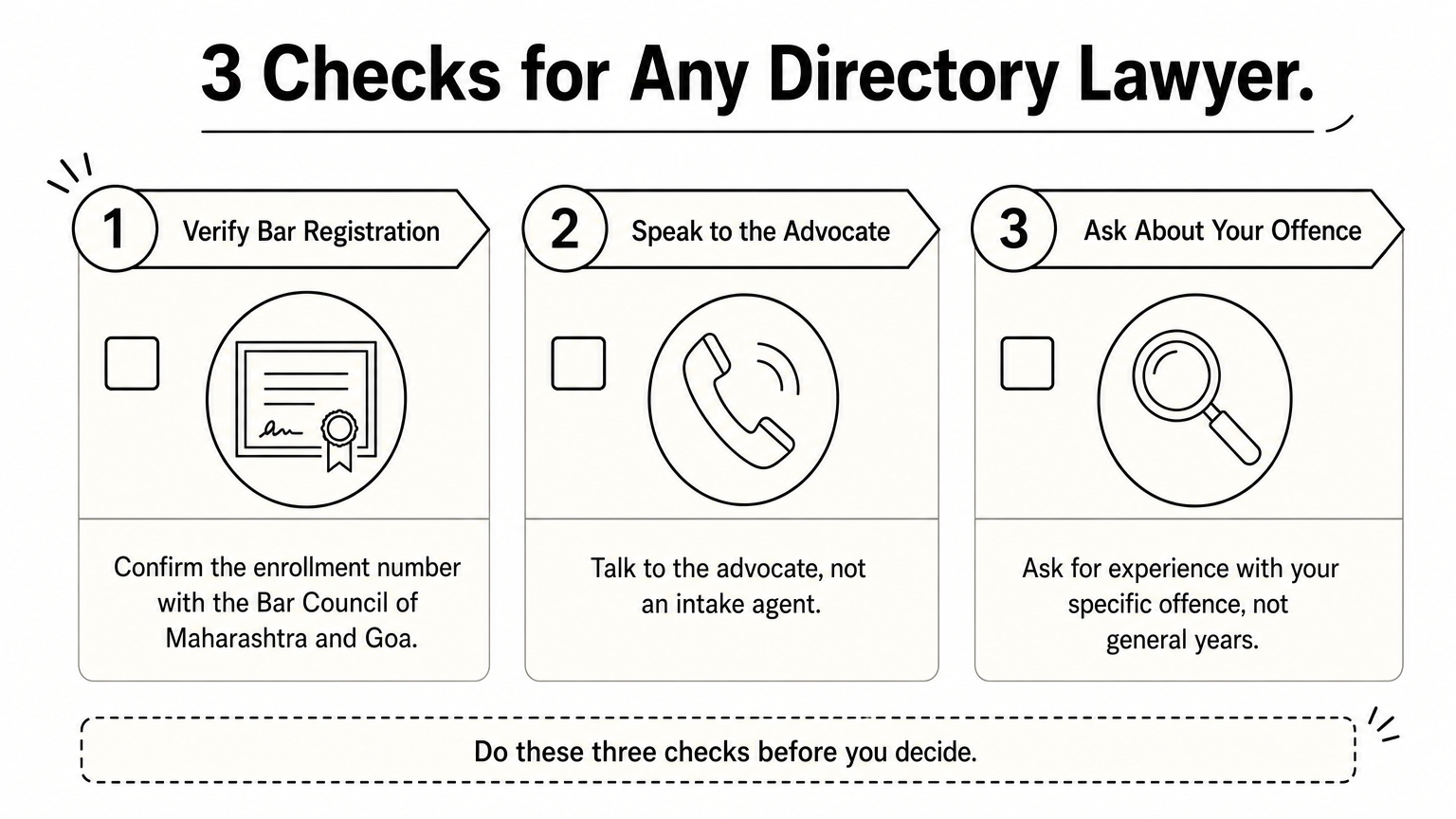
Browsing and viewing contact details is usually free, and the fee is agreed with the lawyer directly. Check the basics yourself:
- Ask for the advocate’s enrollment number and confirm registration with the Bar Council of Maharashtra and Goa.
- Speak to the advocate, not an intake agent.
- Ask for experience with your specific offence, not general years in practice.
6. Free legal aid through the district authority
How it works
Article 22(1) of the Constitution gives every arrested person the right to consult and be defended by a lawyer. Under the Legal Services Authorities Act, 1987, eligible people get a lawyer free through the District Legal Services Authority or the legal services committee at the court. Eligible groups include persons in custody, women, children, members of Scheduled Castes and Scheduled Tribes, and people below the state’s income ceiling. You can ask the magistrate when you are first produced, or approach the legal services office at the court.
If you cannot pay, the law still gives you a lawyer, so never go unrepresented.
Who it suits
This option suits anyone who cannot afford a private lawyer, especially a person in custody with no family nearby. In a sessions trial, the court must also provide an advocate at state expense to an accused who cannot engage one. It fits less well if you want to choose your lawyer or need senior counsel on a complex case, because panel lawyers are assigned to you.
Cost and what to check
The service is free for eligible persons. Carry proof of eligibility, such as an income or caste certificate where relevant. Ask for the assigned lawyer’s name and phone number, and meet them before the hearing, not at the courtroom door. If help is not responsive, raise it with the legal services authority rather than waiting.
Choosing the lawyer to call first
The right choice depends on your situation. A firm with court reach suits arrests and bail. A solo advocate suits simple local matters, a specialist suits technical offences, and High Court counsel suits appeals and quashing. Directories help you compare when you have time, and legal aid ensures that no one faces a charge alone. Whoever you pick, confirm who appears in court, what each stage costs, and that you can speak to the advocate directly.
If you are in Navi Mumbai, Thane, Panvel, Raigad or Mumbai and need to act now, talk to Adv. Bindu Dubey & Associates about your case. Bring your FIR, notices and any court orders, and you will leave the first consultation with a clear roadmap.