

How to File a Domestic Violence Case in India: 4 Steps
To file a domestic violence case in India, you apply to a Magistrate under Section 12 of the Protection of Women from Domestic Violence Act, 2005 (PWDVA). You can reach the Magistrate through a Protection Officer, the police, a lawyer, or directly. A Domestic Incident Report records what happened. Your application then asks for protection, a right to stay in your home, financial support, or custody of your children. If you are in danger right now, call 112 first and deal with the paperwork afterwards.
Many women get stuck before the first step. One office says go to court, another says go to the police, and nobody explains the difference between an FIR and a Domestic Incident Report. Evidence feels thin, and fear of the husband’s family makes waiting feel safer. It is not. Early filing protects you and gives the court a clean record to work from.
This guide first explains who can file and against whom. It then walks through four steps: gathering evidence, choosing where to file, filing the application, and securing interim orders. It reflects how these matters run in the Magistrate courts of Navi Mumbai, Thane, Panvel and Mumbai, where Adv. Bindu Dubey & Associates practises family and criminal law. It is general information, not advice on your particular case.
Who can file a domestic violence case and against whom
Any woman who is or has been in a domestic relationship with the person who abused her can file under the PWDVA. That covers wives, live-in partners, mothers, sisters and daughters who share or once shared a household with the abuser.
Who counts as an aggrieved person
The Act calls the woman who files the "aggrieved person". Marriage is not required. A live-in relationship that resembles marriage in stability and shared living is covered, following the Supreme Court’s ruling in Indra Sarma v. V.K.V. Sarma (2013). You do not need to own the house either. A tenant or a woman living in a joint family home can still claim a right to stay there.
A Protection Officer or another person can file on your behalf, and a child under 18 is protected too. Nobody has to wait for an injury. Even a threat of violence qualifies.
A domestic relationship plus abuse, or the threat of it, is enough to file. You do not need an injury or a divorce.
Who you can file against
You can file against your husband or male partner and against his relatives, including in-laws. After the Supreme Court’s 2016 decision in Hiral P. Harsora v. Kusum Narottamdas Harsora, women relatives such as a mother-in-law or sister-in-law can also be named as respondents.
If you want to file a domestic violence case against your husband, you do not need to file for divorce. The case does not end your marriage. It only asks the court to protect you.
What counts as domestic violence
The definition is wide. The Act covers:
- Physical abuse: hitting, pushing, choking, or any act that hurts you.
- Sexual abuse: forced sex or any sexual act that humiliates you.
- Verbal and emotional abuse: insults, taunts about having no son, threats, or being thrown out.
- Economic abuse: denying food, money or your stridhan, or stopping you from working.
- Dowry harassment: unlawful demands for property or money from you or your family.
Step 1. Gather evidence and documents
Collect whatever shows the abuse and your relationship with the respondent, and start with what you already have. Perfect proof is not required. Abuse happens behind closed doors, and the court decides on probabilities, not proof beyond reasonable doubt.

What to collect
| What to collect | What it proves |
|---|---|
| Marriage certificate, wedding photos or invitation card | The domestic relationship. For live-in couples, use joint address proof, ration card or utility bills |
| Dated photos of injuries or damaged property | Physical harm |
| Hospital records, discharge summary, medico-legal certificate | Injuries and how they were caused |
| Messages, emails, call recordings, social media posts | Threats, insults, dowry demands |
| Husband’s salary slips, your bank statements, household expenses | Your claim for monetary relief |
| Names and numbers of people who saw or heard the abuse | Corroboration |
How to record and protect your proof
Keep a diary with the date, time, place, what was said or done, and who witnessed it. Tell a trusted relative or friend about each incident when it happens. That answers the later question of why you stayed silent.
If you are hurt, go to a hospital, tell the doctor the injury came from domestic violence, and ask for a written record. Store copies outside your phone, such as in a personal email or with a trusted person, because abusers often delete or seize devices. Also keep copies of identity documents, your children’s school records and a list of your stridhan.
Start with what you have. A dated diary, a few photos and one witness are better than waiting for perfect proof.
Step 2. Choose where to file
You can begin with a Protection Officer, the police, a helpline, a lawyer or the Magistrate directly. These routes do not compete with each other. Every one of them leads to the Magistrate’s court for the final protection orders.
Five ways in
| Route | What it does | Best when |
|---|---|---|
| Protection Officer | Prepares the Domestic Incident Report, helps you file, arranges shelter and medical help, free of charge | You want the PWDVA route with official help. Each district has one |
| Police station | Registers an FIR for cruelty, or prepares a Domestic Incident Report | You are in danger or injured, or want criminal action |
| Magistrate court, through a lawyer | Files your Section 12 application with the report attached | Other offices are slow, or you want speed |
| Helplines: 112, 181, NCW 14490 | Emergency response, counselling, referral, a National Commission for Women complaint | You need help now or are unsure where to start |
| Lawyer | Drafts the report, application and affidavit, and appears for you | You also want maintenance, residence or custody orders |
To find your district’s Protection Officer, ask the state Women and Child Development Department or the District Collector’s office.
FIR or Domestic Incident Report
These are two separate tracks. A Domestic Incident Report (DIR) is the document for relief under the PWDVA, such as protection, residence and money. An FIR starts a criminal case, for example for cruelty by a husband or his relatives under Section 85 of the Bharatiya Nyaya Sanhita (the provision that replaced Section 498A of the IPC), and it can lead to investigation and arrest.
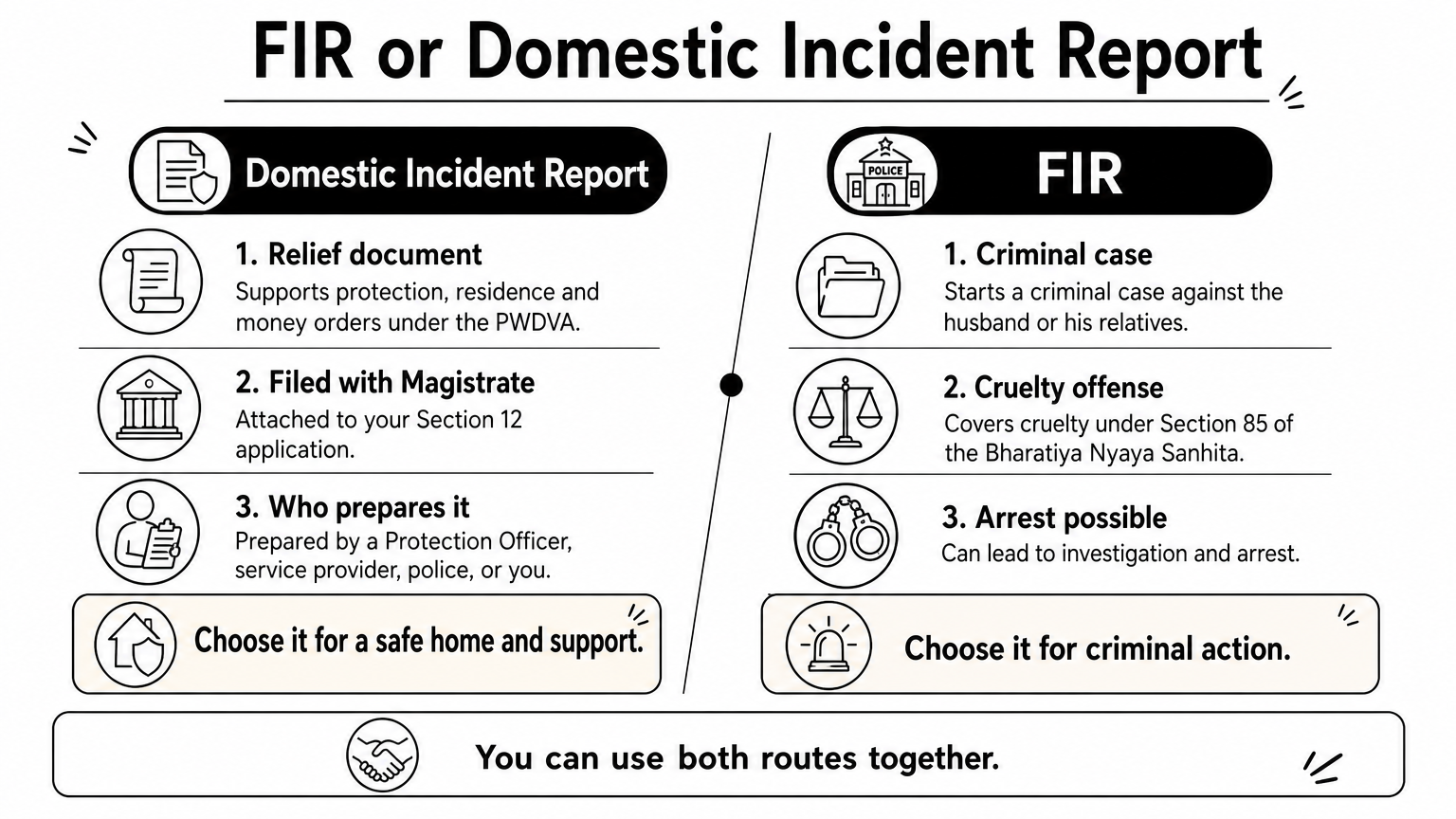
You can use both. Choose the FIR when you want criminal action. Choose the DIR route when your priority is a safe home and financial support.
If the police or officer refuses to help
A refusal does not close the door. For a criminal complaint, send a written complaint to the Superintendent of Police, and if that fails, ask the Magistrate to direct the police to register it. For a PWDVA case, you can approach the Magistrate directly with your own report.
A lawyer can draft the written complaint with the correct sections, which makes refusal harder.
No refusal at a police station or Protection Officer’s office ends your case. The Magistrate can always be approached directly.
Step 3. File the application before the Magistrate
File a written application under Section 12 of the PWDVA before the Judicial Magistrate First Class, or the Metropolitan Magistrate in Mumbai. Attach the Domestic Incident Report, an affidavit and your documents.

What the application contains
Your application should include:
- Your details and the respondent’s details, and your relationship.
- The shared household and how long you lived there.
- Each incident of abuse, in date order.
- The reliefs you want, such as protection, residence, maintenance, custody or compensation.
- The DIR from a Protection Officer, service provider or police, or your own.
- Your affidavit and the Step 1 documents, with a list of them.
Ask for interim relief in the application itself. Do not leave it for a later hearing. A Protection Officer helps with the paperwork at no charge. If you hire a lawyer, a good first meeting should end with a clear roadmap and fee structure. At Adv. Bindu Dubey & Associates, the paid consultation of about an hour covers this before any drafting begins.
Which court hears your case
Under Section 27 of the Act, you can file where you live or work, where the respondent lives or works, or where the abuse took place. If you moved to your parents’ home in Panvel, you can file at the Magistrate court covering Panvel instead of returning to your husband’s area. The same applies across Navi Mumbai, Thane, Raigad and Mumbai.
What happens after you file
The Magistrate fixes the first hearing within 3 days under Section 12(4), and the notice goes to the respondent. The Act aims to decide the application within 60 days of that first hearing under Section 12(5). In practice, cases usually run longer. That is why interim orders matter so much.
Step 4. Get interim orders and follow the case through
Ask for interim relief at the first or second hearing. Under Section 23, the Magistrate can pass interim orders, and even orders without hearing the respondent, if satisfied that violence has happened or is likely.
Orders the court can pass
| Order | Section | What you get |
|---|---|---|
| Protection order | 18 | The respondent must stop violence and contact, and stay away from your workplace or your child’s school |
| Residence order | 19 | You can stay in the shared household and cannot be evicted, or you get alternate accommodation |
| Monetary relief | 20 | Medical costs, lost earnings, property loss and maintenance for you and your children |
| Custody order | 21 | Temporary custody of your children |
| Compensation order | 22 | Compensation for mental torture and emotional distress |
The Magistrate decides how much money to award, so bring salary slips and bank statements. Permanent custody needs a separate case under other laws.
How long it takes in practice
The law’s 60 days is rarely met. In our experience, interim orders typically arrive within 3 to 6 months, and the final order takes longer. Use that period well. Attend every hearing, because missed dates weaken your case. If the court sends both sides to counselling under Section 14, you can still continue the case if counselling does not help.
After the order is passed
Disobeying a protection order is punishable with up to 1 year in jail, a fine of up to Rs 20,000, or both under Section 31. Report any breach to the Protection Officer, the police and your lawyer immediately. An order passed in one state is enforceable across India.
Make a safety plan alongside the case. Pack documents and some cash, tell a trusted person where you are going, and ask the Protection Officer about shelter homes.
The order protects you only if you enforce it. Report every breach and keep your lawyer informed.
Start with one safe step
Filing a domestic violence case comes down to four steps. Gather what proves the abuse, pick an entry point, file a Section 12 application with the Domestic Incident Report, and ask for interim orders at once. You do not need to be sure of everything before you begin. A Protection Officer, a helpline or a lawyer can fill the gaps.
If you want a lawyer to draft the report and application and appear for you in the Magistrate court, you can speak with Adv. Bindu Dubey & Associates by phone or WhatsApp. Meetings run on prior appointment, and every consultation is confidential. Whatever you decide, do not stay silent in an unsafe home. Call 112 if you are in danger.