

Format of Application for Withdrawal of Writ Petition
The format of application for withdrawal of writ petition is short and follows a fixed shape. You file it under the cause title of your own petition, state who you are and why you no longer want to proceed, and pray for permission to withdraw. If you may want to return to court later, you ask for "liberty to file afresh" in the same prayer. Your advocate signs it, you support it with an affidavit, and the bench records the permission in its order.
Most petitioners treat withdrawal as a harmless exit. It is not. A petition withdrawn without liberty can bar a fresh writ on the same cause of action, and any interim protection ends the day the petition is disposed of. A missing affidavit or a wrong cause title can also trigger Registry objections and delay your listing when time matters.
This guide takes you through the process in five steps, with an application and an affidavit you can adapt. It follows Bombay High Court practice, where litigants from Navi Mumbai, Panvel, Thane and Raigad file, and the same structure works in other High Courts once you change the cause title. It is general information, not advice on your specific file, so have your advocate check the final draft against your orders.
Why a writ withdrawal needs a proper application
What the application does
A withdrawal application asks the High Court for permission to end your own petition and tells the court what you want kept open afterwards. Once a writ petition under Article 226 is registered, it forms part of the court’s record. You cannot simply stop attending. A petition left unattended may be dismissed for default, which leaves a poorer record than a clean withdrawal.
The application does three jobs. It identifies the petition, gives a short and truthful reason, and states the exact permission you want. The third job matters most, because the order that follows is the only document that decides what you can do later.
Why liberty decides what you can do next
Under Order XXIII Rule 1 of the Code of Civil Procedure, a plaintiff who withdraws a suit without permission cannot file a fresh suit on the same subject matter. The Code does not strictly govern writ petitions. Even so, in Sarguja Transport Service v. State Transport Appellate Tribunal (1987) 1 SCC 5, the Supreme Court applied the same principle to writs on grounds of public policy. A petitioner who withdraws without liberty to file afresh cannot file a second writ on the same cause of action. The aim is to stop litigants from withdrawing when a bench looks unfavourable and trying again before another one.
Withdrawal is not a decision on merits, so it does not work like a final judgment. Other remedies, such as a statutory appeal or a civil suit, are not automatically closed. Whether they remain open depends on your facts and on limitation, so ask your advocate before you file.
An unconditional withdrawal can bar a fresh writ on the same cause of action, so ask for liberty in writing if you may need it.
When withdrawing makes sense
Withdrawal is the right move when the petition has served its purpose or is no longer the best route. Common situations are:
- The dispute has been settled and the grievance no longer survives.
- The authority has withdrawn or corrected the impugned order after you filed.
- A statutory appeal, tribunal or civil court is a better forum.
- The petition has a curable defect, such as a missing party or missing documents.
- Facts have changed so much that you want to file a fresh petition with new pleadings.
Withdrawal is the wrong move when your only motive is a bench that seems unreceptive. Courts do notice that pattern, and they can refuse permission or impose costs. Public interest petitions get even closer scrutiny, because the court may not allow a petitioner to walk away from a matter raising public issues.
Step 1. Decide which kind of withdrawal you need
Pick the type of permission
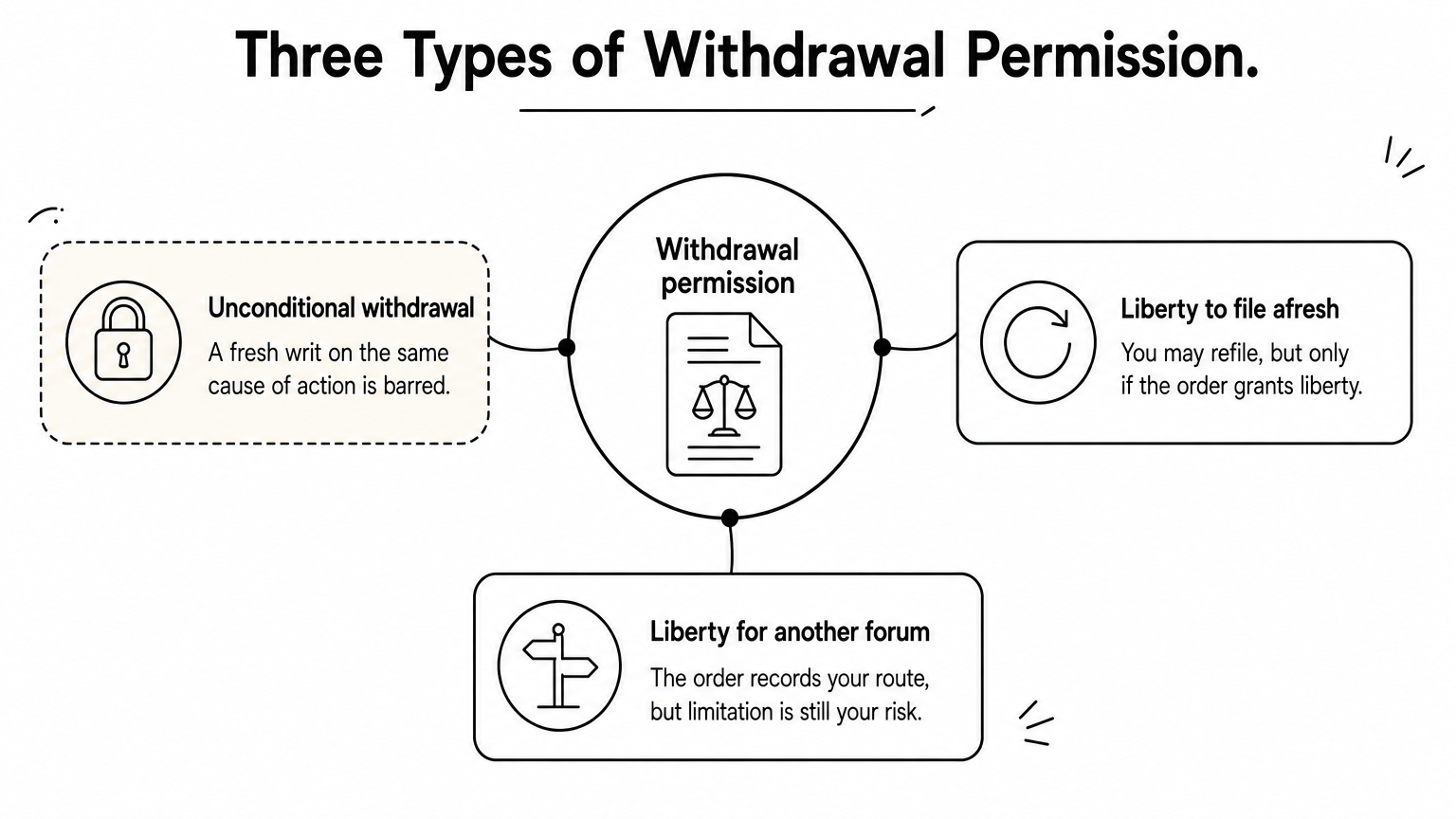
You have three choices, and the wording of your prayer follows from the choice. Pick before you draft, because the prayer clause is the heart of the application.
| Type of withdrawal | Prayer wording | Use it when | Effect |
|---|---|---|---|
| Unconditional | "permit the Petitioner to withdraw the petition and dispose of it as withdrawn" | The dispute is settled, relief is received, or you do not wish to pursue it | A fresh writ on the same cause of action is barred |
| With liberty to file afresh | "…with liberty to file a fresh petition on the same cause of action" | A curable defect, a missing party or document, or new facts to plead | You may refile, but only if the order grants liberty |
| With liberty to approach another forum | "…with liberty to approach the [tribunal / authority / civil court]" | A statutory or alternative remedy suits you better | The order records your route, but limitation is still your risk |
Two quick examples show the choice. Suppose a petitioner from Panvel challenged a municipal order, and the corporation cancelled that order after hearing. The grievance is gone, so an unconditional withdrawal is enough. Now suppose you named the wrong authority as respondent. You want liberty to file afresh, so the corrected petition is not met with an objection that you already used your writ.
Check interim orders and the respondents’ position
Before you decide, read your last order. Interim protection ends when the petition is disposed of. If the court had stayed an order, restrained coercive action or protected you from eviction, that shield disappears on withdrawal. In a criminal writ seeking to quash an FIR, withdrawal means the FIR continues. So settle and document everything first, and plan your next step before you give up the interim order.
Also note whether the respondents have been served, have appeared or have filed a reply. If they have, they may object or ask for costs. An advance copy of your application to their advocate, or to the Government Pleader where the State is a party, reduces the chance of a surprise on the day.
Interim protection lapses the moment the petition is withdrawn, so line up your next step before you ask the court to let you go.
Step 2. Collect the details and the client’s consent
Gather the particulars the application needs
Keep one sheet with every detail the application will carry, so the draft takes minutes rather than hours. Collect these:

- Writ Petition number and year, and the exact cause title as it appears on the petition.
- The court, jurisdiction line and the bench or roster before which it is pending.
- The date of the last order and the date of the next listing.
- Names and advocates of all respondents, and whether notice has been served or a reply filed.
- Details of any interim order and whether it is still in force.
- Your reason for withdrawing, in two or three plain sentences.
- The permission you want: unconditional, with liberty, or with liberty to approach another forum.
- Your identity and address details for the affidavit, or the board resolution if the petitioner is a company or society.
Check that your vakalatnama is still valid for this petition. If a different advocate will file the application, a fresh vakalatnama may be needed.
Get the petitioner’s instruction in writing
Your advocate acts on your instructions, and the court treats a withdrawal by counsel as binding on you. Sign a short written instruction that says you want to withdraw, why, and that you understand whether liberty is being sought. This protects you and your advocate if anyone later disputes the decision.
Where there are several petitioners, check who is withdrawing. If only one petitioner withdraws, the application should say so, and the remaining petitioners continue. Where the petitioner is an organisation, the signatory needs written authority to withdraw, not just to file.
A withdrawal is binding on you once the bench records it, so give your written instruction before the hearing, not after.
Step 3. Draft the application and affidavit
The application format
Copy the cause title exactly as it appears on your petition. The version below follows the Bombay High Court pattern for a pending writ petition. Criminal writ petitions use the criminal jurisdiction line, and the Registry may direct a different interim application numbering, so adapt as needed.
IN THE HIGH COURT OF JUDICATURE AT BOMBAY
CIVIL APPELLATE JURISDICTION
INTERIM APPLICATION NO. ______ OF 20__
IN
WRIT PETITION NO. ______ OF 20__

[Full name of Petitioner] ...Applicant / Original Petitioner
        VERSUS
[Name of Respondent No. 1] and Others ...Respondents

APPLICATION FOR PERMISSION TO WITHDRAW THE WRIT PETITION

MAY IT PLEASE YOUR LORDSHIPS,

The Applicant above named most respectfully states as follows:

1. The Applicant is the Petitioner in the above Writ Petition, filed
   under Article 226 of the Constitution of India, challenging
   [brief description of the order or action challenged].

2. The Writ Petition was last listed on [date] before [Hon'ble Bench]
   and is next listed on [date]. Notice [has / has not] been served on
   the Respondents. [An interim order dated ____ is / is not in force.]

3. [State the reason in two or three sentences. For example: The
   dispute has been settled between the parties, and the grievance
   raised in the Writ Petition no longer survives.]

4. The Applicant does not wish to press the Writ Petition and seeks
   leave to withdraw it. The decision is voluntary and taken on the
   advice of the Applicant's advocate.

5. [Use ONE of these.]
   (a) The Applicant does not seek any liberty.
   (b) The Applicant seeks liberty to file a fresh petition on the same
       cause of action because [reason].
   (c) The Applicant seeks liberty to approach [authority / tribunal /
       court] for the same relief.

6. This application is made bona fide and in the interest of justice.
   No prejudice will be caused to the Respondents.

PRAYERS

The Applicant therefore prays that this Hon'ble Court may be pleased to:

(a) permit the Applicant to withdraw Writ Petition No. ____ of 20__
    and dispose of it as withdrawn;
(b) [with liberty to file a fresh petition on the same cause of action /
    with liberty to approach ______ for the same relief];
(c) pass such other and further orders as this Hon'ble Court deems fit.

Place: Mumbai
Date:

Advocate for the Applicant                    Applicant / Petitioner
The supporting affidavit
The affidavit confirms that the petitioner personally wants the withdrawal. Keep it short, and have it affirmed before the proper authority and stamped as the current rules require.
AFFIDAVIT IN SUPPORT OF THE APPLICATION

I, [name], aged ___ years, occupation ___, residing at [address],
do solemnly affirm and state as follows:

1. I am the Petitioner in the above Writ Petition and am competent to
   affirm this affidavit.
2. I have read the accompanying application. The statements in
   paragraphs 1 to ___ are true to my knowledge, and I believe them
   to be true.
3. I have instructed my advocate to withdraw the Writ Petition
   [without liberty / with liberty to ______]. I understand the
   effect of this withdrawal.

Solemnly affirmed at ______ on this ___ day of ______ 20__.

Before me,                                      Deponent
Drafting notes that prevent objections
State the reason neutrally and truthfully. Do not concede that your case was weak, and do not hide a settlement or an order that explains the withdrawal. The court expects a clear explanation, not an argument. Match the liberty wording in paragraph 5 to the wording in your prayer, because a mismatch gives the bench a reason to question you.
For other High Courts, change only the court name, the jurisdiction line and the numbering style, then follow that court’s filing rules. The numbered paragraphs, the reason, the liberty and the prayers stay the same.
The prayer clause is the part that matters, so draft it first and make the paragraphs above it justify it.
Step 4. File the application and mention it
File it with the Registry
If your petition is pending at the Bombay High Court’s principal seat, you file at the High Court in Mumbai, not at any court in Navi Mumbai, Panvel or Thane. Your advocate on record handles filing. Follow these steps:
- Sign the application and have the affidavit affirmed.
- Attach a copy of the last order and any interim order, plus a fresh vakalatnama if the advocate has changed.
- Prepare an index and paginate the bundle.
- E-file or file physically as the Registry’s current practice directions require. Confirm the format before you upload.
- Clear every Registry objection quickly. An objection left open keeps the application off the board.
- Give an advance copy to the respondents’ advocates.
Where the court allows counsel to make an oral statement of withdrawal at the hearing, the written application is still the safer route, especially if the respondents have appeared or an interim order is in force. Ask your advocate which route the roster bench follows.
Mention it and ask for the right words
The application is listed with your petition, or mentioned for listing if the matter is not on the board. How soon this happens depends on the cause list and the bench, so do not plan around a fixed date.
At the hearing, your advocate states the prayer in one sentence, for example: "The petitioner seeks leave to withdraw the petition with liberty to file afresh." Then ask that the order be dictated in open court with the liberty included. If the bench grants liberty orally, check that it is recorded in the order. An oral assurance does not bind anyone.
The bench’s written order is the only record of your liberty, so make sure the words are dictated in court.
Step 5. Check the order and plan the next move
Read the order line by line
When the order is uploaded, read it the same day. Check that it:
- Carries the correct petition number and party names.
- Says the petition is disposed of as withdrawn, with the liberty you asked for.
- States clearly what happens to any interim order.
- Mentions costs, if any, and the time to pay them.
If the court granted liberty in open court but the order leaves it out, move promptly. Your advocate can mention the matter to speak to the minutes, so the order reflects what was granted. Do not wait, because the longer the gap, the harder it is to correct. Keep a certified copy for later proceedings.
Act on the next remedy in time
Withdrawal does not stop the clock on your next remedy. If you were granted liberty to approach a tribunal, an appellate authority or a civil court, file there without delay. Ask your advocate whether Section 14 of the Limitation Act can exclude the time spent in the writ proceeding, because that depends on the facts.
If you refile a fresh petition with liberty, disclose the earlier petition and the order granting liberty. Hiding it invites a dismissal. A short list of mistakes to avoid:
- Withdrawing without written client instruction.
- Omitting the liberty wording from the prayer or the order.
- Forgetting that interim protection lapses.
- Refiling without disclosing the earlier petition.
- Waiting months before taking the next remedy.
Withdrawal ends the writ, not your deadlines, so start the next remedy as soon as the order is in your hands.
Withdraw with care, and keep liberty in writing
A withdrawal application is a short document, but it decides what you can do next. Pick the type of permission first, gather the case details and your written instruction, draft the application and affidavit, file and mention it, then check the order for the liberty you asked for. Each step protects you from the two costliest mistakes: losing the right to refile and losing interim protection by surprise.
If you want an advocate to review your draft or advise whether to withdraw at all, you can speak to Adv. Bindu Dubey about your writ petition. Bring your petition, the last order and any interim order to the consultation, so the advice rests on your actual papers.