

5 Divorce Advocate Options for Mutual and Contested Cases

The right divorce advocate practises family law every week in the court that will hear your case, puts fees and scope in writing, and matches your type of case. If your spouse agrees to part ways, a mutual consent specialist or a solo family court advocate is usually enough. If your spouse fights the petition, you need a trial lawyer who has run interim maintenance and custody applications. If money is tight, legal aid is a real route and not a last resort.
The problem is that most search results are directories with star ratings. A rating does not tell you whether an advocate has cross-examined a spouse in a contested trial or only filed joint petitions. It also does not tell you what the advocate charges or who will appear on your hearing date. A divorce is not the place to find out these things after you have paid.
This article compares five options for people in Navi Mumbai, Panvel and nearby courts: our own firm, a solo family court advocate, a contested divorce litigator, a mutual consent specialist and legal aid. Our firm, Adv. Bindu Dubey & Associates in CBD Belapur, is listed first. We are open about that, and the same checks apply to us. Each option covers how it works, who it suits and what to check before you hire.
1. Adv. Bindu Dubey & Associates in CBD Belapur
How it works
Adv. Bindu Dubey & Associates is a criminal and family law firm in CBD Belapur, led by Adv. Bindu Dubey (LLM Gold Medalist). It handles mutual consent divorce and contested divorce, maintenance, custody and the criminal side of family disputes. It appears in family courts, Sessions Courts, the Bombay High Court and the Supreme Court. You start with a paid consultation of about one hour, in person or by phone. You get a roadmap and the fee structure. Drafting and filing begin once you pay in advance.
A paid hour of full-background advice before any filing shows you early whether the strategy and the fees make sense.
- Meetings run by appointment from 10 am to 9 pm, seven days a week.
- You speak directly with the advocate, with no middleman.
- For mutual consent matters, the firm quotes 6 to 8 months, and the six-month cooling-off period may be waived in some cases.
- For domestic violence and dowry matters, the firm reports 300+ cases handled and interim orders in roughly 3 to 6 months.
Who it suits
This firm suits you if your divorce has a criminal or protection angle. That includes a 498A complaint against you or by you, a Domestic Violence Act application, or a bail issue linked to a family dispute. The same office handles both tracks, so you do not carry papers between two lawyers.
It also suits NRIs who cannot be in Navi Mumbai for hearings, because the firm offers remote video consultations. The firm has 94 Google reviews and an Excellent rating, but read them for the type of case you have.
What to check before you hire
Treat us like any other candidate and ask the same questions.
- Who will appear on each hearing date, Adv. Dubey or an associate?
- What is covered in the quoted fee, and what is billed per stage?
- What is a realistic timeline for your court and your case type?
You can book through WhatsApp or call +91 93232 32932.
2. A solo family court advocate near your court
How it works

A solo family court advocate runs your file personally. This person drafts the petition, files it, appears at every hearing and answers your calls. Many practise close to the court complex, so they know the registry staff, the usual hearing pace and the habits of each bench. Fees are usually lower than at a larger firm because there is less overhead.
With a solo advocate, the person who sells you the case should be the same person who argues it.
Who it suits
This option suits a straightforward, low-conflict case: a mutual consent petition, a simple maintenance claim, or a contested case with few assets and no children in dispute. It also suits you if you want one familiar face and a personal relationship.
It is a weaker fit if your case runs on several fronts at once. An example is a contested divorce, a DV complaint and a bail matter all moving in different courts. One person can then be stretched thin.
What to check before you hire
- Bar enrolment. Ask for the enrolment number with the Bar Council of Maharashtra & Goa.
- Family law volume. Ask how many matrimonial matters the advocate handles in a year.
- Substitutes. Ask who appears if your advocate is stuck in another court that day.
- Paper trail. Ask for copies of every filing and a written fee note.
3. A contested divorce lawyer
How it works
A contested divorce lawyer represents you when your spouse will not consent. The petition must rest on a statutory ground. Under the Hindu Marriage Act, 1955, the grounds include cruelty, adultery, desertion, conversion, mental disorder, communicable disease, renunciation and presumption of death. Interfaith marriages fall under the Special Marriage Act, 1954. Christians and Muslims follow their own statutes and personal law. Irretrievable breakdown is not a ground under the Hindu Marriage Act, so do not expect a lawyer to simply file on it.
After filing, the court issues notice. Your spouse files a written statement, and the court often refers the couple to mediation. Then come evidence, cross-examination and final arguments. Along the way, a contested divorce attorney files interim applications for maintenance under Section 24 of the Hindu Marriage Act or Section 144 of the BNSS (earlier Section 125 CrPC), plus custody or visitation orders. Appeals against a decree must be filed within 90 days, so your lawyer should explain this before the judgment.
In a contested case, the interim applications often matter as much as the final decree, because they decide how you live while the case runs.
Who it suits
This option suits you if your spouse refuses to consent, disputes custody, alimony or property, or has served you a notice that you want to defend. Plan for a long case. Contested divorces commonly run two to five years or more, depending on the court, the number of hearings and any appeals.
What to check before you hire
- Ask how many contested trials the lawyer has taken through to judgment, not just filed.
- Ask for a written strategy and an honest timeline, including the worst case.
- Ask whether fees are per appearance or per stage, and what an adjournment costs.
- Ask how the lawyer would handle interim maintenance in your situation.
4. A mutual consent divorce specialist
How it works
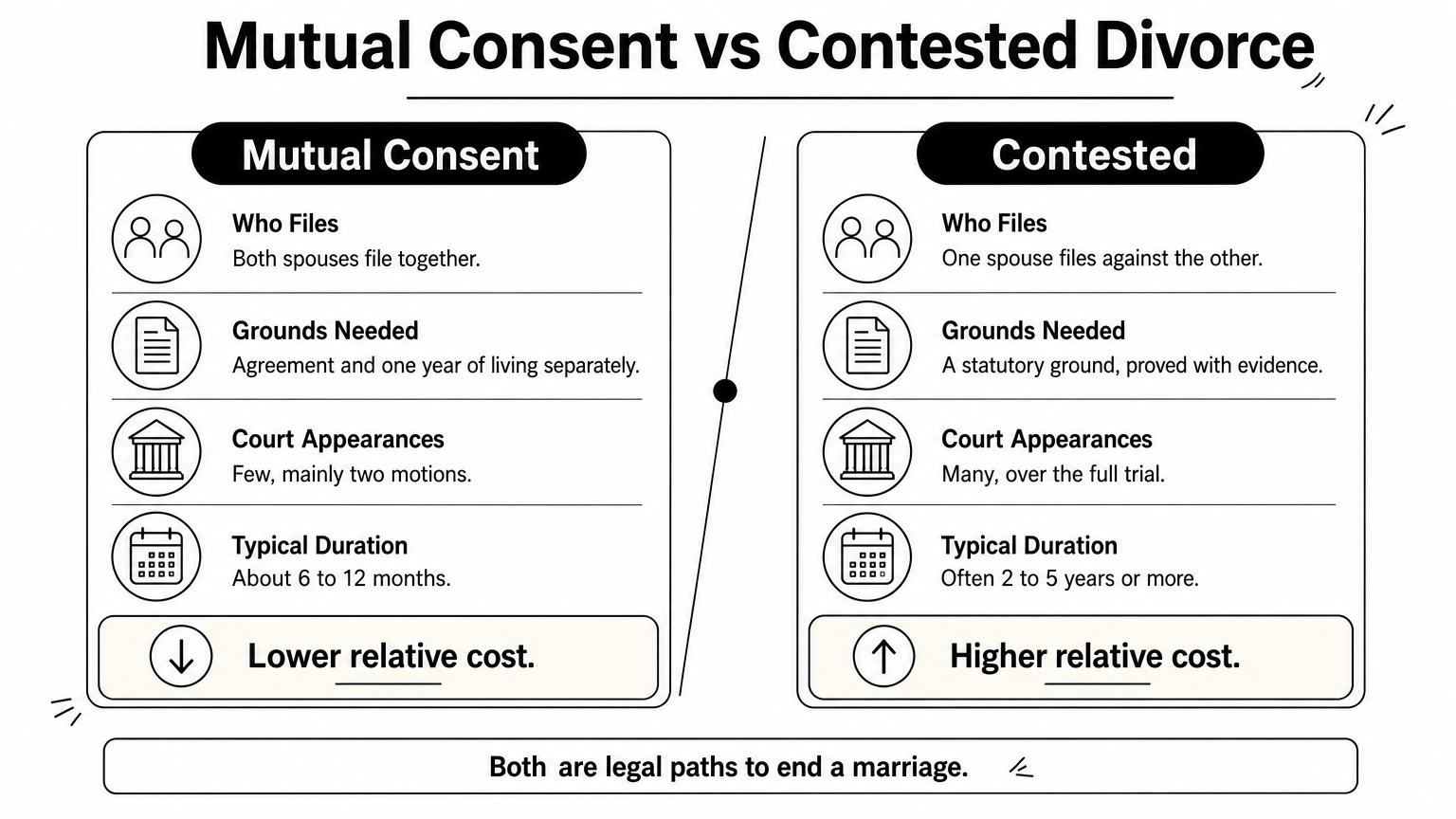
A mutual consent specialist handles divorces where both spouses agree. Under Section 13B of the Hindu Marriage Act, you must have been living separately for at least a year, and the petition needs at least one year of marriage. You file a first motion jointly. The law then expects a six-month cooling-off period before the second motion, and the Supreme Court has allowed courts to waive it in suitable cases. After the second motion and a final hearing, the court passes the decree.
The specialist’s real work is the settlement terms. These cover alimony, custody and visitation, return of stridhan and division of property. Everything must be written into the consent terms before you sign.
In a mutual divorce, the settlement terms are the case, so read every clause before the first motion.
| Mutual consent | Contested | |
|---|---|---|
| Who files | Both spouses together | One spouse, against the other |
| Grounds needed | Agreement, one year separate | A statutory ground, proved with evidence |
| Court appearances | Few, mainly two motions | Many, over the full trial |
| Typical duration | About 6 to 12 months | Often 2 to 5 years or more |
| Relative cost | Lower | Higher |
Who it suits
It suits couples who have already agreed on the main terms, or who can reach them through a lawyer-led discussion. It does not suit you if you suspect your spouse is hiding assets or pressuring you into terms. In that case, you need a litigator who can demand disclosure.
What to check before you hire
- Do not share one advocate with your spouse if the terms are sensitive. Each of you can keep a separate lawyer.
- Ask for the draft consent terms early, in plain language.
- Ask when any lump sum is payable, ideally before the second motion.
- Ask for a document checklist so you do not lose weeks at the registry.
5. Free legal aid through the legal services authority
How it works

Free legal aid comes from the District Legal Services Authority for your district, under the Legal Services Authorities Act, 1987. You apply at the legal services office at the court complex, and the authority assigns an advocate from its panel at no cost to you. Women, children and persons below the state’s income limit are among those eligible, and the limit varies by state, so check the current figure with the authority.
Legal aid is not a lesser service. It is the right door if paying for a private advocate would put your household in debt.
Who it suits
This option suits you if you have no independent income, have just left a marital home with nothing, or cannot afford an advance fee. It works best for maintenance claims, protection orders and standard divorce petitions. For a complex contested trial, you may later decide to hire a private advocate.
What to check before you hire
- Ask what the authority needs from you: an income certificate, ID and the marriage proof.
- You usually cannot pick the panel advocate, so ask about their family law experience.
- Keep your own copies of every document and order, and note each hearing date yourself.
- Ask what happens if you want to switch to a private advocate partway through.
Choosing your advocate
Match the advocate to your case. A solo family court advocate or a mutual consent specialist suits an agreed divorce. A contested divorce lawyer suits a fight over grounds, custody or money. A firm that handles both civil and criminal family matters suits a case with 498A or DV complaints on either side. Legal aid suits anyone who cannot pay. Whoever you pick, get the fee, scope and timeline in writing, and ask who will appear on your hearing date.
If you want to test our approach, book a paid consultation with Adv. Bindu Dubey & Associates. You will get a roadmap and a fee structure after about an hour, and you can compare it with any other advocate on your list.