

Anticipatory Bail in SC/ST Act: Section 18 Bar Explained
Anticipatory bail in SC ST Act cases means asking a court to shield you from arrest, before it happens, after someone accuses you under the Scheduled Castes and Scheduled Tribes (Prevention of Atrocities) Act, 1989. The short answer is that it is usually barred. Sections 18 and 18A(2) of the Act exclude the pre-arrest bail provision. The Supreme Court allows only one narrow exception: where the complaint, read as written, does not disclose an offence under the Act.
Ordinarily, Section 438 of the CrPC lets a person who fears arrest for a non-bailable offence apply for protection in advance. Since 1 July 2024 that power sits in Section 482 of the Bharatiya Nagarik Suraksha Sanhita (BNSS). The Atrocities Act switches this remedy off, and the exception is where most real cases are argued.
This article explains why the bar matters, how to test whether the exception applies, which Supreme Court and High Court rulings shape the position, and what to do when the bar holds. Our firm handles anticipatory bail applications in the Sessions Court and High Court, so the focus here is practical.
Why the Section 18 bar matters if you are accused
The bar matters because it removes the safety net most accused people rely on: a court order that keeps police from arresting you while your application is heard. Without it, an FIR under the Act can lead to arrest before you have approached any court.

What Sections 18 and 18A say
Section 18 says that nothing in Section 438 of the CrPC applies to a case involving the arrest of a person accused of an offence under the Act. Parliament added Section 18A in 2018 to restate the bar and to remove procedural hurdles for the complainant. The table shows how the provisions fit together.
| Provision | What it does |
|---|---|
| Section 18 | Pre-arrest bail under Section 438 CrPC (now Section 482 BNSS) does not apply to an arrest on an accusation under the Act |
| Section 18A(1) | No preliminary enquiry before registering an FIR, and no prior approval needed for arrest |
| Section 18A(2) | Repeats the bar on pre-arrest bail, notwithstanding any court judgment or order |
| Section 14A | Appeal to the High Court against an order granting or refusing bail |
What this means in practice
Police can register an FIR without a preliminary enquiry and arrest without senior approval. You cannot ask the Sessions Court for pre-arrest bail as a matter of routine. After arrest, you apply for regular bail before the Special Court that tries offences under the Act. That usually means some time in custody, which is why the exception carries so much weight.
The bar does not cancel your right to bail. It removes bail before arrest.
How to tell if the prima facie exception applies
The exception applies when the FIR or complaint, taken at face value, does not disclose an offence under the Act. The court examines the complaint, not your defence, and a bare denial does not unlock anticipatory bail in the SC/ST Act.
The test courts apply
In Prathvi Raj Chauhan v. Union of India (2020), the Supreme Court held that if the complaint does not make out a prima facie case under the Act, the bar in Sections 18 and 18A does not apply. The court reads the allegations as recorded. It does not hold a mini-trial, weigh evidence, or accept your counter-version at this stage.
A checklist to test the complaint
Work through the ingredients of the offence in the FIR itself:
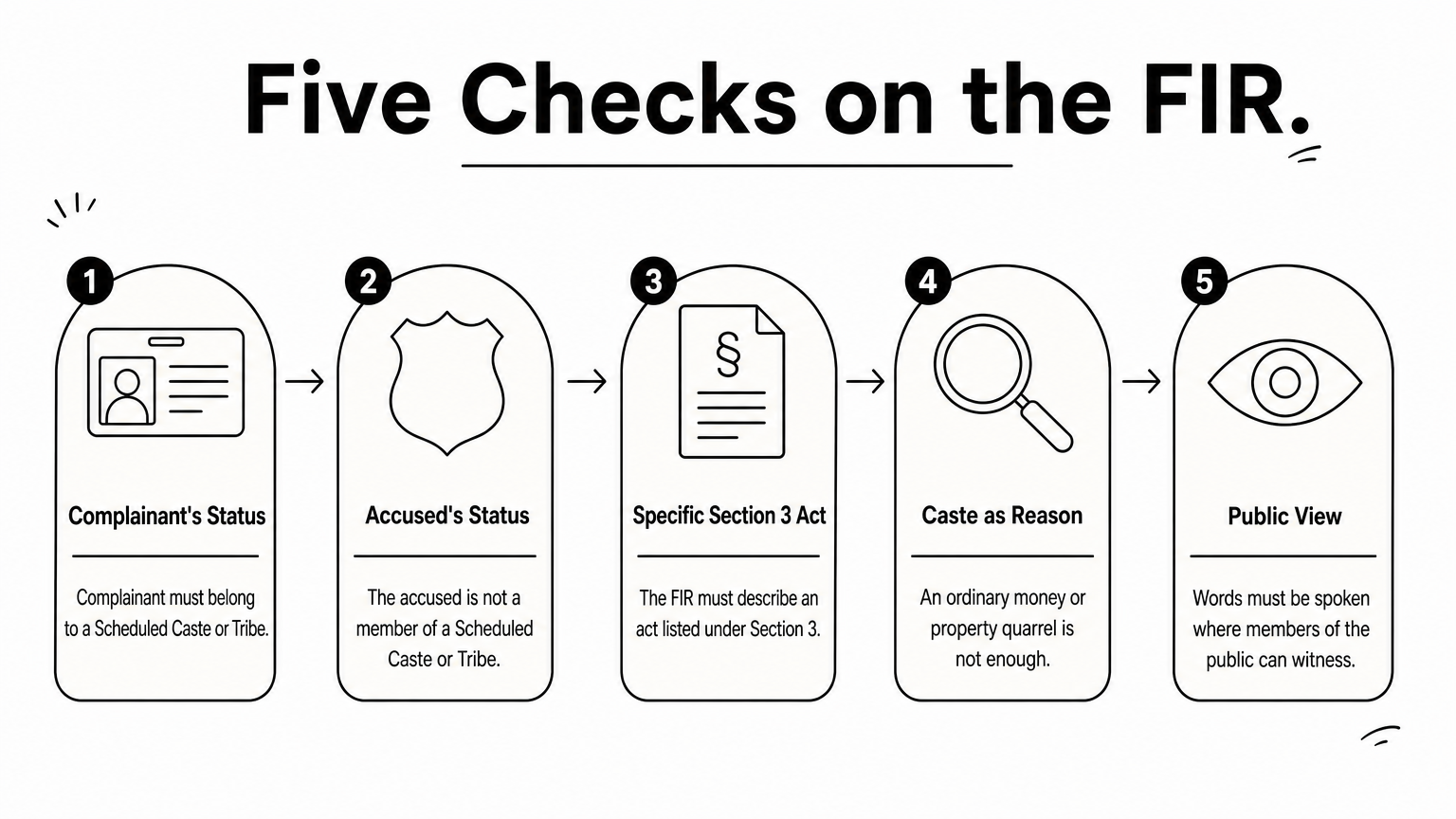
- The complainant’s status. The complainant must belong to a Scheduled Caste or Scheduled Tribe.
- The accused’s status. The Section 3 offences are committed by a person who is not a member of a Scheduled Caste or Tribe.
- A specific Section 3 act. Examples are abusing someone by caste name (Section 3(1)(s)), intentionally insulting or intimidating to humiliate (Section 3(1)(r)), or an offence punishable with ten years or more committed on the ground of caste (Section 3(2)(v)).
- Caste as the reason. An ordinary quarrel over money or property is not enough. The insult must be directed at the person because of caste.
- Public view. For Section 3(1)(r) and (s), the Supreme Court in Hitesh Verma v. State of Uttarakhand (2020) said the words must be spoken where members of the public can witness them. A remark inside a private space with no outsider present does not qualify.
If one of these is plainly missing from the FIR, the exception is arguable. Typical examples are an FIR that never mentions caste-based words, an incident in a closed room, or a clearly civil dispute with the Act added on top. The exception is narrow, and courts refuse it where the allegations, even if untrue, tick every box.
The court asks one question: does the complaint, as written, disclose an offence under the Act?
Supreme Court and High Court rulings behind the rule
Six developments explain the current position, and Prathvi Raj Chauhan is the one to know. They show the law swinging toward a strict bar, then settling on a narrow exception.
The rulings side by side
| Ruling | Year | What it settled |
|---|---|---|
| State of M.P. v. Ram Krishna Balothia (Supreme Court) | 1995 | Upheld the Section 18 bar as constitutional |
| Subhash Kashinath Mahajan v. State of Maharashtra (Supreme Court) | 2018 | Allowed anticipatory bail where no prima facie case exists or the case is malicious, and required a preliminary enquiry before arrest |
| SC/ST Amendment Act | 2018 | Inserted Section 18A and restored the bar in full |
| Prathvi Raj Chauhan v. Union of India (Supreme Court) | 2020 | Upheld the amendment, but held the bar does not apply where no prima facie case is made out |
| Hitesh Verma v. State of Uttarakhand (Supreme Court) | 2020 | Caste insult must be in public view and based on caste |
| Shajan Skaria v. State of Kerala (Supreme Court) | 2024 | Anticipatory bail is permissible only where no prima facie offence is made out, judged from the complaint |
How High Courts apply them
High Courts follow Prathvi Raj Chauhan closely. The Allahabad High Court applies it in decisions such as Smt. Parvati Devi v. State of U.P., and in April 2026 the Jammu & Kashmir and Ladakh High Court held that the Section 18 bar is inapplicable where the FIR or complaint discloses no prima facie offence.
Some reports describe the bar as absolute. That is accurate once the ingredients appear on the face of the complaint: in that situation no court, including the High Court, will grant pre-arrest bail. The exception is not about leniency. It is about whether the Act applies at all.
The bar is absolute when the Act applies, and it does not apply when the complaint shows no offence under it.
What to do when anticipatory bail is barred
If the bar applies to your case, your realistic options are regular bail from the Special Court, a petition to quash the FIR, or both. Which one fits depends on what the FIR alleges.
Your options
- Anticipatory bail under Section 482 BNSS before the Sessions Court or High Court, only where the complaint discloses no prima facie offence under the Act.
- A quashing petition in the High Court under Section 528 BNSS (earlier Section 482 CrPC) or Article 226 of the Constitution, where the FIR does not disclose the offence or is an abuse of process.
- Regular bail before the Special Court after arrest, with an appeal to the High Court under Section 14A against a refusal.
The first days after an FIR
Start by getting a copy of the FIR and reading it against the checklist above. Do not contact the complainant, do not pressure witnesses, and do not go into hiding. Cooperate with the investigation while your lawyer decides the forum, because avoiding police hurts every later bail argument.
Speed matters, because the choice between an exception-based application and a quashing petition has to be made before police act. Our firm offers urgent consultations for arrest-related situations. This article is general information, not legal advice on your case.
Read the FIR first, because the whole strategy turns on what it actually alleges.
Where the law stands today
Anticipatory bail in SC/ST Act cases is barred by Sections 18 and 18A(2), and the bar holds whenever the complaint discloses the ingredients of an offence under the Act. The only door left open is the prima facie exception from Prathvi Raj Chauhan, which asks whether the FIR, read as written, shows an offence at all.
If you have been named in such a complaint, the next step is a careful reading of the FIR, then a decision between an exception-based application, a quashing petition, or regular bail. For a case-specific view, speak to an anticipatory bail lawyer at Adv. Bindu Dubey & Associates before the police reach your door.