

Advocate of Divorce in Navi Mumbai: 5 Types and Who Fits
The right advocate of divorce in Navi Mumbai is the one whose specialization matches your case, who appears regularly in the family court that will hear it, and who explains fees and timelines before you pay. A mutual consent case needs a careful drafter. A contested case needs a courtroom litigator. If domestic violence, dowry allegations or children are involved, you need someone who knows those laws as well. The five picks below cover these needs, starting with a full-service firm for cases that mix family and criminal law.
Searching for a divorce lawyer near you gives long directories of profiles and star ratings, with little to separate one from the next. A 4.9 rating from a handful of reviews does not tell you whether the person can run a contested trial or move a mutual petition quickly. This article sorts advocates by what they actually do, so you can match your situation first and check names second.
Adv. Bindu Dubey & Associates, based in CBD Belapur, is listed first because it is our firm, and we say so plainly. The other four are types of advocate to look for, each with the checks that apply. This is general information on Indian family law, not advice on your facts. Laws change, so confirm the details with an advocate before you act.
1. Adv. Bindu Dubey & Associates, CBD Belapur
Adv. Bindu Dubey & Associates suits you best when your divorce overlaps with criminal law, such as a 498A complaint, an arrest risk or a domestic violence case running beside the divorce petition. The firm is led by Adv. Bindu Dubey (LLM Gold Medalist, 12 years in practice, registered with the Bar Council of Maharashtra & Goa) and works from an office in CBD Belapur, Navi Mumbai.
One firm that works in both the family court and the criminal court saves you from coordinating two advocates on the same dispute.
What they handle
The firm works as a divorce case advocate for mutual consent and contested petitions, and it also takes the disputes that travel with them. It serves Mumbai, Navi Mumbai, Thane and Panvel. The work covers:
- Mutual consent divorce: drafting, filing and hearings. The firm’s service page describes a process of 6 to 8 months, with a 6-month cooling-off period that may be waived in some cases.
- Contested divorce, alimony, maintenance, child custody and separation of property.
- Domestic violence and dowry cases, for complainants and for people accused.
- Bail, anticipatory bail and quashing matters, in Family Courts, Sessions Courts, the Bombay High Court and the Supreme Court.
Who it suits and what to check
This is the pick if you want to speak directly with the advocate with no middleman, if your case may climb to the High Court, or if you live abroad. NRI clients can use remote video consultations. Before you book, know the terms:
- Consultation: paid, about 1 hour, in person or by phone. The advocate hears your full background and gives you a roadmap.
- Fees: shared with you after the consultation. Work starts once you pay in advance.
- Hours: Sunday to Saturday, 10 am to 9 pm, by prior appointment.
- Contact: +91 93232 32932, or WhatsApp. Consultations are kept confidential.
2. Mutual consent divorce specialist
A mutual consent divorce specialist advocate is the right choice when both of you agree to end the marriage and have settled custody, money and property. The petition is filed jointly under Section 13B of the Hindu Marriage Act, 1955, or Section 28 of the Special Marriage Act, 1954, for civil marriages.

In a mutual consent case, the settlement terms are the real work, and the court stage only confirms them.
What they handle
The advocate drafts the settlement agreement and the joint petition, then guides you through two court stages. You file the first motion, wait out the cooling-off period, then file the second motion. The Supreme Court has held that the six-month wait can be waived in suitable cases, so ask whether the advocate files waiver applications. A typical timeline:
- First motion filed in March, with statements recorded.
- Second motion possible from September if the wait is not waived.
- Decree after the second hearing, so roughly 6 to 12 months overall, and shorter when papers are in order.
You must have been married at least one year and have lived apart for one year before filing.
Who it suits and what to check
This pick suits couples who agree on every term, including alimony, custody and visitation. If the terms look lopsided, each spouse should consider a separate advocate, because one advocate cannot protect two competing interests. Ask for these before you pay:
- The draft settlement terms in writing, before anything is signed.
- Whether they appear at the Belapur family court regularly.
- A fixed scope and fee covering drafting, both motions and any waiver application.
3. Contested divorce litigator
When your spouse will not agree, you need a divorce case advocate who litigates, meaning someone who argues interim applications, cross-examines witnesses and handles appeals. Contested petitions rest on the grounds in Section 13 of the Hindu Marriage Act, such as cruelty, adultery, desertion, conversion, unsound mind, a communicable disease, renunciation and presumption of death.
A contested divorce is won on evidence, so pick the advocate who has cross-examined witnesses in your court.
What they handle
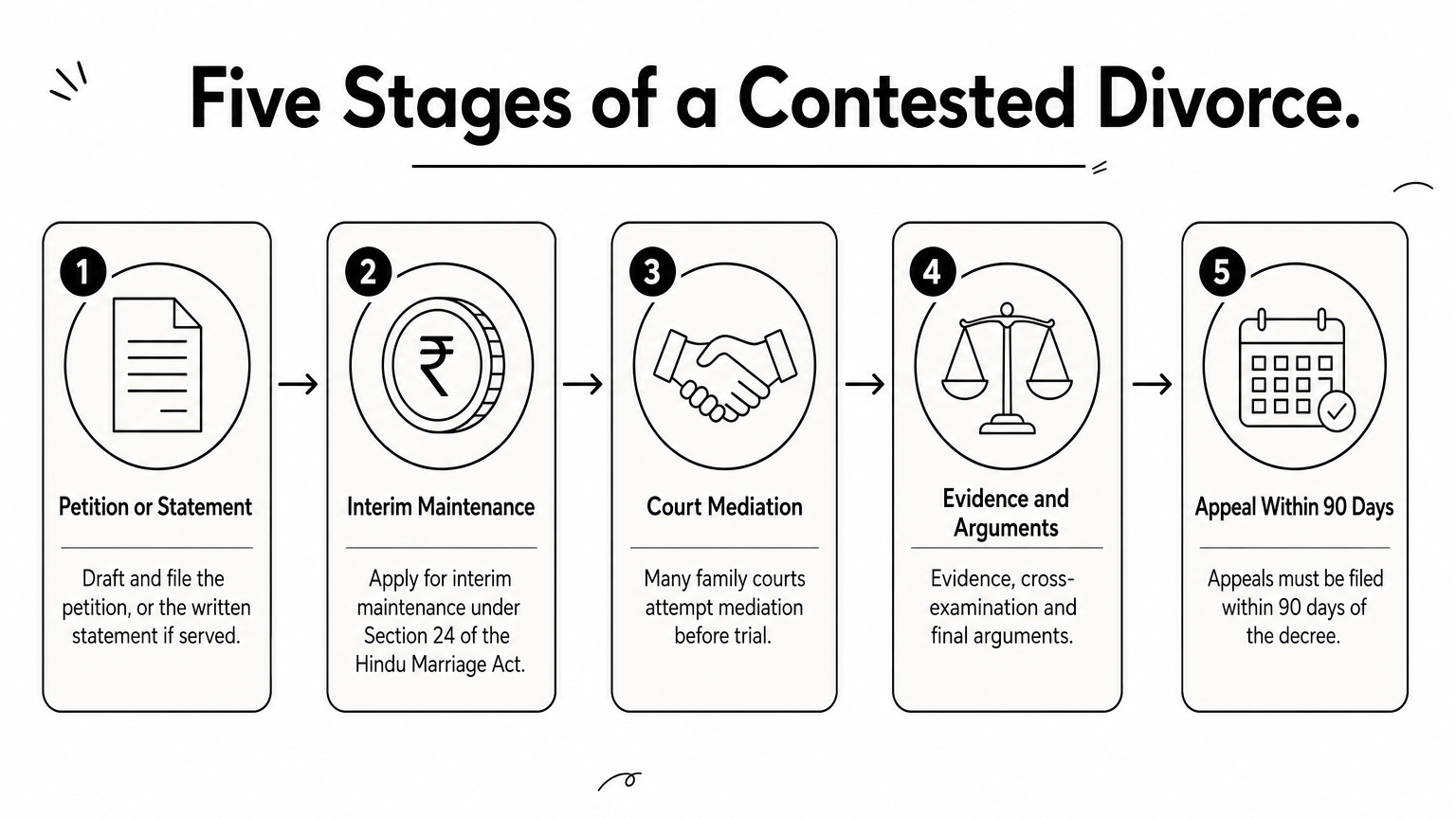
The litigator builds your evidence and manages each stage of a case that often runs two to five years, and sometimes longer if appeals follow. The usual stages are:
- Drafting and filing the petition, or the written statement if you are served.
- Interim maintenance applications under Section 24 of the Hindu Marriage Act.
- Mediation, which many family courts attempt before trial.
- Evidence, cross-examination and final arguments.
- Appeals, which must be filed within 90 days of the decree. You cannot remarry until that period ends, unless the appeal window is waived or no appeal is filed.
Who it suits and what to check
This is for the spouse who is contesting the marriage’s end, or who has been served a petition and must reply. Check the following:
- Trial experience in the family court that will hear your case, not only settlement work.
- Whether the advocate personally appears at hearings, or sends a junior.
- A realistic timeline, with the causes of delay named honestly.
4. Domestic violence and 498A advocate
Choose this advocate when the divorce comes with allegations of cruelty, dowry or violence. The right person knows the Protection of Women from Domestic Violence Act, 2005 and Section 498A of the IPC, now Section 85 of the Bharatiya Nyaya Sanhita for offences after 1 July 2024. The strategy differs sharply depending on whether you complain or defend.
If a 498A complaint exists, find an advocate with criminal court experience before you think about the divorce petition.
What they handle
For a complainant, the advocate seeks protection and residence orders, monetary relief and custody under the DV Act, plus maintenance under Section 125 CrPC, now Section 144 of the BNSS. For the accused, the work is different:
- Anticipatory bail, when arrest is a real risk.
- Replies to legal notices and police summons.
- Quashing petitions in the High Court where the complaint is false or exaggerated.
- Defending the trial in the Sessions or Magistrate court.
Who it suits and what to check
This pick suits women seeking protection, and husbands or relatives facing dowry or violence allegations. Urgency matters here, so test the following:
- Regular appearances in criminal courts, not only the family court.
- Availability for emergencies, since arrest scares do not wait for office hours.
- A clear explanation of which proceedings run in parallel, and how they affect the divorce case.
5. Child custody and maintenance advocate
If your children or your finances are the real fight, hire an advocate who focuses on custody, guardianship and maintenance. Courts decide custody on the welfare of the child, under laws such as the Guardians and Wards Act, 1890 and the Hindu Minority and Guardianship Act, 1956.

Custody and maintenance orders shape your life for years, so hire for those skills even when the divorce itself is simple.
What they handle
The advocate files custody and visitation petitions and argues for a parenting schedule a court will accept. On money, the work includes:
- Interim maintenance under Section 24 and permanent alimony under Section 25 of the Hindu Marriage Act.
- Maintenance claims under Section 125 CrPC, now Section 144 of the BNSS.
- Disclosure affidavits, which the Supreme Court has directed both spouses to file on income and assets.
- Enforcement, if orders are not followed.
Amount and duration depend on income, assets and length of the marriage, so no honest advocate can promise a figure at the first meeting.
Who it suits and what to check
This pick suits parents seeking custody or visitation, and spouses who depend on or must pay support. Check these points:
- How they gather proof of income and assets, since weak documents sink maintenance claims.
- Their approach to mediation, because a workable parenting plan beats a long custody fight.
- Experience enforcing orders, not only obtaining them.
How to compare advocates before you hire
Compare any divorce advocate on five checks: specialization, court experience, enrolment, fee clarity and access. Ratings help only when the reviews are many and specific, so treat them as a last tie-breaker.
The best advocate for your case is the one who answers these checks plainly, in writing if you ask.
Five checks before you hire
| Check | What to look for | Warning sign |
|---|---|---|
| Specialization | Family law is a main practice and covers your case type | Lists every branch of law with no family work shown |
| Court experience | Regular appearances at the family court, plus Sessions or High Court if there is a criminal angle | Cannot name the courts they appear in |
| Enrolment | Registered with the Bar Council of Maharashtra & Goa | Hesitates to share enrolment details |
| Fees | Written scope and fee structure before you pay | A vague package with no list of what is covered |
| Access | Clear answer on who takes your calls and who appears at hearings | Your file passes to someone you never meet |
Questions for the first call
Prepare these questions, and bring your marriage certificate, address proof, income papers and any police complaints or notices:
- Which Act governs my marriage: the Hindu Marriage Act, the Special Marriage Act, or another personal law?
- What is a realistic timeline, and what could delay it?
- Who will appear at my hearings?
- What does the fee cover: drafting, appearances, appeals?
- What should I do, and avoid doing, while the case is pending?
Choosing your advocate
Pick by case type first. Mutual consent needs a drafter, contested divorce needs a litigator, domestic violence and 498A need criminal court skill, and custody and maintenance need an advocate who documents money and parenting well. Then verify courts, enrolment, fees and who actually appears for you.
If your situation crosses family and criminal law, or you want to talk to the advocate directly, you can book a consultation with Adv. Bindu Dubey & Associates. Explain your background, ask the questions above, and decide only when the fees and roadmap are clear.