

Which Advocate for Family Court Fits Your Case? 5 Types

The right advocate for family court is one who handles your exact type of matter every month, practises before the court that will hear it, and tells you the fee, the stages and the likely timeline before you pay. Couples who agree to separate need a mutual consent specialist. A spouse who will fight needs a trial lawyer. Custody and maintenance, domestic violence and dowry cases, and NRI matters each call for a different strength.
Many people in Navi Mumbai, Panvel, Thane and Mumbai hire the first family advocate they find online. Then they learn that the lawyer mostly does property or corporate work. Family disputes also spill into criminal law, so a wrong first choice can cost months. This article sorts family court advocates into five types by case, so you can match your situation to the right one.
Adv. Bindu Dubey & Associates is a criminal and family law firm in CBD Belapur, Navi Mumbai. Its work in each area serves as a reference point below. Every section ends with a short check you can apply to any advocate you consult, including us.
1. Advocate for mutual consent divorce
Choose this advocate when both spouses agree to part ways and want a clean, quick, private exit. The job is mostly precise drafting and sound sequencing, not courtroom combat.
What this advocate handles
A mutual consent divorce is filed jointly, usually under Section 13B of the Hindu Marriage Act. The advocate drafts the petition and the settlement terms on alimony, child custody and property, then files it and appears for both court motions. A 6-month cooling-off period applies between the motions. The Supreme Court has held that it is not mandatory in every case, so a waiver application is sometimes possible.
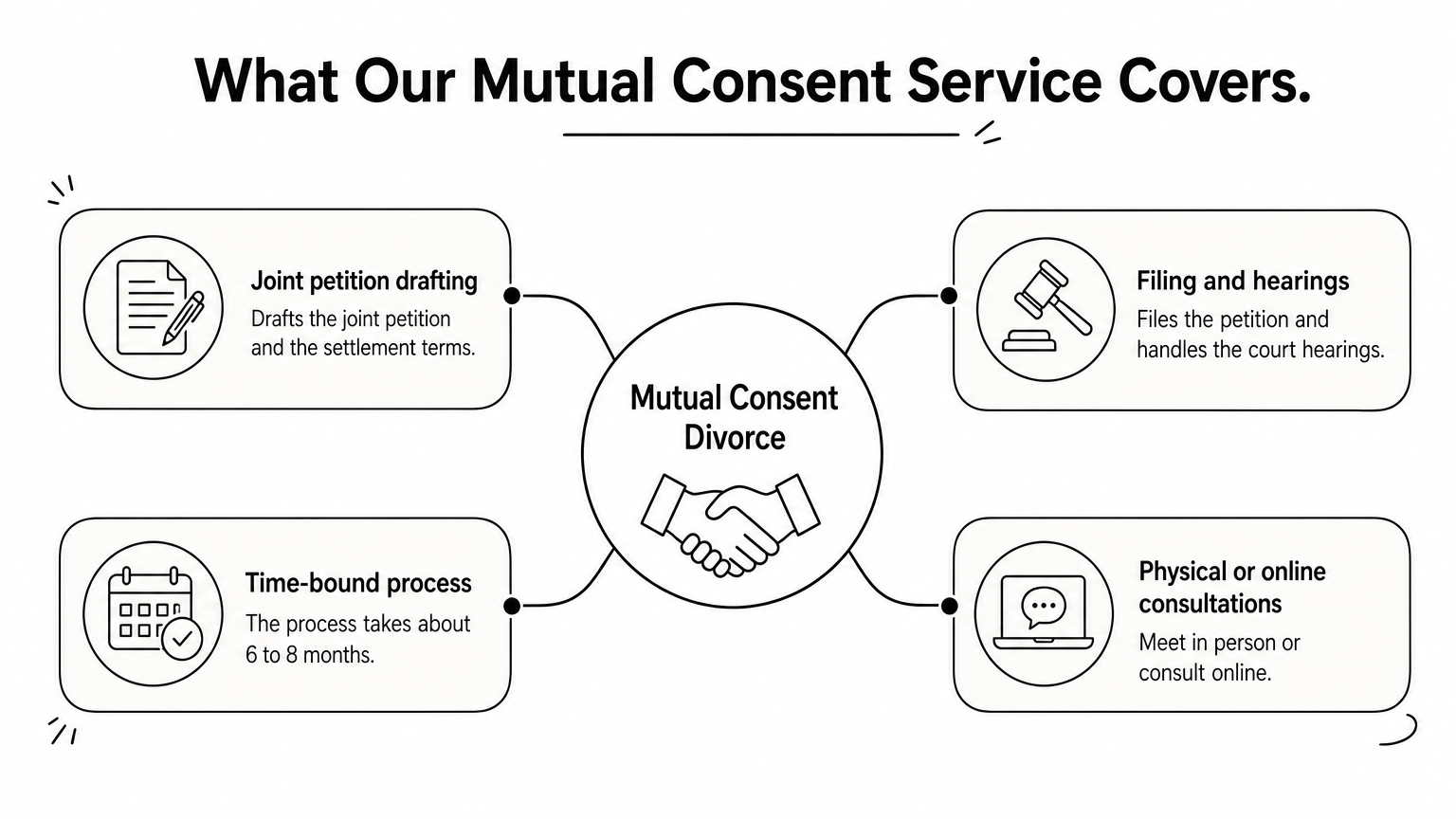
At our firm, the Mutual Consent Divorce service covers these stages for couples who have completed one year of marriage:
- Drafting the joint petition and settlement terms
- Filing and court hearings
- A time-bound process of about 6 to 8 months
- Physical or online consultations
How to choose one
Ask how many mutual consent cases the advocate has closed and whether the settlement is written so that it can be enforced later. Vague clauses on child custody or the return of property are the usual reason a "simple" divorce stalls.
Also settle the consultation process at the start. Our consultation is paid and lasts about an hour, after which you get a roadmap and the fee structure. Work starts after the advance is paid. Meetings run Sunday to Saturday, 10 am to 9 pm, by prior appointment.
A mutual consent divorce moves only as fast as its settlement terms are clear.
2. Advocate for contested divorce
Choose this advocate when your spouse disputes the divorce, the grounds or the terms. You need a litigator who is comfortable with evidence, cross-examination and long hearings.
What this advocate handles
A contested divorce is filed on a ground such as cruelty or desertion under Section 13 of the Hindu Marriage Act. The family court must first attempt a settlement, so expect referrals to mediation or counselling. If that fails, the case moves to pleadings, evidence, cross-examination and final arguments. The advocate also files interim applications, for example for temporary maintenance under Section 24.
A contested case runs well beyond the 6 to 8 months of a mutual consent case. Be wary of any family advocate who promises a date.
How to choose one
Look for trial experience, not just filing speed. Ask who will appear at your hearings and who drafts the written statement. Our clients speak directly with the advocate, with no middleman, and each stage and its scope are explained up front.
Request an honest assessment of your grounds in the first meeting. An advocate who only says you will win is selling, not advising.
In a contested divorce, evidence wins the case and the advocate’s courtroom habits decide how well you use it.
3. Advocate for child custody and maintenance
Choose this advocate when the fight is about a child, money or both. These cases are won on facts and documents, and the court’s test is the welfare of the child.

What this advocate handles
Custody petitions arise under the Guardians and Wards Act, 1890, or the Hindu Minority and Guardianship Act, 1956. The advocate argues for sole custody, joint arrangements or visitation, depending on your goal. Maintenance claims include interim and permanent alimony under Sections 24 and 25 of the Hindu Marriage Act. They also include maintenance for a wife, children or parents under Section 125 of the CrPC, now Section 144 of the BNSS.
The Supreme Court, in Rajnesh v. Neha (2020), required both spouses to file an affidavit of assets and liabilities in maintenance cases. A good advocate builds that affidavit with care.
How to choose one
Ask how the advocate prepares the financial affidavit and handles an opponent who hides income. Ask what interim relief to expect while the case runs.
Check that this family court advocate also negotiates. Many custody and maintenance disputes end in a signed settlement, and a lawyer who can only litigate will prolong yours.
Custody and maintenance cases turn on documents, so hire the advocate who organizes them first.
4. Advocate for domestic violence and dowry cases
Choose this advocate when a marriage dispute involves violence, dowry demands or a criminal complaint, whether you are the complainant or the accused. Pick someone who practises both matrimonial and criminal law.

What this advocate handles
Not every family dispute stays in family court. Applications under the Domestic Violence Act, 2005 go before a Magistrate. A dowry harassment complaint under Section 498A of the IPC (now Section 85 of the BNS) is a criminal case. It can bring arrest, anticipatory bail and quashing petitions in its wake.
Our Domestic Violence & Dowry Cases service represents both sides. Women seek protection, maintenance or custody, and husbands and families answer false allegations. The firm reports handling 300+ such cases in the courts of Navi Mumbai, Thane and Mumbai. It also reports interim orders within 3 to 6 months. If you are in immediate danger, call 112 first, then contact an advocate.
How to choose one
Ask whether the advocate can act in the Magistrate court, the Sessions Court and the High Court. One case often needs all three.
Ask also about confidentiality. A legal family advocate near you should protect your privacy from the first call. Our consultations are confidential and covered by legal privilege.
A domestic violence or dowry case is half family law and half criminal law, so hire an advocate who practises both.
5. Advocate for NRI family matters
Choose this advocate when you or your spouse lives abroad. You need someone who works across time zones and limits how often you must travel to India.
What this advocate handles
NRI family matters include divorce, custody, maintenance and notices served on a spouse overseas. They often involve disputes over which country’s court has jurisdiction. The advocate coordinates documents, signatures and hearing dates from a distance.
Our firm offers remote video consultations and representation for NRI clients. It serves clients in places such as the UAE, the USA and Nepal. You can call (+91) 932 32 32 932 from India, or (+971) 5 4525 7449 from the UAE.
How to choose one
Ask in the first call what can be done through a power of attorney and what needs your personal presence. A clear answer saves you a flight.
Confirm how updates reach you. Written summaries after each hearing and a WhatsApp line are a practical minimum when you cannot attend in person.
For an NRI client, the best advocate is the one who explains up front what can be done without a flight.
Pick the advocate for your case first
Start with the type of matter, not the lawyer’s advertising. A mutual consent divorce, a contested trial, a custody fight, a dowry complaint and an NRI dispute each need a different skill. Ask for the fee, the stages and the timeline in the first meeting, and check that the advocate practises in the court where your case will be heard.
If your matter is in Navi Mumbai, Thane, Panvel or Mumbai, you can book a consultation with Adv. Bindu Dubey & Associates by phone or WhatsApp and get a clear roadmap for your case.