

5 Family Court Advocate Options in Mumbai and How to Choose
The right advocate for the Family Court in Mumbai is one who appears there regularly, handles your exact type of dispute, and puts the fee and scope of work in writing before you pay. Of the five options below, a full-service firm suits disputes that also involve 498A or domestic violence. A matrimonial specialist suits contested divorces. A Bandra regular suits straightforward filings. Senior counsel suits appeals, and legal aid suits people with limited means.
Most people start this search at a bad moment. You face a divorce, a custody fight or a maintenance claim, and every directory shows dozens of near-identical profiles with star ratings. Experience in years tells you little. What matters is which court will hear your case, who will attend each hearing, and whether your dispute stays in the Family Court or spills into criminal proceedings.
This article sets out five realistic options, including our own firm, and explains what each does, who it fits and what to ask before you commit. A comparison section follows, with a table, a checklist of questions and a worked timeline for a mutual consent divorce.
1. Adv. Bindu Dubey & Associates
Adv. Bindu Dubey & Associates is a criminal and family law firm in CBD Belapur, Navi Mumbai. It suits disputes where the family case and a criminal complaint run side by side.
How this option works
The firm is led by Adv. Bindu Dubey (LLM Gold Medalist, pursuing a PhD in Criminology) and has a team of 15 lawyers. It handles divorce, mutual consent divorce, child custody, maintenance, alimony, separation of property, domestic violence and dowry cases in the courts of Mumbai, Navi Mumbai, Thane and Panvel.
The process starts with a paid consultation of about one hour, in person at the office or by phone. You explain the full background and receive guidance and a roadmap. The fee structure is then shared, and once you pay in advance, drafting and filing begin. You speak directly with the advocate, with no middleman.
Choose an advocate who works on both the family and the criminal side when your dispute includes 498A or a domestic violence complaint.
That combination matters because the two tracks run in different courts. Domestic violence complaints are usually filed before a magistrate, and 498A (now Section 85 of the BNS) is a criminal offence. An advocate who sees both can keep your positions consistent.
Who it suits and what to ask
This option fits people who face or want to file a domestic violence or dowry case, and the firm reports handling 300+ such matters. It also fits couples who agree to part (the firm quotes 6 to 8 months for mutual consent divorce) and NRIs, who can consult by video. Meetings run Sunday to Saturday, 10 am to 9 pm, by prior appointment. The legal consultation number is +91 93232 32932.
Before you hire any firm, including this one, ask these:
- Which lawyer will personally appear at each hearing?
- What exactly does the advance fee cover, and what is billed separately?
- Which court will hear my matter, given where I live and where we married?
2. A dedicated matrimonial specialist
A matrimonial specialist is an advocate, usually in a solo practice or small chamber, who takes only divorce and family disputes. This option suits you when the case will be contested and the stakes are high.
How this option works
Specialists typically run chambers in Bandra, BKC or south Mumbai and draft and argue matters personally. Because the practice is narrow, they know how custody, alimony and property claims usually play out before the same judges.
A good specialist also works for settlement first. The Family Courts Act, 1984 directs the court to make efforts at settlement before trial, so counselling and negotiation are part of the process. An advocate who uses that stage well can save you months of litigation.
A specialist earns the higher fee only if the advocate, not a junior, handles your hearings and negotiations.
Who it suits and what to ask
This option suits contested divorces, custody disputes with allegations on both sides, and cases with significant assets, businesses or multiple properties. It is less necessary for a simple, agreed separation.
Ask how many matters the advocate runs at once, because a crowded diary means shorter attention for you. Ask what share of the advocate’s cases settle and what a realistic timeline looks like for your facts. Ask for the scope of work in writing, including drafting, interim applications and appeals. Expect a specialist to answer these plainly. Vague answers are a warning sign.
3. A Family Court Bar regular at Bandra
The Family Court in Mumbai sits at Bandra, and advocates who appear there daily are the most practical choice for straightforward filings. They suit you when your case is uncomplicated and you want hands-on court knowledge at a sensible cost.

How this option works
Daily presence teaches things no website covers: how the filing counter works, how the hearing list moves, how counselling sessions are scheduled and what each bench expects in an application. Many of these advocates belong to the Family Court Bar Association.
You can verify activity yourself. The case status page of the Maharashtra Family Courts website lets you search by advocate name, so you can see whether the person you are considering has live matters before this court.
An advocate whose name appears in current Bandra Family Court matters knows the court’s routine in a way an office address cannot show.
Who it suits and what to ask
This option fits uncontested or lightly contested matters: a mutual consent petition, a maintenance application or a custody petition with no serious conflict. It also fits Mumbai residents who want an advocate close to the court.
The trade-off is delegation. Busy court regulars often send juniors to routine hearings. That is acceptable if you know it in advance and the senior handles the important ones. Ask who will appear on the first date, who will argue interim applications, and how you will be told about each next date. Also ask whether the fee is one package or paid per appearance, since the two structures can produce very different totals.
4. Senior counsel at the Bombay High Court
Senior or High Court counsel is the right option when your family matter moves beyond the first-level court. That mostly means appeals against Family Court orders, or when a decision on custody or maintenance has gone against you.

How this option works
An appeal against a Family Court judgment or order lies to the Bombay High Court under Section 19 of the Family Courts Act. The usual period to file is 30 days from the date of the judgment or order, so the decision to escalate cannot wait.
You normally reach senior counsel through your own advocate, who briefs them, prepares the paper book and handles the file. Senior counsel then argue the key hearings. This keeps one advocate in charge of the case while adding strength at the stage that matters.
If you want to challenge a Family Court order, speak to an appellate advocate within days, not weeks.
Who it suits and what to ask
This option suits people with high-value or high-conflict disputes, such as a custody order with serious consequences or a maintenance order that is far out of line with the evidence. It rarely makes sense for the first petition in an agreed divorce.
Ask for an honest view of your chances on appeal, since not every order is worth challenging. Ask whether a stay of the order is realistic and how long the High Court is likely to take. Also ask how fees are split between your regular advocate and senior counsel, so nothing surprises you later.
5. A legal aid advocate
A legal aid advocate is a panel lawyer provided through the legal services authorities, and it is the right option when you cannot afford private fees. It suits women, children and others entitled to free legal services.
How this option works
Under the Legal Services Authorities Act, 1987, free legal services are available to groups that include women and children, as well as persons in custody and those below an income limit set by the authority. The Mumbai legal services authorities assign a panel advocate to your matter once you apply. Applications are made through the legal services office at the court.
The panel advocate files and argues your case like any other advocate. You pay no professional fee for it.
Free legal aid is a legal entitlement for eligible people, so apply for it instead of dropping a valid maintenance or custody claim.
Who it suits and what to ask
This option fits maintenance claims, custody petitions and defence of a family case where money is tight. Panel advocates generally carry heavy caseloads, so plan to follow up on dates and documents yourself and keep your own copies of every filing.
Ask the legal services office what documents prove your eligibility, who your assigned advocate is and how to reach them. If your case grows complex, you can still engage a private advocate later, though the change should be handled formally with the court.
How to compare family court advocates before you hire
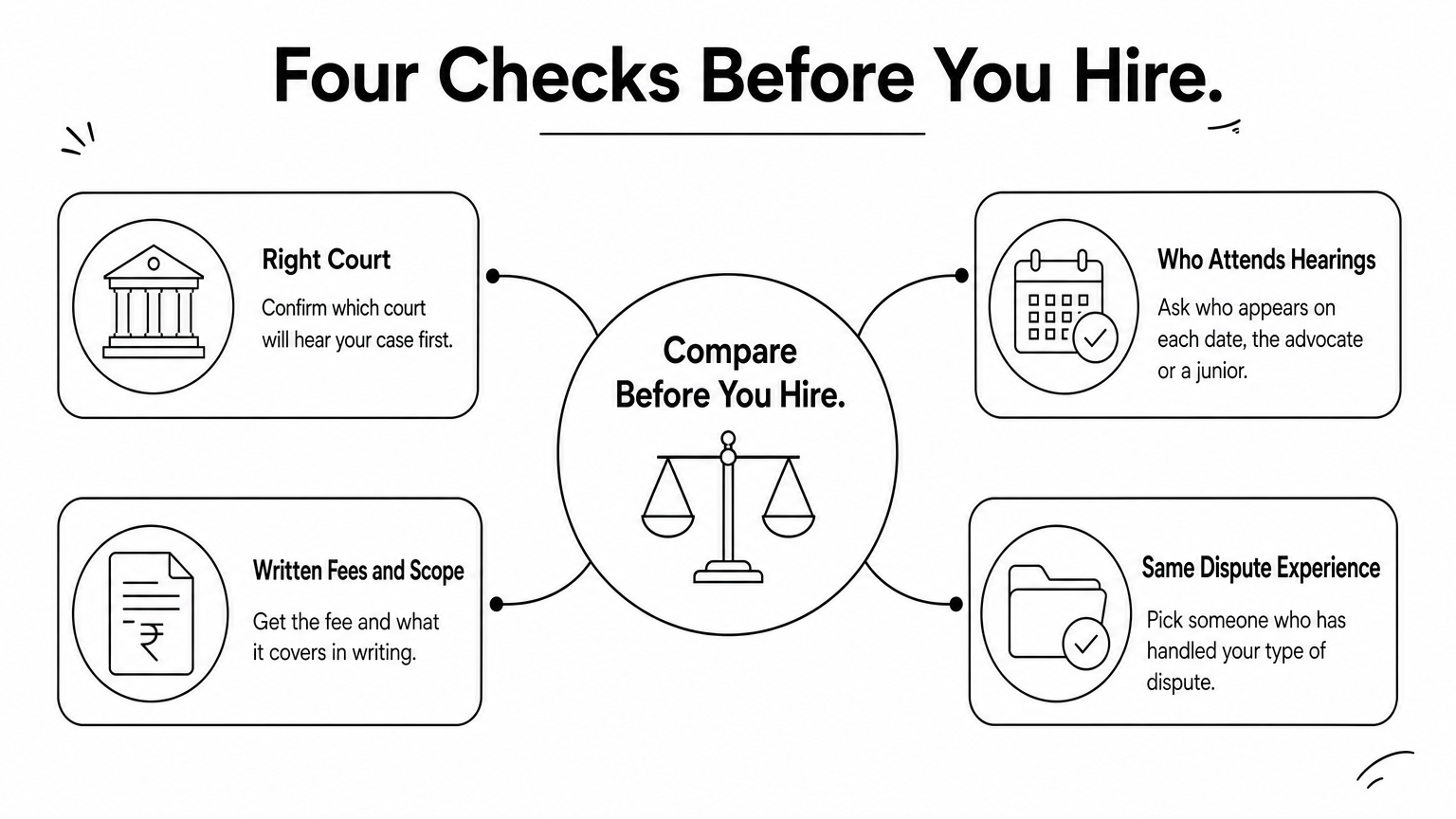
Compare advocates on four points: which court will hear your case, who attends hearings, how fees and scope are written, and whether the advocate has handled your type of dispute. If you search for a family law advocate near you, the nearest office matters less than where your case will actually be heard.
Match the advocate to your court and matter
For Hindu marriages, a petition can usually be filed where the marriage took place, where the couple last lived together, or where the wife now lives (Section 19 of the Hindu Marriage Act). So a resident of Navi Mumbai, Thane or Panvel may end up before a court other than Bandra. Always confirm the forum first, then pick an advocate who appears there.
| Option | Best suited to | Confirm before hiring |
|---|---|---|
| Full-service family and criminal firm | Family disputes with 498A or domestic violence | Who attends hearings, fee scope |
| Matrimonial specialist | Contested divorce, custody, large assets | Caseload, personal attendance |
| Bandra Family Court regular | Simple filings, local residents | Junior delegation, fee structure |
| High Court senior counsel | Appeals, high-stakes orders | 30-day limit, fee split |
| Legal aid panel advocate | Limited means, maintenance, custody | Eligibility proof, follow-up |
Questions to ask in the first meeting
Use the first consultation to test the advocate, not just to be heard. A paid first meeting is normal, so prepare your documents and questions beforehand:
- Which court will hear my case and why?
- Who will appear on each date, you or a junior?
- What does the quoted fee include, and what costs extra?
- What is a realistic timeline, and what could delay it?
- Will you be reachable by phone or WhatsApp between hearings?
- Is the consultation confidential?
A worked example: mutual consent divorce
Take a couple married four years, living apart for two, who agree on custody and settlement. The advocate drafts and files the joint petition. After the first motion, the law provides a six-month cooling-off period before the second motion, which the court can waive in some cases. Expect a decree roughly 6 to 8 months after filing, which matches what our firm quotes for this process.
For fees, no honest standard figure exists, because cost depends on complexity and the advocate’s seniority. Ask for the quote in writing, with the number of appearances it covers.
A fee quote without a written scope is only a guess about your final bill.
Pick the advocate your case needs
The best family court advocate in Mumbai is the one whose practice matches your dispute: a firm for family cases with a criminal edge, a specialist for contested matters, a Bandra regular for routine filings, senior counsel for appeals, and legal aid when means are limited. Confirm the court, the person who will appear and the written scope before you pay anything.
If your matter involves divorce, custody, maintenance, domestic violence or dowry allegations, you can book a consultation with Adv. Bindu Dubey & Associates and get a clear roadmap from the first meeting.